Read More
In the almost three years that Hong Kong shut itself off to the world during Covid, hundreds of thousands of people were sent to isolate in vast quarantine camps built from scratch. As the city reopens, there is no plan yet on what to do with these metal containers that were emblematic of some of the city’s most extreme pandemic rules.
ADVERTISEMENT
SCROLL TO CONTINUE WITH CONTENT
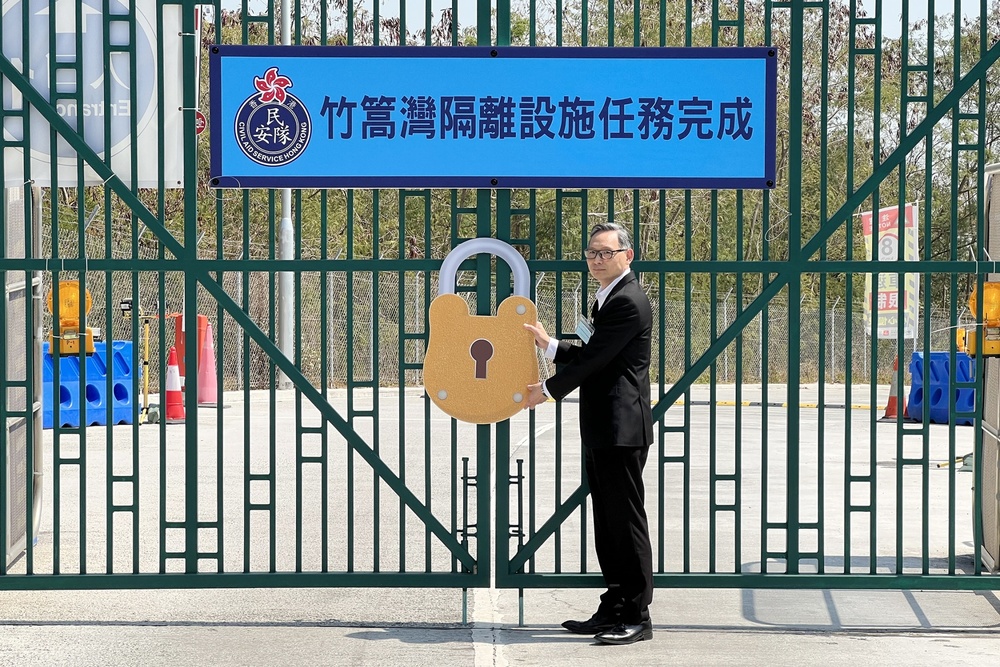
The biggest camp — the 18,000-bed Penny’s Bay facility next to Hong Kong Disneyland — was the last to be shuttered on March 1. At the closing ceremony, a banner that read “Penny’s Bay Quarantine Facility Mission Accomplished” in Chinese was hung on the camp’s closed gates, along with a large cut-out of a padlock. A band played Auld Lang Syne.
The closure of the quarantine camps comes as Hong Kong dismantles the last of its Covid restrictions, with the city finally ending its mask mandate on March 1. But even as normal life returns on the city’s streets, the future of these vast isolation sites, where many confinees were held for as long as 21 days, remains a huge question mark.
“We build these camps and now it’s kind of like: How do we justify that we’ve built them?” says Paul Zimmerman, a district councilor and co-founder of the urban-planning advocacy group Designing Hong Kong. “Are we just going to scrap them and put them somewhere else?”
Hong Kong, with the help of mainland Chinese firms, constructed eight quarantine camps from scratch, and repurposed some existing buildings such as public housing or holiday villages into isolation centers. At one point, those who were found to be close contacts, or even close contacts of close contacts, were sent to isolation. Travelers who had been on the same plane as Covid patients were yanked from their quarantine hotels and taken to a facility. Living conditions were spartan, and many residents complained about bad food, bugs and tiny beds.
The city is still “reviewing” what to do with the camps, according to a government spokesperson. The Architectural Services Department said some bigger units can house families of eight and noted that the largest quarantine camps are “structurally designed for life cycle of 50 years.”
The suggestion that the units could be repurposed in some way for housing echoes calls from social workers and urban planners who see the readily available containers as a way of alleviating Hong Kong’s housing crisis. Chua Hoi-wai, head of the non-government group Hong Kong Council of Social Service, has said that the facility at Kai Tak would be “ideal” for transitional public housing, and suggested the flat-slab box units could be merged into larger apartments.
Kai Tak refers to a strip of land in Kowloon Bay area where the city’s old airport was located, and was the second-largest isolation facility, with 2,700 rooms. If turned into housing, its central location, with ferry services, buses and shopping complexes nearby, would be ideal for working families, said Ng Mee Kam, director of the Urban Studies Program at the Chinese University of Hong Kong.’
Despite the litany of complaints of the camps, repurposed quarantine units could actually be an improvement in living conditions for many of the city’s poor. Ng said that some quarantine units are more spacious than the city’s infamous “cage homes” and subdivided units that are as small as 60 square feet (5.6 square meters). They could also be used for homeless shelters, she said, but it takes work to transform spaces designed to keep people apart into ones that foster togetherness.
In mainland China, one city is turning a camp into temporary housing for workers at an industrial park. Australia’s largest quarantine facility, the 3,500-bed Howard Springs complex on the outskirts of Darwin, is reportedly being considered for tourism or housing, while another camp north of Melbourne was used as a flooding evacuation center. Australia has also explored other uses, such as migrant housing or domestic violence shelters.
Aside from housing, some see potential for the quarantine camps in Hong Kong to be transformed into new leisure destinations. It’s a suggestion that might best fit the facility at Penny’s Bay. The 45-hectare (0.45 square kilometer) coastal area could be a natural home for a go-karting track, a space for movies or flower shows or any other “compatible” experience with Disney, said Zimmerman.
Whatever the Hong Kong government decides to do with these sites down the line, the contrast between its decisiveness and speed in putting up these facilities at the start of the pandemic and its current inaction is frustrating people like Brian Wong of local think tank Liber Research Community, who advocates turning the sites into social housing.
“If the government can use land when Covid is an urgency, can we say housing affordability is also an urgency?” he said. “If they want to do it, they can.”
(Bloomberg)
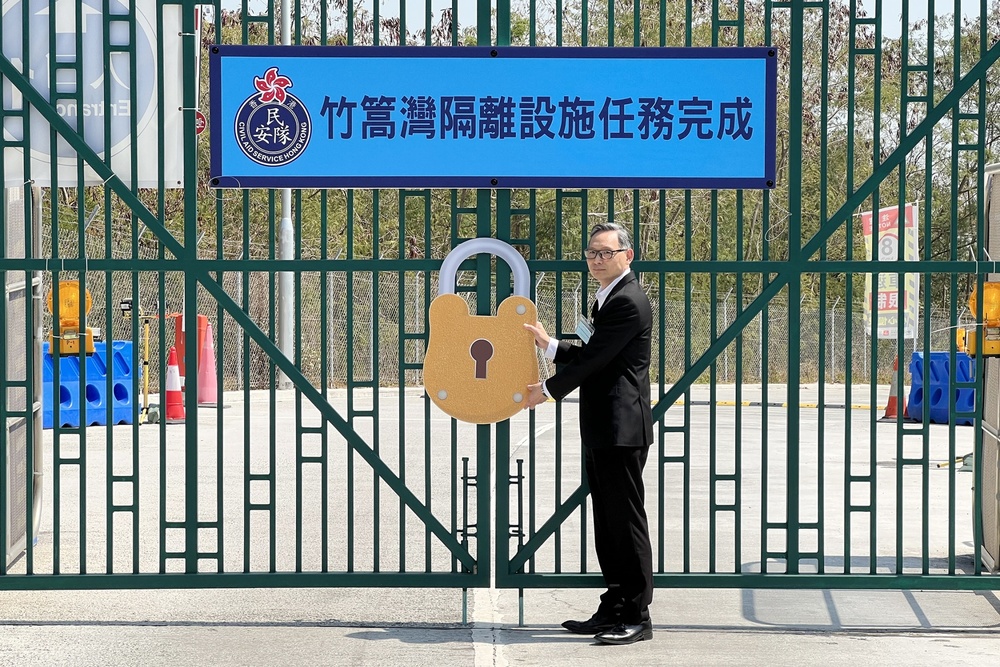
Michael Cheuk, Hong Kong’s undersecretary for security, puts a large cut-out of a padlock on the gates of the Penny’s Bay facility on March 1. (Bloomberg)