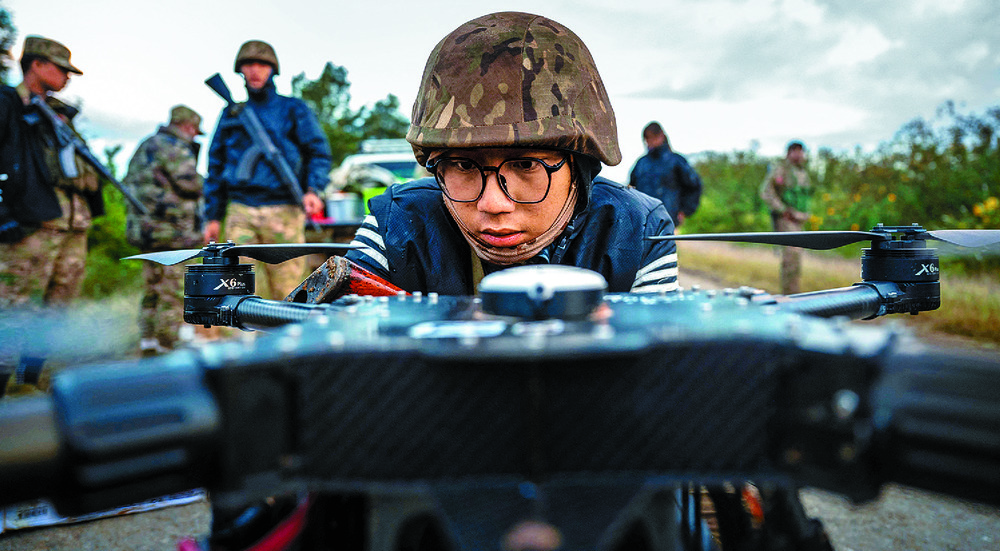
A squad of Myanmar pro-democracy fighters works quickly to ready drones for an attack on a military base, the latest target in a wave of aerial assaults that has helped turn the war against the junta.
The team stood back as a drone named "Bomber VIII," carrying a new six-kilogram explosive, soared over a line of trees.
"The military position is four kilometers away," said Soe Thuya Zaw, the drone unit's leader, as he punched coordinates into a map on his phone. "It is within our reach."
Minutes later the drones had reached the position and at the push of a button released their "drop bombs" over the target.
The team counted two blasts. One failed to detonate, but all three drones returned.
The fighters use such attacks to challenge the junta's aerial dominance through its Russian- and Chinese-built jets and helicopters.
"We are also trying to conquer the sky of the battlefield," said Soe Thuya Zaw of the Mandalay People's Defense Force.
Soe Thuya Zaw said his group's drone operations were entirely "the creations of our generation Z".
Myanmar's junta chief Min Aung Hlaing has admitted the drone barrages have forced the military to retreat from its positions.
An alliance of ethnic minority armed groups had used 25,000 "drop bombs" in their recent offensive, he said in November.
Ahead of the launch, Soe Thuya Zaw admitted the range of their drones is limited, making every attack risky.
"We are in the red zone and the military can hit us any time."
But in recent weeks waves of "drop bomb" attacks across Myanmar have displaced junta troops from positions, hit domestic airports and killed a brigadier-general near the China border.
The word has even entered the lexicon of junta-controlled media, which regularly attacks PDF groups - designated as "terrorists" by the military - for using them in fighting.
At one workshop hidden in the hills of northern Shan state diesel generators splutter alongside power tools, coils of wire and stacks of plastic piping.
Gunpowder cooks in a pan over a log fire. It will later be poured into plastic shells that will be filled in with deadly shrapnel.
The Mandalay PDF drone unit was started by two engineering students and now has more than 50 members, said Soe Thuya Zaw.
The group uses 3D printers to produce prototype shells that are filled with non-explosive materials and launched from drones in test missions. Contact fuses - which detonate the charge on impact - are checked by being dropped from trees.
Women make up around a third of the Mandalay drone unit.
Moe Moe, 18, joined after witnessing brutal crackdowns on peaceful protests in her hometown of Mandalay, and has since taken part in several drone missions.
"We have taken some territory, we have to keep going," she said.
In recent weeks the Mandalay PDF has launched hundreds of "drop bombs" in Shan state, said Soe Thuya Zaw.
His unit has given training to a powerful alliance of ethnic minority armed groups and carried out joint operations with them during a recent offensive.
Analysts say it is the biggest challenge the military has faced since it seized power in 2021.
As night fell around the town of Namhsan in Shan state last month, a Ta'ang National Liberation Army commander ordered a "drop bomb" strike on junta troops holding out in a tea factory.
In the courtyard of the temporary command post, a drone operator in a down jacket and beanie swiftly got to work.
Two comrades in camouflaged uniforms carefully unpacked two bombs from a crate.
Static crackled over the radio and the drone shot up into the sky.
Minutes later two explosions rumbled across the hills and the commander ordered another strike.
TNLA fighters later took control of Namhsan's bullet-ridden streets, the latest town to fall to the alliance.
The TNLA is one of Myanmar's myriad ethnic minority armed groups, many of whom have fought the military for decades for autonomy and control of lucrative resources.
Some have given shelter and training to the new PDFs that have sprung up to overturn the coup.
"When we started our revolution [for autonomy] we used homemade guns," said TNLA spokesman Tar Aik Kyaw.
"Now, we can say 'it's the era of drones.'"
A Mandalay People's Defense Force unit prepares to launch a drone after the bombs are cooked in a hut in Shan state.