Read More






Right to a trial without a jury | To The Point | Cheng Huan
15-06-2026 00:07 HKT





Ocean Park crowds revive memories of its busiest days
15-06-2026 14:27 HKT
The rainforest reverberates at night in the village near Assua River in Brazil. The sound of generators at times competes with the forest, a sign of people. But until recently the Juma people seemed destined to disappear like countless other Amazon tribes decimated by European invaders.
In the late 1990s the last remaining family was made up of sisters Borea, Mandei and Mayta and their father, Aruka, in his 50s. In 2021, Aruka died of Covid, prompting obituaries like one in The New York Times that said the "last man of his tribe" was gone, pushing the Juma, a patriarchy, closer to extinction. Or so it seemed.
The sisters and their dad, Aruka Juma, had another plan.
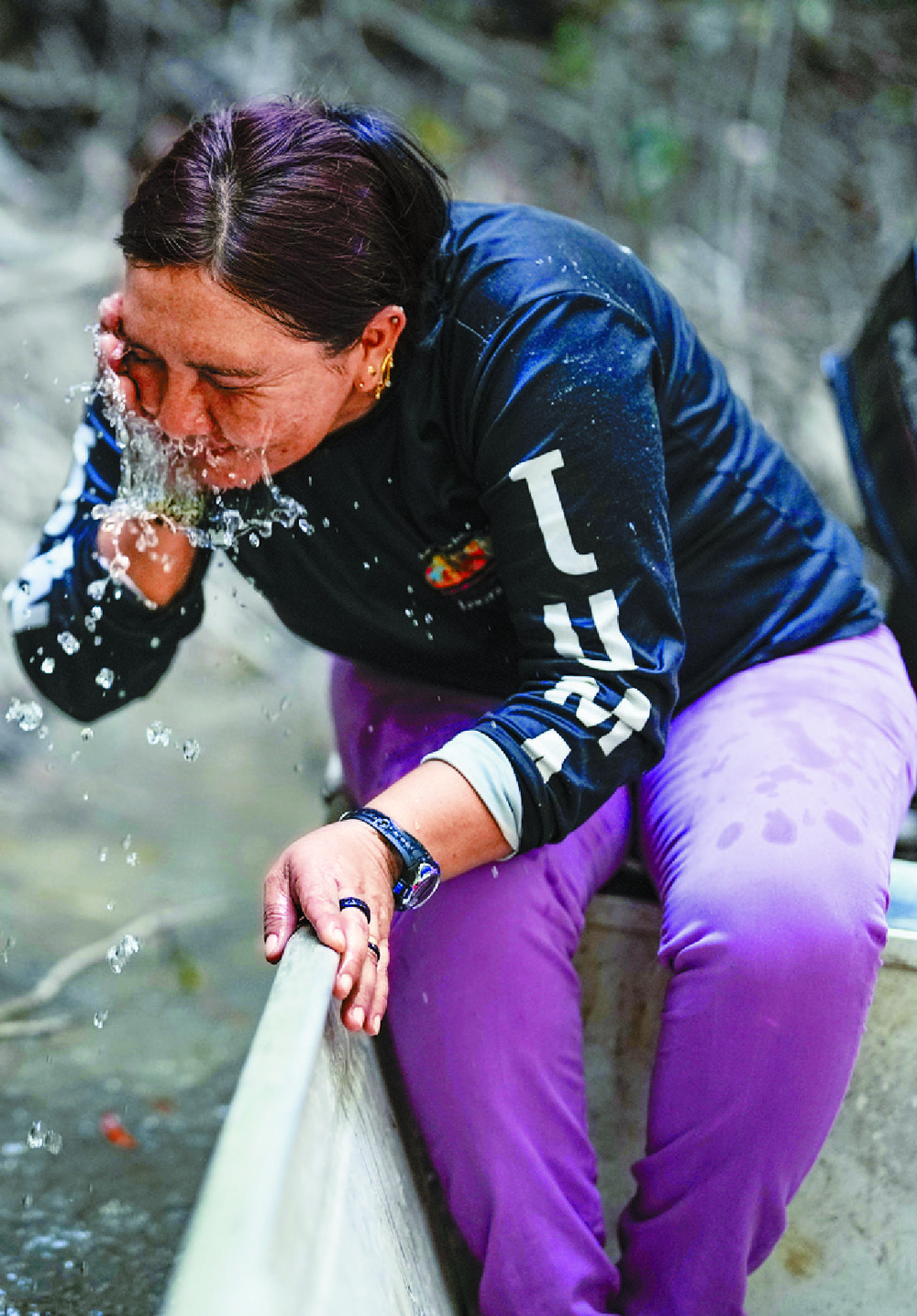
"I became interested in trying to gather more strength," says Mandei. "So I started taking on the role of the leader, the first woman to do so. My sisters and my father encouraged me to assume the position."
During a forced relocation earlier, the sisters made the decision to marry men of other tribes, maintaining their lineage, despite a patrilineal tradition.
Today, against long odds, the Juma are making a comeback. In their territory, a two-hour boat trip from the nearest road, their village is full of life. Children play in the river. People fish with nets and rods. Women grind cassava into flour manually, preserving scarce fuel for the generators. Others are out hunting.
Throughout the day people gather at a soaring maloca, or common building, designed in the traditional Juma way, to eat, tend to macaws and parrots, lounge on hammocks during warmest hours, pound cassava, and check WhatsApp messages.
Aruka is buried under the maloca.
Mandei has been chief for more than a decade, stepping down recently in favor of older sister Borea.
"Because we were few people didn't respect us," she says. "There had never been a woman leader before, and then people came to tell me, 'You shouldn't have assumed it because you're a woman.'"
At first, that hurt, she says. Then she stopped caring. "I adapted to seek solutions for our people," she explains.
The Juma Indigenous Territory, the size of Las Vegas, is covered by old-growth Amazon rainforest. A top priority is to protect their territory, located in the south of Amazonas state, a hotspot of land-grabbing and illegal deforestation.
Mandei fears they could be invaded the same way as the Uru-eu-wao-wao village where she grew up. Once immersed in the forest, it is now surrounded by pasture planted illegally by invaders.
"I went back for a visit and the forest" She trails off, weeping. "It's very painful."
The planned paving of a highway next to the territory increases the likelihood of being invaded by land-grabbers. Cattle farming and soybean crop expansion across the region are changing the environment.
"The river doesn't fill with water as it used to," Mandei says. "It's much hotter, it wasn't like this before. Why is this happening? Because of deforestation."
To protect against this young men, including her nephew Pure, patrol by boat. They use drones donated by a non-profit to monitor the most remote areas against loggers, poachers and fishermen.
"I kind of broke the anthropology rules and followed my mother's lineage," Pure, 22, says proudly in the maloca. "If I don't identify myself as Juma who will?"
His mother, Borea, married a man from the Uru-Eu-Wau-Wau. Following a tradition among indigenous Brazilians he was registered with his tribe father's name as his surname. But when he was 15 he went to the indigenous bureau, Funai, and demanded to add his mother's tribe. Now his full name is Pure Juma Uru-Eu-Wau-Wau.
Jumas most likely numbered a few thousand before contact, but they resisted invaders and suffered massacres in reprisal. The last one was in 1964 on the order of a trader.
Aruka, one of the few survivors, lost his dad. His mom would die years later of malaria, a disease introduced by outsiders.
In 1998, as the six remaining Juma were struggling to survive, Funai transferred them to an Uru-Eu-Wau-Wau village hundreds of kilometers away.
Despite sharing a language, Kawahiva, the elders struggled to adapt. A few months after the arrival Aruka's sister and her husband died of sadness.
Aruka pressured to return to his home village, with his first three daughters, the place that would eventually become officially recognized as Juma and return to life.
For Mandei, her people's language has also been key to this survival. She got a linguist, Wesley dos Santos, to visit in 2019. As part of this collaboration a multimedia dictionary was created along with an online collection of traditional narratives, monologues, and songs in the Juma language.
Despite the recent achievements, Mandei remains concerned. The 24 inhabitants of their village are very few, and there are not enough Juma men to increase their population, she reckons.
More than ever, the three women are grappling with how to pass down Juma's traditions to the next generations.
"The largest responsibility I share with my sisters is to not lose Juma culture," Mandei says.
Fabiano Maisonnave, Teresa de Miguel and Andre Penner