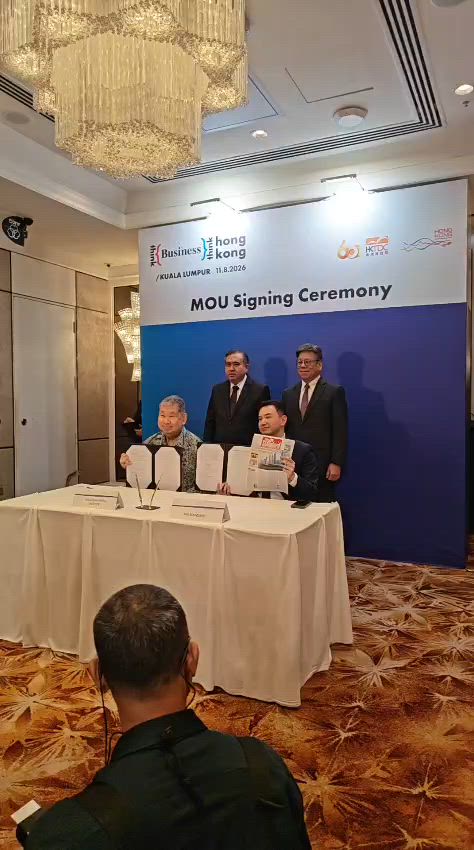
Some partnerships are born in boardrooms. Others are born out of necessity. And occasionally, a partnership comes along that makes you wonder why somebody didn’t think of it much earlier.
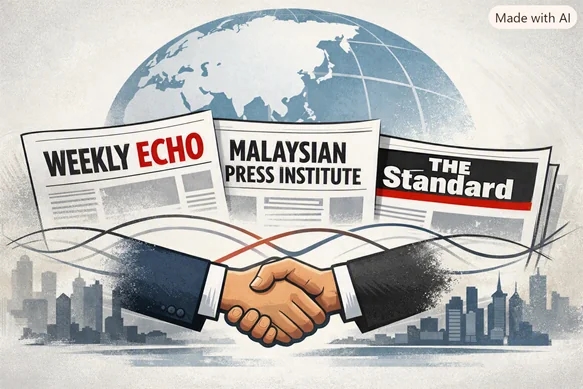
The new cooperation between Hong Kong’s The Standard, the Malaysian Press Institute (MPI) and Weekly Echo is one of those.
On paper, it is about editorial exchanges, content sharing, cross-border reporting, digital innovation, journalism training and artificial intelligence.
But beneath the language of memoranda and partnership agreements lies something rather more interesting: Hong Kong and Malaysia share a surprisingly deep journalistic DNA.
Both were once British colonies. Both inherited aspects of the British common-law and parliamentary traditions.
Both developed newspapers in English alongside vibrant Chinese-language and vernacular presses.
And both developed generations of journalists accustomed to the basic idea that the press should not merely report what those in power say, but should sometimes ask why they are saying it.
That shared inheritance deserves to be exploited.
Not because colonialism should be romanticized. It shouldn’t. The historical record shows that the British themselves censored and controlled newspapers in both territories. Hong Kong’s press, particularly its Chinese-language newspapers, was subject to substantial restrictions during much of the colonial period.
But history has a curious habit of leaving behind institutions and habits that outlive the empires that created them.
And journalism was one of them. Two former colonies, one journalistic language
Hong Kong was returned to China in 1997. Malaysia became independent in 1957. Politically, their trajectories have obviously been very different. Yet the connection between their media traditions remains striking.
Hong Kong remains a major international center where English-language journalism has historically played an important role. Its English press developed alongside the city’s commercial and international character, serving both British and Chinese communities and, eventually, a global readership.
Malaysia, meanwhile, has deliberately made Bahasa Malaysia the national language. But try telling the Malaysian business community that English has disappeared. It hasn’t.
English remains deeply embedded in Malaysian commerce, finance, law, technology, aviation, academia and international business. It is the language in which a Malaysian businessman can negotiate with a Hong Kong investor, a Singapore banker, a London lawyer or an American technology company without reaching immediately for a dictionary.
That gives the two media markets an unusually useful bridge. English. It is not merely a colonial relic. It is a working language of Asia. And that matters enormously in journalism.
A Malaysian story published in English can travel far beyond Malaysia. A Hong Kong story published in English can travel far beyond Hong Kong. The potential audience is not merely Malaysian or Hong Kong Chinese. It is Asian. And increasingly, global.
Hong Kong after 1997
There is also a fascinating irony in the Hong Kong connection. When the British flag came down in 1997, many wondered what would happen to Hong Kong’s famously energetic press.
In the years after the handover, Hong Kong’s media remained vigorous and internationally minded. The situation has become considerably different in recent years because of changes over time. That reality should not be ignored. Nor should it make cooperation between Malaysian and Hong Kong journalists less valuable. Quite the opposite.
It makes professional dialogue, journalism education, newsroom exchanges and discussion about ethics, verification, technology and the responsibilities of the press even more important.
The point is not for one side to lecture the other. It is for journalists to learn from each other.
Malaysia’s own complicated media journey: Malaysia has had its own complicated relationship with the press.
The British introduced modern Western concepts of free speech and journalism, but they also imposed restrictive legislation. After independence, some of those restrictions remained, and new ones were introduced.
So, neither Malaysia nor Hong Kong can honestly claim an uncomplicated history of press freedom. But perhaps that is precisely why cooperation between journalists from the two places could be so useful.
There is history to discuss. There are different experiences to compare. There are different political environments to understand.
And there is a common professional language in which to have that conversation. That is much more interesting than pretending that journalism exists in some politically neutral vacuum. The opportunity is much bigger than an MoU
The opportunity is far greater.
Imagine a Malaysian journalist spending a week in The Standard newsroom in Hong Kong. Imagine a Hong Kong journalist coming to Kuala Lumpur and discovering that Malaysia is rather more complicated than the usual political stories suggest.
Imagine joint reporting projects on China-ASEAN trade. Hong Kong investment in Malaysia. Malaysian companies entering Hong Kong. Technology. Tourism. Education. Artificial intelligence. Financial services. The halal economy. The Belt and Road. ASEAN.
And the extraordinary transformation taking place across Asia. These are stories that do not stop at national borders. Neither should the journalism.
The English advantage
There is another reason this partnership makes particular sense. Both sides can communicate with a substantial international audience without translation becoming the first obstacle.
Malaysia may be proudly Bahasa Malaysia-speaking. Hong Kong may be predominantly Cantonese-speaking.
But English gives the professional classes of both places a common operating language. In business, it is already there. In law, it is there. In higher education, it is there. And in journalism, it provides an enormous bridge.
This means The Standard and Weekly Echo could potentially do something much more ambitious than exchanging stories. They could create an English-language Asian journalism corridor between Hong Kong and Malaysia.
Stories could originate in Kuala Lumpur, be refined with a Hong Kong editorial perspective and reach readers elsewhere in Asia.
Hong Kong stories could travel in the opposite direction. Young journalists could be trained to think beyond national audiences. That would be a genuinely forward-looking use of an old colonial language.
The British may have left. English clearly didn’t. And then there is AI
The partnership’s emphasis on artificial intelligence is particularly timely. AI is going to transform journalism whether journalists like it or not. The question is whether it will transform it intelligently.
Hong Kong and Malaysia could use this partnership as a laboratory. Journalists could experiment with AI-assisted research, translation, document analysis, data journalism, fact-checking and multimedia production.
But the most important lesson should be that AI can make journalism faster without necessarily making it better. That still requires journalists. It requires judgment. It requires skepticism. It requires knowing when a beautifully written sentence is complete nonsense.
And it requires the courage to publish something because it is true rather than because somebody powerful wants it published. Those are old-fashioned journalistic virtues.
They remain surprisingly useful. A partnership whose time has come
Businesses understood the connection years ago. Politicians understand it. Investors understand it. Tourists understand it. Perhaps journalists are finally catching up.
The Standard-MPI-Weekly Echo cooperation comes at a moment when traditional media everywhere is searching for relevance, revenue and credibility. That makes collaboration not merely desirable but necessary.
The future will not belong to newspapers that sit behind national borders waiting for readers to come to them. It will belong to media organizations that understand audiences move across borders, languages and platforms.
Hong Kong and Malaysia are perfectly placed to experiment with that future. They have the history. They have the language. They have the commercial connections. They have sophisticated media professionals.
And they have something increasingly rare in an age of algorithmic noise: journalists who understand that credibility still matters.
So let us not measure this partnership by the number of signatures, photographs or speeches produced at its launch. Measure it by the stories that follow.
Let Malaysian journalists challenge Hong Kong assumptions. Let Hong Kong journalists challenge Malaysian assumptions. Let young journalists cross borders. Let editors argue. Let stories travel.
Let English do what it has always done particularly well in this part of the world — connect people who otherwise might never have had the opportunity to talk to each other.
And perhaps, along the way, both sides can rediscover something larger than their shared colonial past. A shared professional future.
The British Empire may have disappeared. The Commonwealth may be largely ceremonial. But the journalistic connections created in that era have survived in unexpected ways. Now they can be put to much better use.
The sky, as they say, is the limit. And after all these years, it is about time Hong Kong and Malaysia started looking up together.
Dr Rahim Said, currently a strategic marketing consultant and contributor to Weekly Echo, was an academic at Universiti Sains Malaysia in Penang.