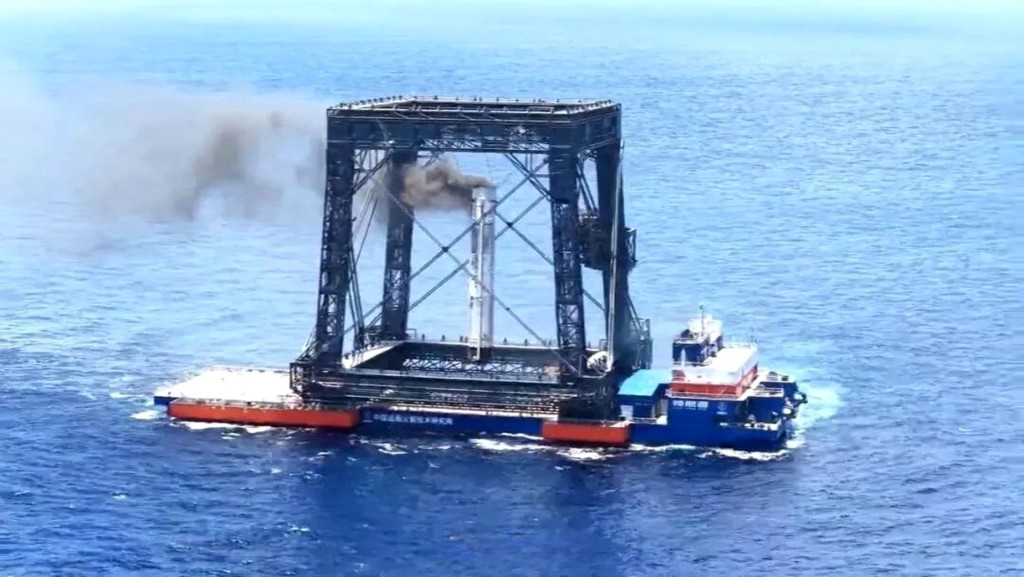
China’s tech and aerospace sectors are abuzz following a milestone breakthrough in reusable space technology. The nation’s Long March 10B carrier rocket completed its maiden flight from Hainan, marking the world’s first successful controlled maritime recovery of a rocket’s first stage using an innovative net system.
The achievement has triggered widespread discussion among global experts. Crucially, Beijing has bypassed the established technological pathways pioneered by American aerospace giant SpaceX. Instead of mimicking existing methods, China has forged a “third way” via its proprietary “sea-based net recovery” architecture, presenting a direct challenge to SpaceX’s commercial launch monopoly. Previously, the global standard for reusable rocketry was defined entirely by Elon Musk’s firm, which relies on the vertical takeoff and landing legs of the Falcon 9 or the mechanical “chopstick” arms of the Starship launch tower.
The Long March 10B demonstrates an entirely different philosophy of engineering ingenuity. Guided by high-precision navigation and control systems, the returning first-stage booster smoothly steered itself into a massive, flexible rope network deployed by a recovery vessel at sea.
The specialized net system cushioned and captured the rocket, removing the need for heavy, deployable landing legs. This design reduces structural weight and eliminates the high maintenance costs and mechanical failure risks associated with complex landing gear. High launch costs have historically acted as a major bottleneck for the expansion of low-Earth-orbit satellite internet networks, a sector SpaceX currently dominates through its aggressive pricing structures.
The maiden flight of the Long March 10B signals China’s entry into a new era of industrialized rocket reuse. Equipped with completely independent intellectual property rights, this technology is poised to exponentially lower commercial launch costs once high-frequency commercial operations scale up. The breakthrough promises to foster healthy competition in mega-constellation deployment, offering global clients highly diverse launch options while reshaping the rules of the commercial space race.
Francis Fong is a Hong Kong IT and Telecom expert who frequently represents the industry in public discussions about innovation, digital transformation, and technology policies