





Read More











Swedish court moves to strip HK parents of 'Save Lily' custody
25-06-2026 06:10 HKT

Star monkey Panchi-kun targeted by lasers; Japan zoo alerts police
25-06-2026 04:14 HKT


As readers of this column will know, I love books and am addicted to the pleasure of reading. I suppose I am what is known as a bibliophile, a word from ancient Greek meaning book lover. The screen of my mobile phone may be brilliant for fact-checking and catching up with the news, but when it comes to reading a well-written book, I much prefer the paper version.
Such is the case with “Japanese Pilgrimage” by Oliver Statler. It is as brilliant today as when it was first published in 1983, and it accompanied me on a wonderful Japanese adventure. The book, which captures the culture and spirituality of Japan, kept me company and was my guide as I completed a pilgrimage to 88 temples on the island of Shikoku.
Oliver Statler was an American who first visited East Asia while on military service during the second world war. After a time in Papua New Guinea and the Philippines in 1947, he arrived in Japan. He quickly fell in love with the country and it so enchanted him that he started to write about the nation, its peoples, and its culture. He soon became an expert on the Japanese woodblock art form called ukiyo-e, or “pictures of the floating world,” which depict Japanese culture and everyday life. Ukiyo-e perfectly embodied the transient beauty of Japan that Statler so admired.
His affection for Japan grew deeper as the years passed, and in 1968, he set off on the ancient pilgrimage route to the 88 temples in Shikoku that he had heard and read so much about. These 88 temples were inspired in the 8th century by the famous monk Kukai and commemorate his long life and saintliness. To this day, Kukai is remembered by the Japanese as the monk who instilled Buddhism in the nation’s culture. The pilgrimage route is long, mountainous, and arduous, which must be partly why Statler did not publish “Japanese Pilgrimage” until 1983. Although it has been more than four decades since it was written, the pilgrimage itself seems as wonderful today as it was 57 years ago.
Whereas it took him two separate trips totaling more than two months to complete all 1,207 kilometers of the circular route on foot, I must confess that it took me shamefully much longer, and I did have the help of a car for much of the time. But I am still proud that in 30 months and three separate trips to Japan, I managed to visit all of Kukai’s 88 temples.
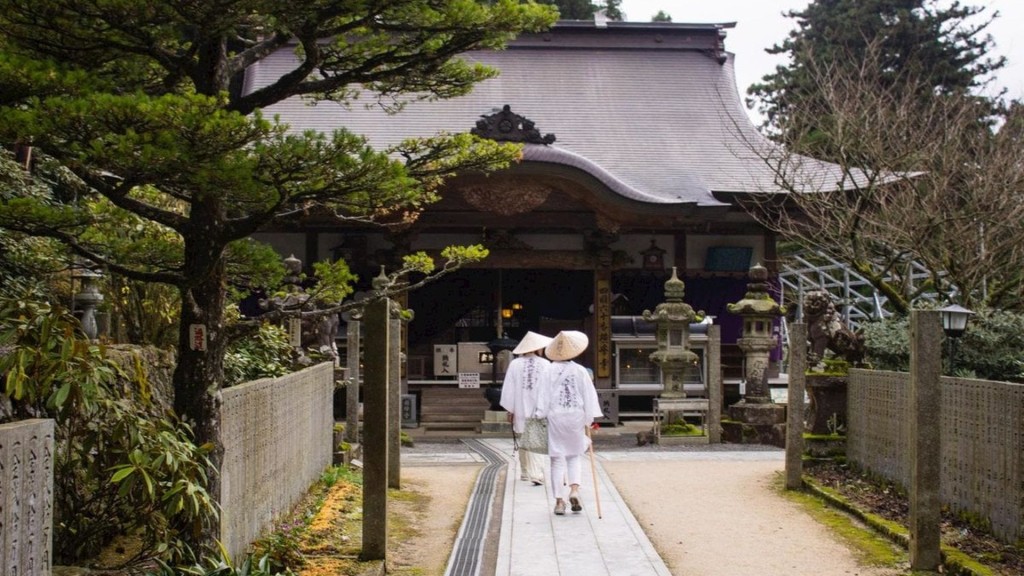
To be a pilgrim, or henro, one has to be properly equipped, as the trails can be arduous and there are thousands of stairs.
Pilgrims wear stoles and sedge hats, and carry a rosary of 108 prayer beads as well as albums with blank pages to be presented at each temple and marked with vermilion stamps and calligraphy. Pilgrims usually start their journey at Koyosan – where Kukai sits in “eternal meditation” – on the main island of Honshu, and from there proceed to Temple 1. Contrary to popular belief, it is not necessary nor advisable to visit the temples in chronological order, and it is permissible to go in a counterclockwise direction. Each temple has its own unique history and architecture, and they generally predate Kukai. Temple 75 is especially revered as it marks Kukai’s birthplace. Along the rugged southern route there are at least 15 temples, ranging from Temples 24 to 37.
Located on the route near Cape Muroto are the once almost inaccessible and desolate temples, and it was there that Kukai is believed to have achieved enlightenment like “a prayer for compassion as wide as the sky and as deep as the sea.”
By the time I reached Temple 88, the last one, in the mountains of northeast Shikoku, and not that far from where I had started out all those months before, I felt that a lifelong ambition had been fulfilled. It delivers the same sense of satisfaction and elevation that people feel when they complete pilgrimage routes in many parts of the world. A European equivalent is the 1,200-year-old pilgrimage from France to Spain known as the Camino de Santiago.
As Oliver eloquently observed, the pilgrimage is more than a physical endeavor: “This circuit around Shikoku will pull me back to try again. And again … What is important is not the destination but the art of getting there, not the goal but the going.”
Cheng Huan is an author and a senior counsel who practices in Hong Kong