Read More















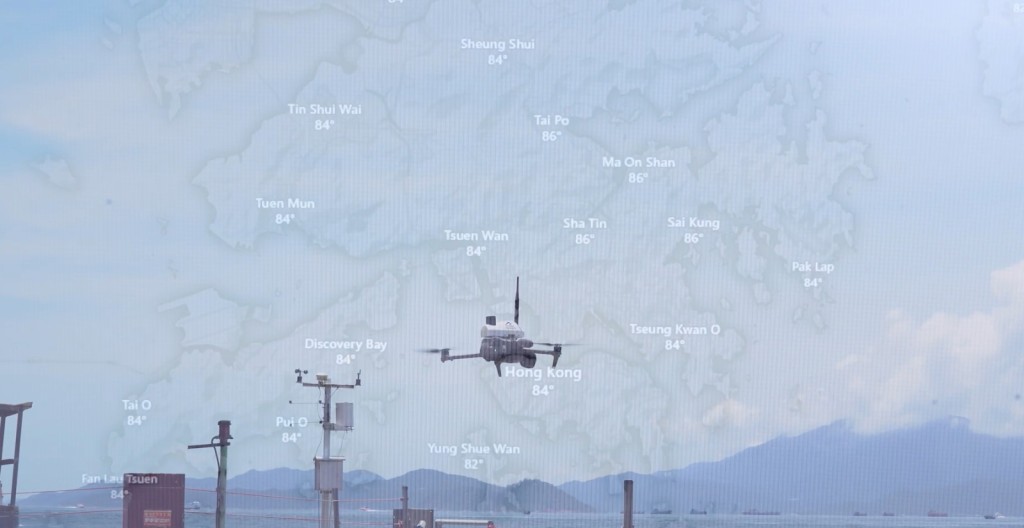
A group of enterprising young engineers developed an Aerovision Sandbox Project recently that aims to support a key component of low-altitude economy, or LAE, activities.
One of the main hurdles to develop drone services in an urban environment is the need to obtain accurate and interference free positional data for safe operation of autonomous drone flights. Precise navigation for critical applications such as aerial surveys, deliveries, and transportation is the key to their safe and efficient operation. Not only is there is need to direct drones to follow exact flight plans, navigate routes, and land on small targets with pinpoint accuracy, complex operations such as Beyond Visual Line of Sight flights and automated collision avoidance must be performed in total safety. Such operations must also be scalable to form a drone ecosystem suitable for dense urban airspace operation.
The Global Navigation Satellite System Sandbox Project is a government-supported initiative which creates a controlled real-world environment to test drones and air taxi (electric Vertical Take-Off and Landing) technologies. It aims to fasttrack the development of practical safety regulations and demonstrates viable commercial applications and should provide commercial operators a unique opportunity to pilot new technologies, validate use cases, and collaborate directly with the regulators. When successfully implemented, it should position Hong Kong as a leading hub for LAE innovation as it can significantly enhance operational safety by providing early detection and localization of GNSS interference to reduce risks of collision, making it a more attractive and secure proposition for investors and operators. It adds a vital layer of protection to drone operations, ensuring all flight activities are accurately and securely monitored to help build public trust. The much more accurate flight operations, equipped with these precise data, will attract lower insurance premiums as the risks levels are significantly reduced.
The main technical feature behind this scheme is its ability to analyze GNSS signal quality coming from multiple constellation systems already in global operations, including China’s BDS, the US’ GPS, EU’s Galileo, and Russia’s Glonass.
The system can support an unlimited number of users, useful for large drone fleets. It can provide essential flight information and GNSS signal issues to all related parties in real time which serves as an important safety protection for low-altitude flight operations.
With this increased level of security, it provides the necessary protection layer to build a resilient and scalable GNSSdependent infrastructure for dense urban environments. Sentry drones, operating in GNSS-denied environments – with real-time signal quality data continuously available along the flight paths through ground stations and data hubs – and a web dashboard can detect any abnormalities, such as erroneous signals from intentional jamming and spoofing, so that they can be readily detected and eliminated.
Self-developed artificial intelligence algorithms can estimate the location of interference sources, enabling a rapid response to threats. In general, it provides a cost-effective and scalable solution for monitoring airspace integrity.
With these features, it should enable the authorities to have ample critical data for their proof-of-concept approval with a far higher level of confidence.
What is even more noteworthy is that this concept was developed by a small team of young engineering graduates in Hong Kong. Their average age is only 26 and they come from a diverse ethnic and religious background, spanning the mainland, Indonesia, and Pakistan. But they are able to work closely as a team.
Despite high work pressure to meet the project timelines and with limited resources, they cheerfully continued with varied experiments, often working late nights but never felt tired or defeated. Often, they would make jokes with each other, their small office often echoing with happiness and laughter, showing the funny side of their work. They’ve enjoyed their achievements and will continue to develop and improve the system details for smooth operation.
Now, who says Hong Kong hasn’t got talents!
Veteran engineer Edmund Leung Kwong-ho casts an expert eye over features of modern life