Read More

Hong Kong CPI rises 1.7pc in April
15 hours ago
CK Hutchison: No plan to sell PARKnSHOP
16 hours ago

ImmD crackdown targets moonlighting domestic helpers arresting 17
19-05-2026 17:52 HKT

The world is getting fatter - and along with it the weight-loss drugs market.
Obesity among adults has more than doubled since 1990 with one in eight people in the world now living with obesity, The Lancet says, while the World Obesity Federation warns that more than half the world's population -- or more than four billion people - will be classed as obese or overweight by 2035 if action is not taken.
Little wonder then, that weight-loss drugs are flying off the shelves in a market that's expected to grow 16-fold from US$6 billion (HK$46.8 billion) to US$100 billion by the end of the decade.
Film stars and celebrities too have been lending their influence to these drugs and fueling demand.
In the US, Superstar Oprah Winfrey, who battled obesity all her life, made headlines after confessing she successfully shed more than 18kg with the help of weight-loss drugs, in a special TV last month.
And in China, famous actress Jia Ling's comedy Yolo - You Only Live Once - not only broke the Lunar New Year box office but also sparked fresh interest in weight loss and fitness, especially among women.
Currently showing in Hong Kong, Yolo tells the story of an unemployed, overweight woman who transforms her life after taking up boxing, which helps her lose weight and regain her self-esteem, and Jia, who plays the protagonist in the movie, set the internet afire as she was able to slim down from 100kg to 50kg over the course of shooting.
TWO-HORSE RACE
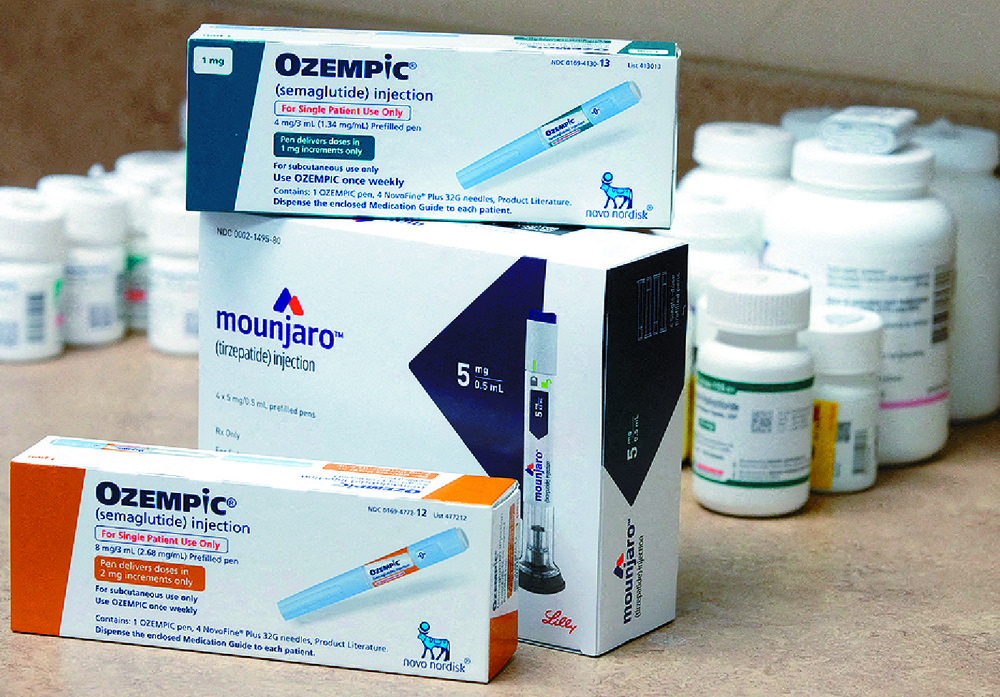
The injectable weight-loss drug market is dominated by Novo Nordisk, which manufactures Ozempic and Wegovy - and its rival Eli Lily, whose best-sellers are Zepbound and Mounjaro.
They belong to a class of glucagon-like peptide-1 agonists or GLP-1 drugs that work by helping control blood sugar levels and triggering a feeling of fullness. In clinical trials, people have lost 15 percent to 20 percent of their body weight, depending on the drug.
Wegovy and Ozempic both contain semaglutide, which is used to control type 2 diabetes while Zepbound and Mounjaro's use trzepatide, also for diabetes and weight loss.
Frost & Sullivan expects the global GLP-1 market to be worth US$28.3 billion by 2025, with the Chinese market - where Ozempic already sells like hot cakes and Wegovy is expected to be approved this year - worth 15.6 billion yuan (HK$16.8 billion).
Goldman Sachs Research is even more upbeat. It says the market for anti-obesity medications has reached US$6 billion annually and by 2030, it could grow by more than 16-fold to US$100 billion.
Novo Nordisk's stock has risen 53 percent over the past year, and the Danish firm is currently ranked as the 12th largest globally with a market capitalization of US$558 billion, surpassing Tesla's US$556 billion, according to FactSet.
Eli Lily, meanwhile, is up nearly 27 percent and its shares are trading 56.17 times the earnings estimates for the next 12 months, according to London Stock Exchange data.
HONG KONG CHOICES
Hong Kong's Mandatory Provident Fund investors who are interested in these drug giants can opt for Manulife's MPF Healthcare Fund, which holds an 8.4 percent stake in Eli Lilly, its largest holding, and 6.04 percent stake in Novo Nordisk.
The fund's year-to-date increase is 3.92 percent, and five-year growth is 41.5 percent.
Investors seeking similar stocks in Hong Kong also have a couple of choices.
United Laboratories (3933) has submitted its GLP-1 agonist liraglutide for approval. It is one of the first among its peers to have entered clinical trials and is the drug is expected to be approved by 2024.
Innovent Biologics (1801) says its application for mazdutide - co-developed with Eli Lilly - has been accepted by the National Medical Products Administration.
And CSPC Pharmaceutical's (1093) semaglutide injection has been approved by the NMPA for clinical trials on overweight adults.
Everbright Securities International's securities strategist Kenny Ng Lai-yin says that compared to overseas players which already have GLP-1 drugs on the market, Hong Kong-listed firms may face uncertainties in the earlier stages of research and development.
Among those researching GLP-1 products, United Laboratories is in the mid-to-late stage of clinical trials. And unlike Innovent Biologics which is still in the red, United Laboratories is profitable with a relatively stable performance and higher defensive ability, he says.
Macquarie has a "neutral" rating for Innovent Biologics with a target price raised from HK$34 to HK$37, estimating the group return to profitability in 2025.
"However, if a drug has not yet been launched on the market, research and development risks must be considered, and there is currently no listed company in Hong Kong that can rely solely on weight-loss drugs to drive performance," Ng says.
While weigh-loss drugs continue to shine, analysts also tell investors to keep an eye out for innovative drug and online health players which are currently undervalued.
INNOVATION AND ONLINE HEALTH
The innovative drug sector is also expected to rise amid speculation that China are reportedly working on a plan to offer "full-scale support" for innovative drug development.
SPDB International recommends focusing on innovative pharmaceuticals, as this industry expanded overseas in 2023, with three innovative drugs receiving US Food and Drug Administration approval, showing the potential for revaluation.
Beigene's (6160) esophageal cancer drug has won approval from the FDA and the drug, named Tevimbra, is expected to enter into the US market in the second half of this year.
CLSA has raised Beigene's target price from HK$136.7 to HK$138.5 and given it a buy rating.Following the FDA's approval, it's lifted overall operating revenue forecasts for 2024 to 2026 by 1.3, 0.9 and 0.9 percent, respectively.
Another sector that could shine is online healthcare.
Ng says that there are not enough brick-and-mortar hospitals and clinics in the mainland and therefore there is considerable potential for internet-based healthcare platforms.
He favors JD Health (6618) over other major H shares in the sector, based on its stable financial performance over the past few years.
"Backed by JD.com (9618), JD Health benefits from a well-established logistics system, particularly in the delivery of pharmaceuticals, showcasing an ideal synergistic effect," Ng points out.
JD Health's active users rose by 6.4 million quarter on quarter to 175 million in September 2023, a China International Capital Corporation report shows.
CICC believes its marketing and low-cost strategies will accelerate user acquisition and increase the number of active users, further consolidating its competitiveness.
Morgan Stanley, meanwhile, says JD Health is the top medical and healthcare e-commerce platform in China, based on gross merchandise volume, and is optimistic over its online expansion in pharmaceutical sales in the long term.
CICC maintains an "outperform" rating for JD Health with a target price of HK$41.2, while Morgan Stanley has lowered the target price from HK$43 to HK$40, with a rating of "in line with the overall market."