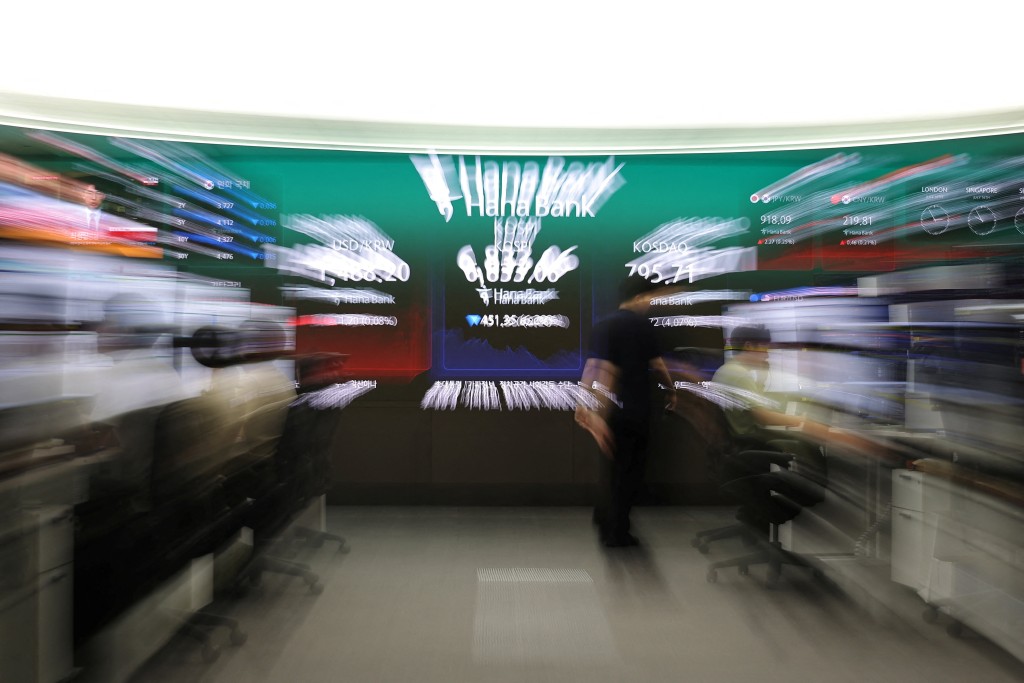
South Korea's bourse operator triggered a sell-side "sidecar" trading halt early Thursday as the benchmark KOSPI index plunged more than 5 percent, tracking a tech-led selloff on Wall Street, where sticky US inflation data fuelled more rate-hike bets.
The automatic five-minute suspension on program sell orders was triggered after steep losses in index futures, an abrupt cooling mechanism, as the KOSPI was set for its seventh straight session of losses, its longest losing streak since September 2024.
The benchmark KOSPI was down 450.02 points, or 7.49 percent, at 5,558.79 as of 01:35 GMT. Chipmaker Samsung Electronics fell 9.05 percent, while peer SK Hynix lost 11.06 percent.
The market "is struggling to find a new buyer" after buybacks have run their course at Samsung and SK Hynix, said Mixo Das, head of Korea equity strategy at J.P.Morgan in Hong Kong.
"Over the next few weeks, we expect that process to evolve. And we think the most volatile part of this flow discovery is likely behind us. On a six- to 12-month basis, we still think that all of these AI stocks will be substantially higher than where they currently stand."
Among other index heavyweights, battery maker LG Energy Solution slid 3.44 percent, while Hyundai Motor and sister automaker Kia Corp were down 3.99 percent and down 2.03 percent, respectively.
Of the 889 issues traded, 90 shares advanced while 768 declined.
Foreigners were net sellers of shares worth 355.6 billion won.
The won was quoted at 1,339.5 per dollar on the onshore settlement platform, up 0.21 percent from its previous close at 1,342.3.
In money and debt markets, December futures on three-year Treasury bonds gained 0.12 point to 103.00.
The most liquid three-year Korean Treasury bond yield fell 3.0 basis points to 3.855 percent, while the benchmark 10-year yield fell by 2.1 bps to 4.224 percent.
Reuters