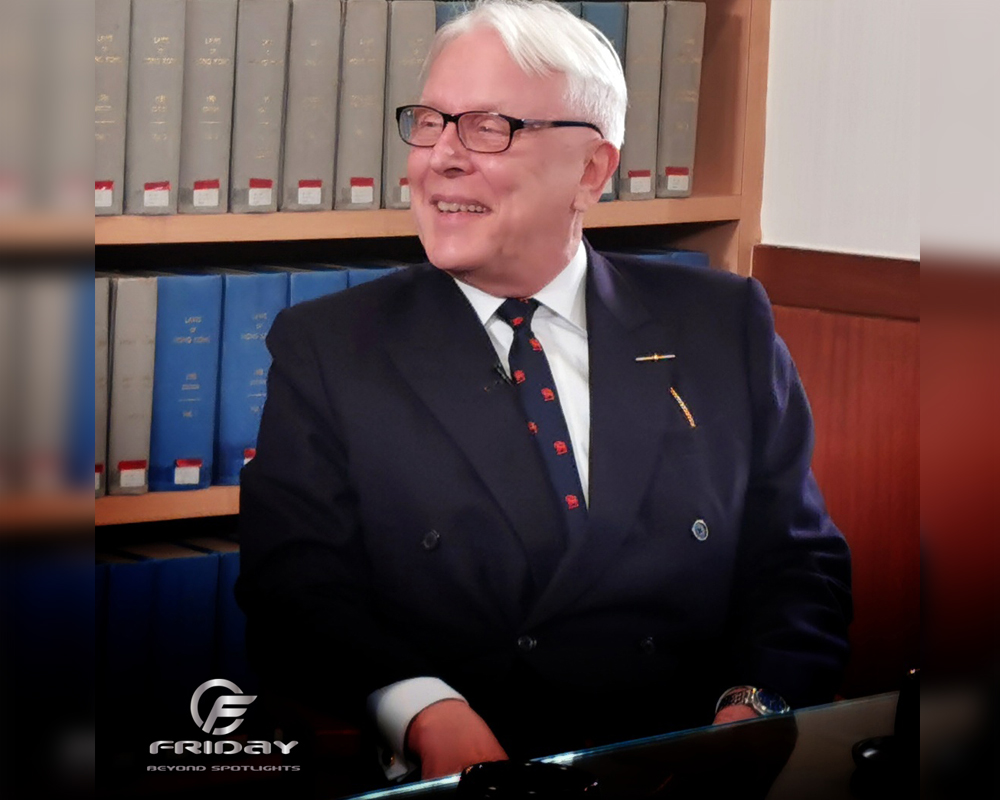
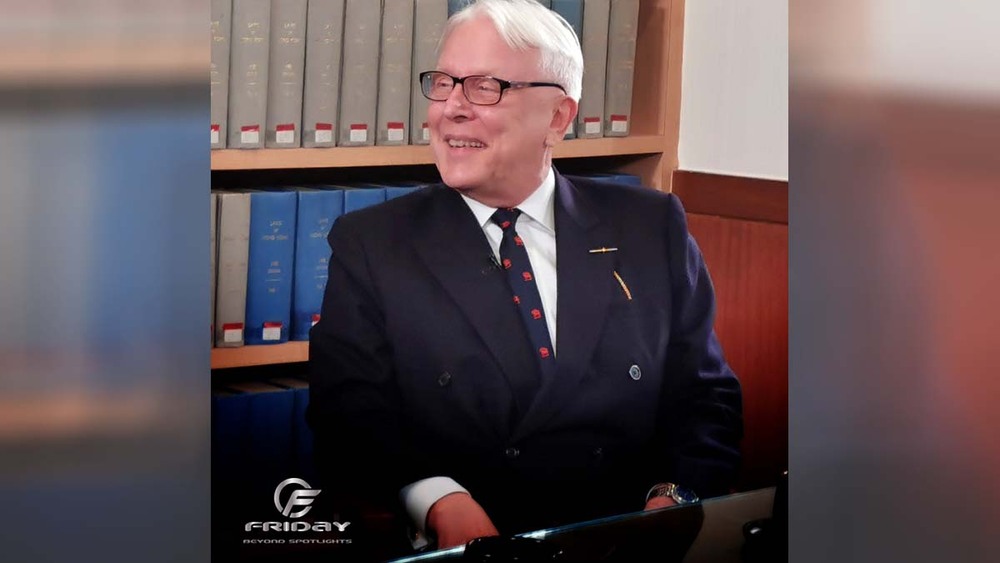
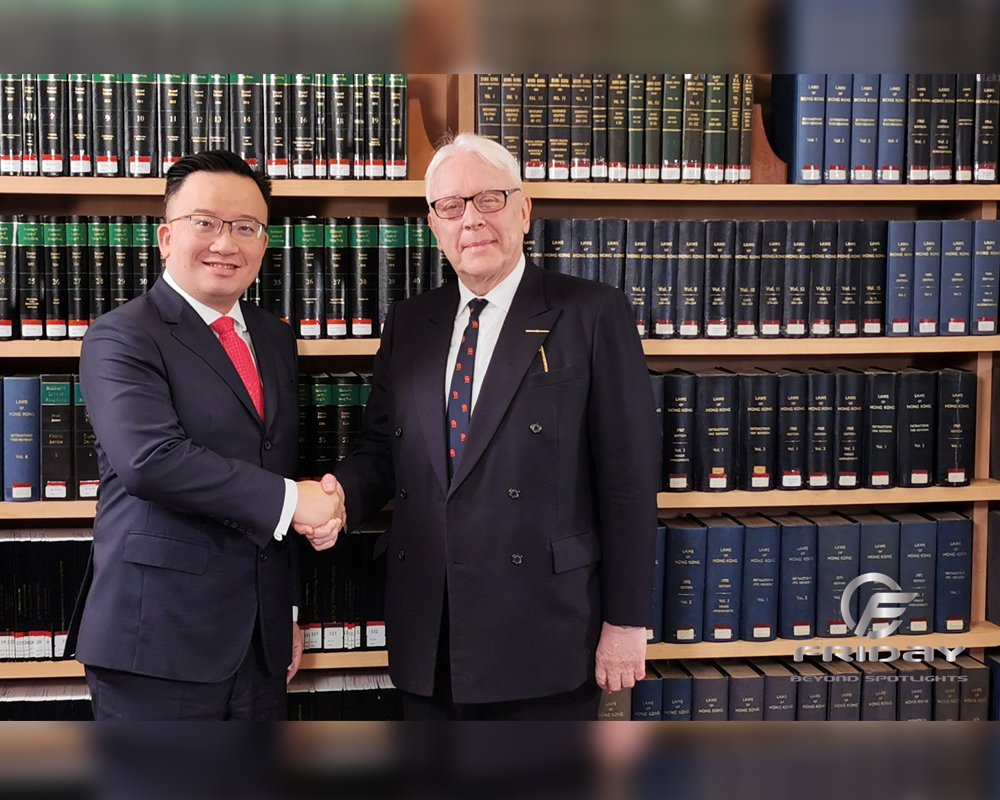
Friday Beyond Spotlights is an all-new and all-star English talk show aired every Friday at 8:30 pm on Hong Kong International Business Channel (#76). The light-hearted and informative programme, hosted by Mr Patrick Tsang On-yip and Mr Nick Chan Hiu-fung, invites leading minds and game changers in Hong Kong to share their views and insights on topical issues, and their experience in grasping opportunities and tackling challenges.
ADVERTISEMENT
SCROLL TO CONTINUE WITH CONTENT
The ninth episode, hosted by Mr Chan, features Mr Grenville Cross, GBS, QC, SC, British barrister, Deputy Director of Public Prosecutions from 1990 to 1997, and the first Director of Public Prosecutions for Hong Kong Special Administrative Region post-1997. He provides insight into the past, present, and future of Hong Kong’s legal system and weighs in on the strength of the rule of law in the city. He also highlights his first experience representing Hong Kong in appeals before the Privy Council in the UK.
Rule of law – the cornerstone of Hong Kong
Cross firmly believes that the rule of law is the secret to Hong Kong’s great success before and after 1997. “We have an independent judiciary, a strong legal profession, a respect for legal traditions and values, a belief in the system of precedent, and people committed to the well-being of Hong Kong,” he observes. Since the enactment of the Basic Law by the National People’s Congress in 1990, the common law system has been preserved at the heart of Hong Kong’s future. “The whole emphasis of the Basic Law was on maintaining the pre-existing legal system because that was regarded as being the best for Hong Kong,” he explains.
The only changes made to Hong Kong’s legal system, Cross notes, were improvements to strengthen the rule of law. “During British rule, the Governor of Hong Kong could not be prosecuted as he represented the Monarch, a figure above the law in the UK,” he elucidates. Hence, it was not until the return of sovereignty to China that Hong Kong finally achieved the fundamental concept of equality before the law. Additionally, the establishment of the Hong Kong Court of Final Appeal ensured that the power of final adjudication rested within Hong Kong rather than the UK. Regarding the criminal justice system, Cross highlights the fairness of sentencing in Hong Kong. “Our own system of sentencing ensures that the courts lean over backwards to be fair to people who are convicted of criminal offenses.”
National security and human rights
In the Hong Kong National Security Law, Cross asserts that basic traditions of the common law are specifically highlighted to guarantee suspects the traditional protections they enjoy. In particular, articles 4 and 5 stipulate that human rights and the principle of the rule of law shall be respected and protected in the application of the National Security Law. “Looking at the national security cases that have been tried, it is clear that all the traditional protections contained in the Basic Law and the International Covenant on Civil and Political Rights are being upheld as the National Security Law envisaged,” he adds. “The law has fitted nicely into our traditional legal apparatus and is functioning successfully so far.”
The National Security Law has also proven beneficial to international businesses in Hong Kong. “What businesses look for is stability, a place where they can operate without fear, danger, or violence,” says Cross. “The protests of 2019-2020, which turned extremely violent, made life difficult for businesspeople. But once the National Security Law was enacted, people felt safe again and businesses could resume their normal activities.”
With the success of the National Security Law and the implementation of a new electoral system, Cross is optimistic about the prospects of Hong Kong. “I am confident that Hong Kong will go from strength to strength. The development of the Greater Bay Area, combined with the fact that China is shortly becoming the world’s largest economy, signifies a bright future ahead for us.” He also maintains that the continuation of ‘One Country, Two Systems’ is in the interests of both the people of Hong Kong and the rest of China, thus, he is hopeful that the present system will extend beyond 2047.
In light of the promising future ahead, Cross emphasises that young people should focus on the great opportunities Hong Kong provides. “As long as they take full advantage of the opportunities which are now becoming increasingly accessible to them through legal and other professions, the sky really is the limit.”
Defender of the rule of law
Cross began his professional journey as a prosecutor in London, but seized the opportunity to join the Attorney General’s Chambers of Hong Kong in 1978. He was appointed Queen’s Counsel in 1990 and later became the first Director of Public Prosecutions for HKSAR post-1997. “I enjoyed the work enormously and I came to love Hong Kong and the people. I like the way of life, low taxation, the incentives for working hard, and respect for authorities. Here, people can achieve anything as the sky is the limit,” he reveals.
For Cross, one of the most memorable moments of his career was when he first represented Hong Kong in appeals before the Privy Council in London. “It was a triad society case which had been to the Court of Appeal in Hong Kong, but the Attorney General decided to appeal to the Privy Council in London,” he recalls. “So I went and presented the case before the Council. We ultimately won and my father commemorated the occasion by giving me a pocket watch with the date of the judgement engraved on it.” From then on, Cross continued to stay in Hong Kong and has been committed to strengthening the rule of law in the city.
A love for Chinese history
Aside from his passion for law, Cross has also been fascinated by history from an early age. He is currently delving into the history of the late Qing Dynasty and is an avid collector of Mandarin hat buttons. “I started collecting them after my first visit to Tianjin in 1991, where I stumbled on a coral coloured hat button in a little antique shop,” he notes. “After discovering that these coral coloured buttons were worn on the hats of second-grade officials during Qing China, I set out to collect all nine grades of mandarin buttons.” Pulling out his treasured collection of mandarin hat buttons, Cross proudly shares that he has finally completed the set and is excited to continue studying late Chinese history.
To watch the video, visit Friday Everyday YouTube Channel – Friday Beyond Spotlights Ep.9 l Grenville Cross.