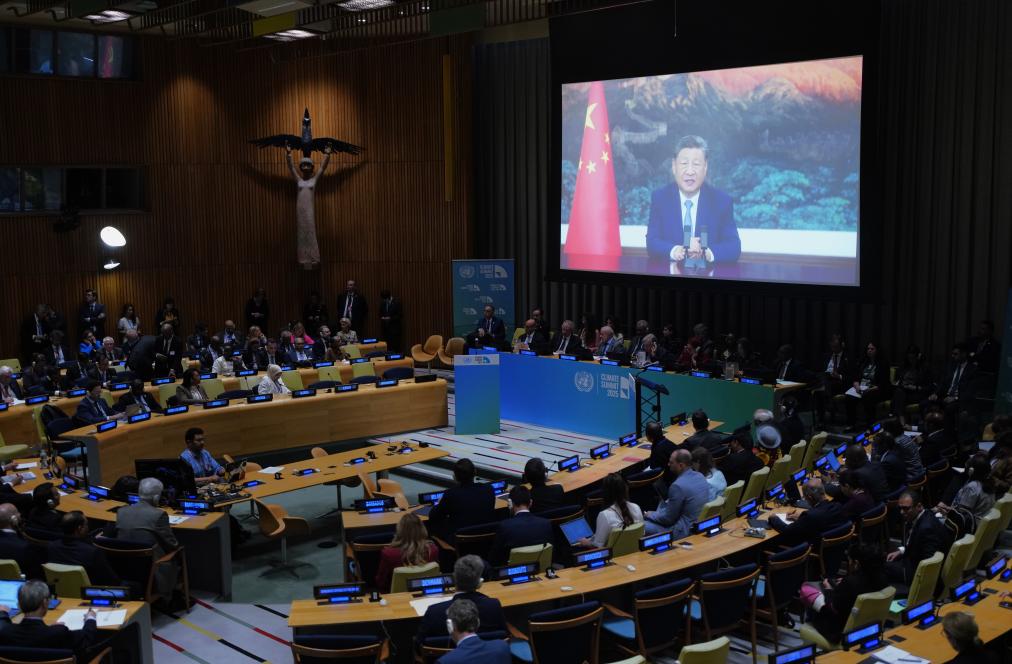
China's President Xi Jinping announced new decarbonization targets by 2035, including reducing net greenhouse gas emissions by at least 7 percent from the peak, showing the world’s second-largest economy's ambition to keep leading in global green transition.
It also comes as Europe and other areas are struggling to reach the global goal of controlling the worldwide temperature rise to no more than 1.5 degrees Celsius, as geopolitical tensions have increased energy prices and disrupted supply chains.
Xi, delivering a video speech to the United Nations Climate Summit 2025 on Wednesday, said 2025 marks the 10th anniversary of the Paris Agreement and global climate governance is entering a key stage.
China’s new targets indicate the country's "best efforts" based on the requirements of the Paris Agreement and meeting them needs "painstaking efforts by China itself and a supportive and open international environment," Xi said.
For China's contributions by 2035, Xi announced that the targeted range of cutting the economy-wide net GHG emissions is 7 to 10 percent and the country will strive to do better.
It is the first detailed goal about emission reduction after China disclosed the roadmap in 2020 of hitting a peak before 2030 and reaching carbon neutrality before 2060.
Xi also set the ratio of non-fossil fuel consumption of total energy consumption at 30 percent or above within the coming 10 years, 5 percentage points higher than the goal for 2030.
Notably, China's new energy consumption already accounted for 19.8 percent in 2024 and is expected to exceed 20 percent in 2025, according to an article by the National Energy Administration.
While China remained the largest coal consumer in 2024, NEA added that the proportion of non-fossil energy consumption was 7.8 percentage points higher than in 2015, faster than the global level and the developed economies like the European Union and the United States.
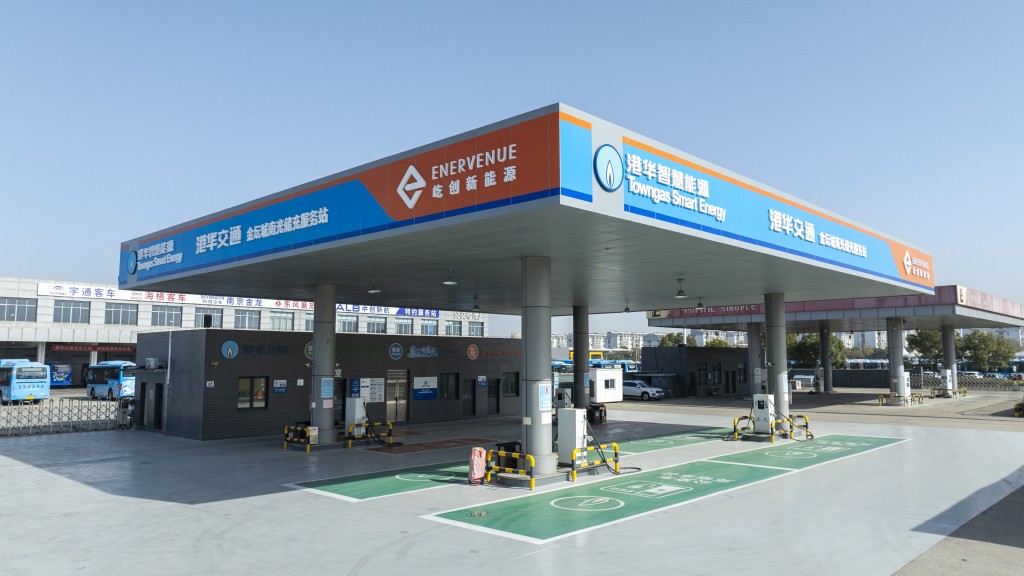
Xi also mentioned electric vehicles in the decarbonization goals for the first time, expecting them to be the majority of the newly sold cars by 2035. In the first half of 2025, the ratio already reached 44.3 percent, thanks to the renewed trade-in subsidies and price wars in domestic markets.
In the coming 10 years, China aims to see its total installed capacity of wind and solar power generation exceed six times that of 2020, striving to reach 3.6 billion kilowatts, which is also threefold the 2030 target announced five years ago.
In fact, China has been a leading renewable energy product maker, contributing over 80 percent of the world's total photovoltaic modules, over 70 percent of lithium batteries and over 60 percent of EVs, according to NEA.
Xi also mentioned that China's forest stock volume should surpass 24 billion cubic meters and the national carbon emissions trading market should cover major high-emission industries.