Read More









Nobel laureate inspires HK students at St. Joseph’s College forum
19-03-2026 23:11 HKT


Hong Kong Chu Hai College pushes for university status
11-03-2026 18:20 HKT

Penguins are known for waddling clumsily on land, making them an adorable species loved by many. But southern rockhopper penguins are different, as they literally hop about in style on rocky island shores - hence its name.
Standing at only 55cm in height and weighing around 3kg, the southern rockhopper penguin is one of the smallest species of penguins. In spite of their compact size, they are robust and bursting with energy. They can bounce to around 1m in height and are often found shooting off from the water near shorelines, landing on rocks with a perfect belly flop.
Southern rockhopper penguins mostly inhabit among the rocky, windswept shorelines in the South Atlantic, Indian and Pacific Oceans.
They can walk and hop on craggy rock surfaces thanks to their strong legs and sharp claws. Yet, they do not always stay on land. Around the time when summer ends and autumn begins in the southern hemisphere, they head toward the sea for feeding for three to five months. Their bodies are beautifully streamlined for easier movement in the water and their narrow wings and webbed feet serve as powerful flippers which allow them to dive into a depth of 30m in pursuit of prey, although they mostly remain in shallow waters to forage for fish, krill and squid.
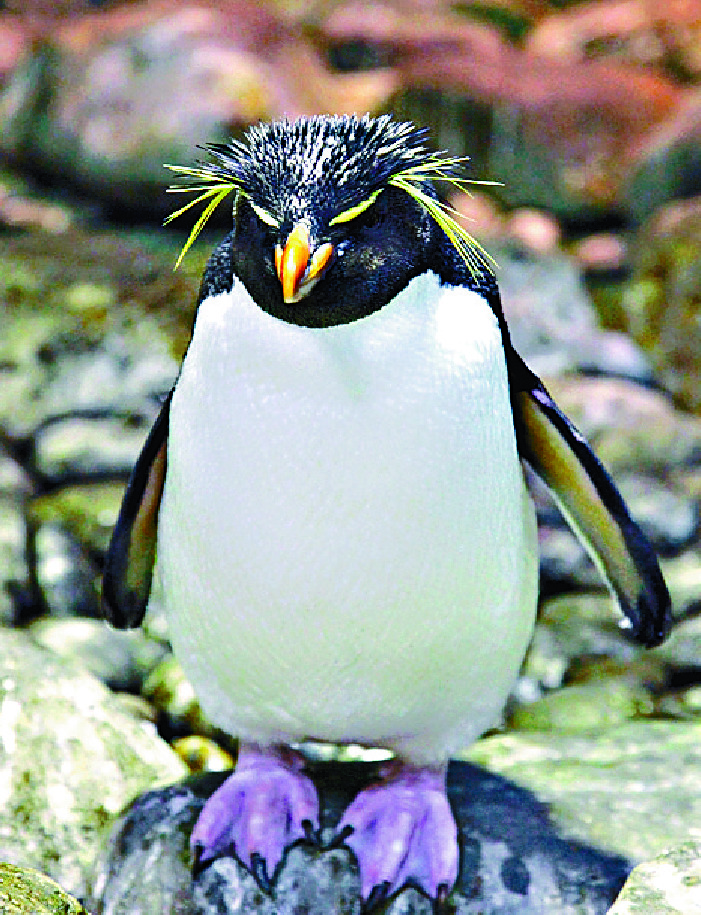
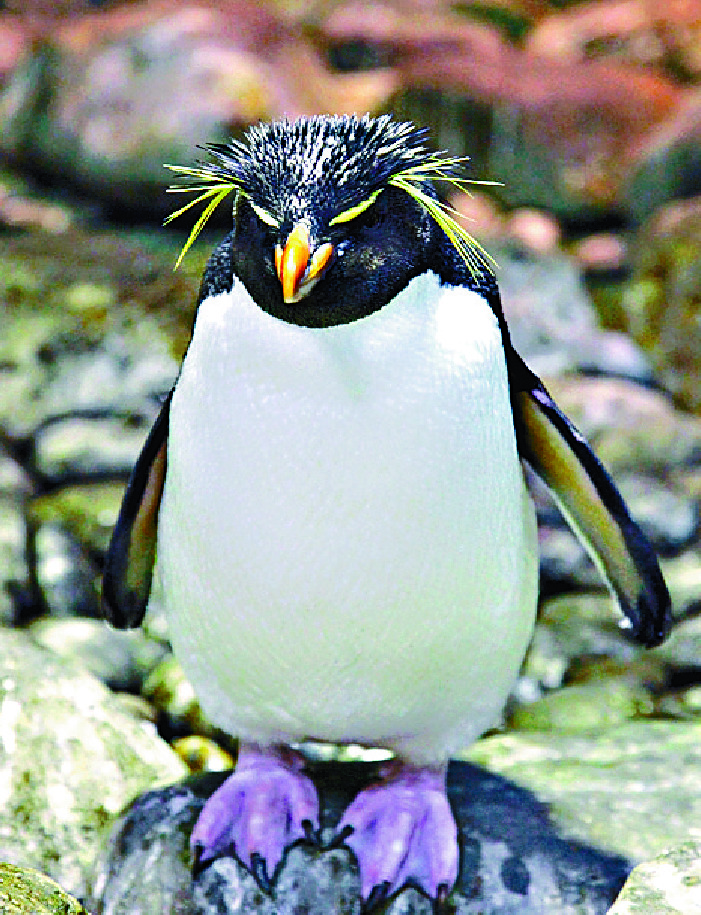
The lightweight marine birds have blood-red eyes and rouge short bills, giving them an irritable appearance. They can be easily distinguished by their fury eyebrows, which are spiky and bright yellow.
Their vividly-colored features play a key role in mating rituals, which comprise of two steps - first, they make mating calls vocally to draw attention; then they shake their heads so that their yellow crest forms a "halo" to attract the opposite sex.
Southern rockhopper penguins are highly sociable, especially during the breeding season, when they gather to form vast and noisy colonies of up to 100,000 nests. Loud aggressive sounds are typical at the colonies due to fierce competition for territory and defense of babies.
In early spring in the southern hemisphere, southern rockhopper penguins converge on their respective breeding colonies, where they return to year after year. Not only do they go back to the same breeding ground and often the same nest, but they are also loyal to their lifetime mates. As the couples pair up, two eggs are laid by the female and incubated in November and December. Both parents take turns sitting on the eggs while the other forages for food.
Once the baby chicks are hatched, the father will remain with the chicks so that the mother can bring food home. When the chicks are old enough to leave their nests, they join other young penguins from the same colony when their parents are out hunting.
Over the past few decades, the number of southern rockhopper penguins has dropped sharply and they are now listed as "vulnerable" on the International Union for Conservation of Nature's Red List. Climate change has set off a chain reaction, which severely threatens their survival in many ways.
Extreme weather conditions, as well as changes in temperatures and wind patterns, may result in habitat degradation, breeding irregularities and the collapse of food resources. In an increasingly hostile environment, survival has become a daily struggle.
Indeed, we can all contribute to combat climate change and save the vulnerable species. It is time for us to reduce fossil fuel consumption and simply adjust our diets by choosing more organic and unprocessed local vegetables and fruits over meat. Such little acts can go a long way in lowering our carbon footprint.
Meanwhile, get to know more about southern rockhopper penguins by visiting them in the South Pole Spectacular at Ocean Park Hong Kong.