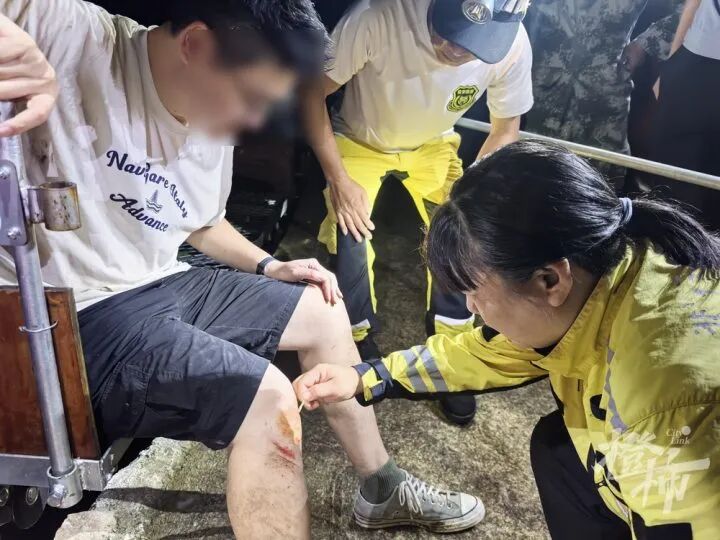
(Photo from City Link)
A man from Suzhou found himself trapped at an altitude of over 1,300 meters on a rugged mountain in the Lin'an district of Hangzhou on the night of August 12.
The perilous situation unfolded after the man got into a trivial argument with his wife and sought travel advice from an artificial intelligence chatbot to clear his head.
After the program asked detailed questions about his psychological state, personality, height, and physical fitness, it confidently recommended hiking the challenging terrain of Tonggongjian, part of the popular but demanding Three Peaks of Western Zhejiang.
Trusting the technology completely, the man traveled straight to Hangzhou despite having almost no outdoor sports experience.
A grueling late-night rescue operation
Tonggongjian reaches an elevation of over 1,500 meters and is characterized by steep, undeveloped paths, dense wilderness, and significantly lower night-time temperatures compared to the city.
The man was severely underprepared for the environment, wearing only flat-soled skate shoes and carrying nothing but a small folding chair.
He eventually slipped on the steep incline, sustaining multiple abrasions to his knees and feet.
Fortunately, his mobile phone still had reception in the dark wilderness, allowing him to call the police for help.
A joint search party consisting of seven members from the local Wolf public service emergency rescue team, two police officers, and three firefighters was immediately dispatched.
After a strenuous hour-and-a-half climb in the dark, the team located the injured man.
Because he weighed around 80 kilograms, rescuers had to take turns physically supporting him as they slowly made their descent.
They eventually reached a local walnut farming area where they utilized a small agricultural transport railcar to bring him safely to the base of the mountain, concluding the exhausting five-hour operation in the early hours of the following day. Support staff immediately disinfected and treated his wounds upon arrival at the mountain's foot.
Rescuers warn against blind faith in chatbot algorithms
The local rescue team leader noted that in their many years of emergency operations, this was the first incident they had encountered where a tourist was stranded solely due to following an AI-generated itinerary.
The team suspected the chatbot simply scraped and compiled data from experienced backpackers' online travel guides without properly accounting for the user's lack of actual outdoor experience.
Furthermore, the program completely failed to remind the man to bring essential hiking equipment for an environment where the altitude constantly increases.
Following the incident, emergency personnel reminded the public to thoroughly research trail conditions independently before setting out.
They urged hikers to choose routes that match their physical abilities and to prepare proper gear such as slip-resistant shoes, walking sticks, and first-aid kits.
Authorities strongly advised against venturing into undeveloped wilderness areas.
In the event of an injury or becoming stranded, hikers are instructed to remain calm, contact emergency services immediately with their precise location and injury status, and conserve their energy while waiting for help.