Read More
Three Hong Kong universities have invented a cost-effective "artificial mussel" to test radioactivity in the ocean accurately.
ADVERTISEMENT
SCROLL TO CONTINUE WITH CONTENT
The "artificial mussel'' is a cross-institutional study conducted by the Education University, City University and University of Hong Kong, which has been shown to absorb heavy metals and radionuclides in the sea, could be applied for monitoring radioactively contaminated areas around the world. The device can only be used once.
The device, akin to the characters of natural mussels for its high absorbability to metal, was pioneered by Rudolf Wu Shiu-sun, a professor at the EdU's department of science and environmental studies together with his research team over a decade ago.
The polyacrylamide gel chemical along with artificial seawater inside the device, will absorb the radionuclides and heavy metal for seven to eight weeks until saturation.
After that the device will be transferred to clean seawater and the collected chemicals will be taken out for analysis, allowing researchers to measure the concentrations of varied chemicals.
The device has undergone a test in waters off Sydney last year, and found it can effectively collect three commonly seen radionuclides - uranium, strontium and cesium.
The research team also said that 29 countries and regions have been using their artificial mussels.
"The study confirms that artificial mussels can resolve the limitations presented by traditional detection methods and offer authorities around the world a practical and cost-effective way to monitor radionuclides in waters," Wu said, adding that it also plays a role in safeguarding the environment and offering food safety measures.
Each device only costs about US$1 or HK$8, and researchers only need to drop two or three artificial mussels at a single spot in the sea.
The research team said the artificial mussels are more convenient offering cost efficiency compared to the old methods, as in the past, researchers needed to collect hundreds of liters of seawater for sufficient concentration to analyze the chemicals in the water, which is costly, requires manpower, and is time-consuming.
The team said they hope the technique will be reliable for monitoring international waters. The study was peer-reviewed and published in the Journal of Marine Science and Engineering in June.
The device has not been used in Hong Kong and Wu said the radioactivity in local water is relatively low, but he said that the team will seek cooperation with the government for wider use.
The team is hoping to work with Xiamen University's key laboratory of marine environmental science, and looking forward to testing their invention in the Taiwan Strait.
On a recent decision by the Japanese government to discharge contaminated water from the destroyed Fukushima Nuclear Plant into the sea, Wu said that those radionuclides will not decompose but accumulate and will further spread across the world by marine creatures, which may affect international waters.
"The risks posed by nuclear wastes to marine ecology and human health cannot be underestimated," said Wu.
He suggested that the government should embargo high-risk Japanese seafood if the contaminated seawater is discharged.
A chemistry professor at CityU Vincent Ko Chi-chiu, said the artificial mussels will be effective in measuring the contamination levels in the Japanese sea.
Wu also said that the team is willing to work with the Japanese government to monitor their sea condition if needed.
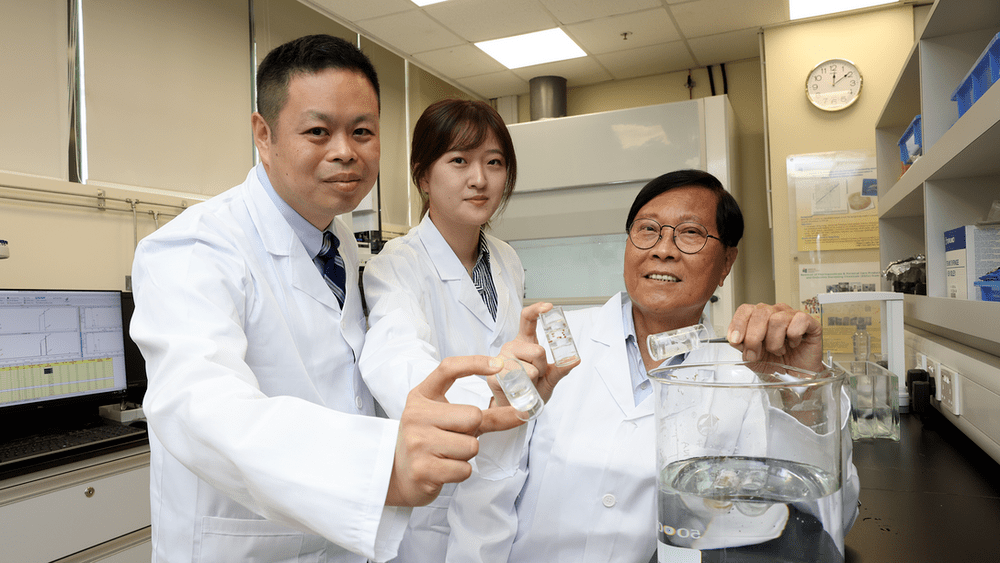
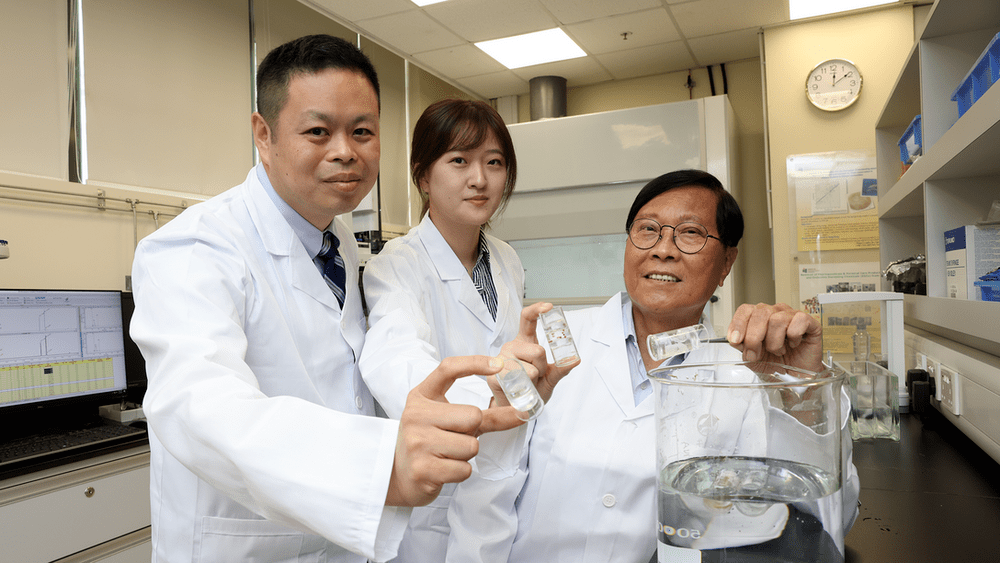
Vincent Ko, Yang Yi and Rudolf Wu demonstrate the device that has been developed by three Hong Kong universities.Sing Tao