Read More
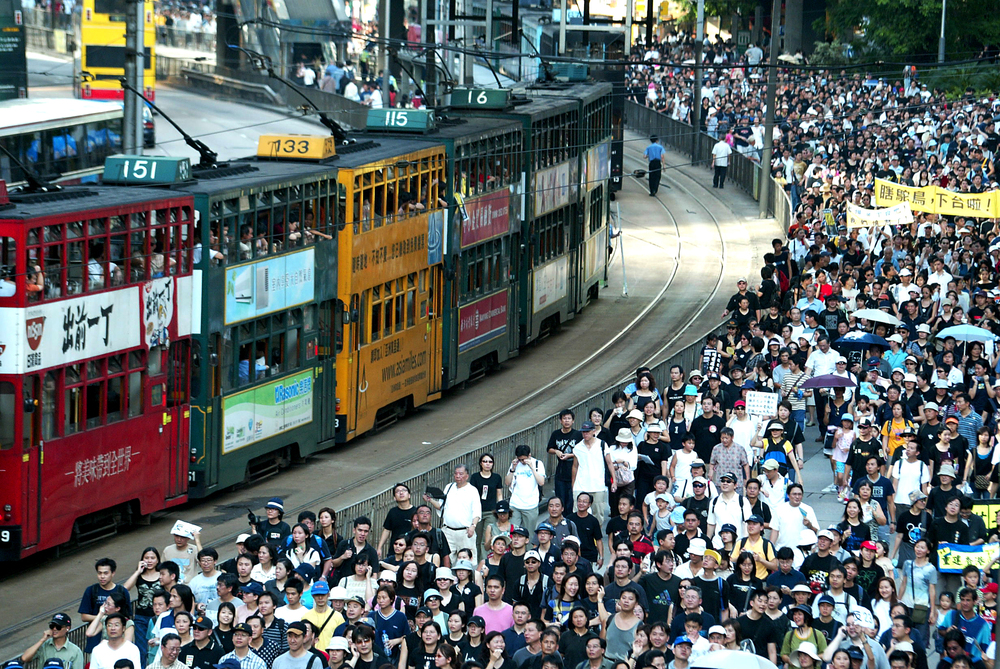
On July 1, 2003, some 500,000 Hongkongers took to the streets to oppose the enactment of Article 23 of the Basic Law.
ADVERTISEMENT
SCROLL TO CONTINUE WITH CONTENT
The protest was the first major feat by Civil Human Rights Front, which was established in September 13, 2002.
Formed by dozens of civic groups and political parties, it started organizing protests annually on July 1 – a public holiday to celebrate Hong Kong's handover to China since 1997.
Article 23 requires Hong Kong to enact laws to ban treason, secession, sedition and subversion. Theft of state secrets will be made an offense, while local political groups would be prohibited from establishing ties with foreign bodies.
Worried about erosion on Hong Kong's freedoms, and with the property market slumping amid a financial crisis, hundreds of thousands people joined the protest.
The turnout was the highest since the Hong Kong protest in 1989 following the Tiananmen crackdown. Under mounting pressure, Liberal Party backed out from supporting the enactment. Then Chief Executive Tung Chee-hwa resigned in 2005 due to health problems.
Legislation for Article 23 has been shelved till now. But the July 1 protest became an annual occurrence as the front moved on to other topics ranging from universal suffrage to introduction of a minimum wage and opposing national education.
In 2014, the front claimed 510,000 people participated in the July 1 protest when Leung Chun-ying was Chief Executive.
Some participants stayed after the rally and occupied part of Chater Road in Central as a “rehearsal” for Occupy Central movement – which took place later in September that year.
In 2019, the front organized various protests against the extradition bill, which would allow the transfer of fugitives from Hong Kong to mainland.
The protest on June 9 drew an estimated 1 million people, but the government showed no sign of backing down.
Protesters surrounded the Legislative Council on June 12, during which police used tear gas in confrontations. The government declared the confrontations a riot.
On June 15, she suspended the extradition bill. But protests continued on June 16, when the front made the famous “five demands” --- for the government to retract the bill; to hold the police responsible for the clashes; to free all arrested protesters and not to prosecute them; to retract an earlier statement saying June 12 protest was a riot; and for CE Carrie Lam Cheng Yuet-ngor to step down.
The front claimed two million people joined the rally, while police said there were 338,000 people at its peak.
On the following July 1, while peaceful rally continued on the one hand, others broke into Legislative Council, spraying the SAR emblem and damaging other facilities.
In September, Lam withdrew the extradition bill. But public uproar continued and the front organized a protest from Victoria Park to Central on October 1 despite opposition from the police. Violent clashes erupted across Hong Kong.
The unrest continued till the beginning of 2020, when the Covid-19 outbreak and prosecution of protesters put an end to protests. The front held its last rally approved by the police on New Year's Day.
In June 2020, the national security law was introduced in Hong Kong, which created offenses of subversion and sedition. Police rejected the front's application to organize the annual July 1 rally on health grounds.
In March this year, sources said police were investigating the front for receiving foreign funding, which would be in breach of the national security law.
Then officers asked the front to provide information for its probe of it being an “illegal society”. But the alliance refused to cooperate, saying the police didn’t ask the front to register nor questioned its status over the past two decades.
Since then, major groups and political parties withdrew from the front, including Democratic Party, Civic Party and the now disbanded Hong Kong Professional Teachers' Union.
The number of member groups dwindled to eight, including Confederation of Trade Unions and League of Social Democrats.
Convener Figo Chan Ho-wun was jailed 18 months for organizing the October 1 rally without authorization. With no one willing to take up the secretariat's work, the front announced today it has no choice but to disband.
Nevertheless, the disbandment will not spell the end of ill fate for its members.
The Hong Kong and Macao Affairs Office said that the front has remained “unrepentant” at the time of its dissolution and attempted to evade legal liability.
The front is “thoroughly an unregistered illegal organization that has grouped various anti-China and anti-Hong Kong forces under the deceptive pretext of peace, reason, and non-violence over the years”, the office said, adding it colluded with external forces to launch “color revolutions”.
A spokesman said that the members must be prosecuted even if the front disbanded.
"Along with political parties, media outlets and unions, we sadly now must add NGOs to the list of those targeted simply for doing their legitimate work," Joshua Rosenzweig, head of Amnesty International's China team, stated.
"The pattern of self-censorship seen this week also signals a concerning domino effect as Hong Kong's draconian national security law has triggered an accelerating disappearance of independent civil society groups from the city," he said.
Johnson Yeung Ching-yin, the front's former convener, said the alliance has insisted on being peaceful and legal. But authorities are trying to eradicate all opposition despite their positioning, as the front's core members are either jailed or remanded.
Political commentator Ma Ngok believed it will be increasingly difficult to get approval for large scale protests in the future.
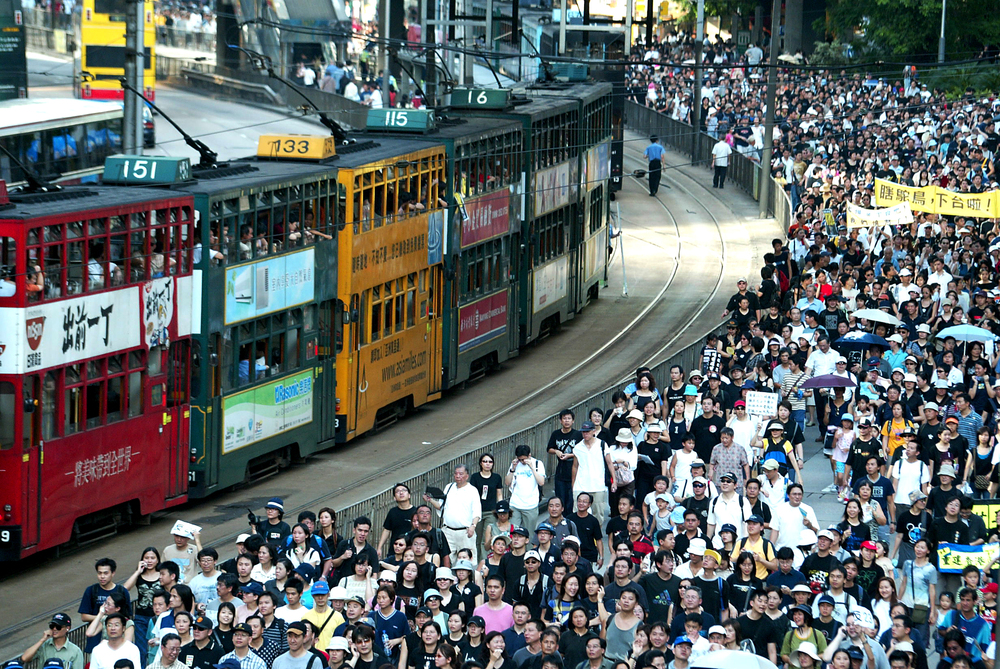
The July 1 protest on July 1, 2003.