Read More
China sent three astronauts to its Tiangong space station yesterday, putting a civilian into orbit for the first time as it pursues plans to send a crewed mission to the Moon by 2030.
ADVERTISEMENT
SCROLL TO CONTINUE WITH CONTENT
And Hong Kong leader's expressed the hope that at least one of the city's aspiring astronauts will one day be part of China's future missions to space.
The Shenzhou-16 crew took off atop a Long March 2F rocket from the Jiuquan Satellite Launch Centre in northwest China at 9.31 am, docking the space station's Tianhe core module in the afternoon, more than six hours after taking off.
The launch was a "complete success" said Zou Lipeng, director of the Jiuquan Satellite Launch Center.
Leading its crew is commander Jing Haipeng on his fourth mission, as well as engineer Zhu Yangzhu and Beihang University professor Gui Haichao, the first Chinese civilian in space.
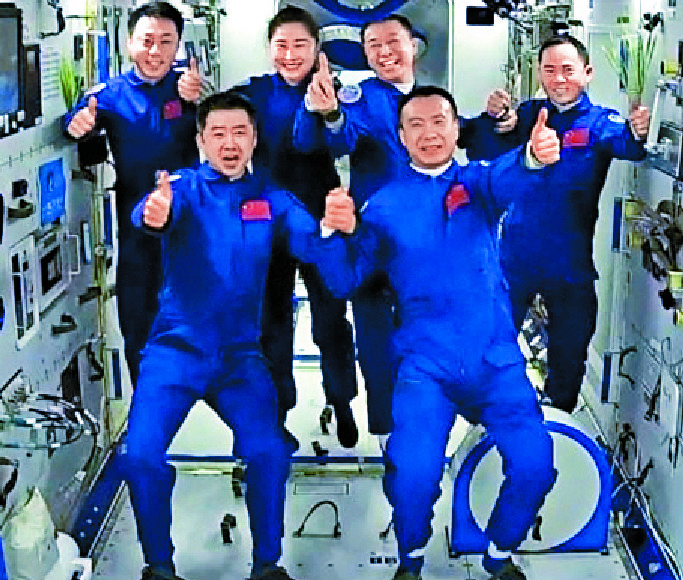
The crew met their three colleagues from the Shenzhou-15 flight, who have been at the station for six months and who will return to Earth in the coming days.
China was the third country to put humans in orbit and Tiangong is the crown jewel of its space program, which has also landed robotic rovers on Mars and the Moon.
The crew will carry out a number of experiments during the mission, including in "high-precision space time-frequency systems", general relativity, and into the origin of life, China Manned Space Agency spokesperson Lin Xiqiang said.
"The goal is to achieve China's first crewed landing on the Moon by 2030 and carry out lunar scientific exploration and related technological experiments," Lin said.
In Hong Kong, Chief Executive John Lee Ka-chiu watched a livestream of the launch and said he's proud of the mission.
The SAR's candidates for China's fourth recruitment of astronauts are from the government, Hospital Authority and other institutions, of which a dozen candidates from the city and Macau will go to Beijing for the second interview next month, he revealed.
"Our country has made great progress and success [in its manned space missions] along the way. This is something I take great pride in. I'm honored," Lee said.
He said the selection of payload specialists in Hong Kong implied the country values the development of young people and has confidence in the local scientific research.
"I'm rooting for our candidates. I hope that one of them will make it and become part of the manned mission to contribute to our country's space missions and bring glory to us," Lee said.
"This selection shows our country attaches great importance to our youth development. This also shows our country's confidence in our science and technology. This inspires many young people here to take an interest in technology."
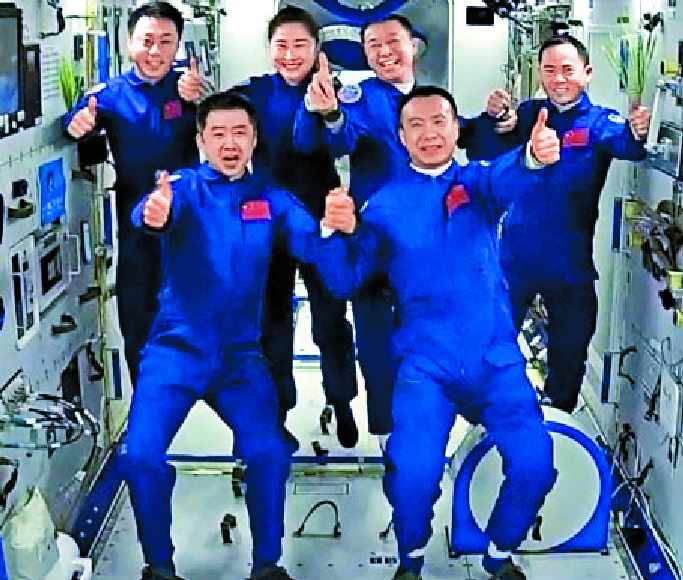
The astronauts with their three colleagues aboard the space station.