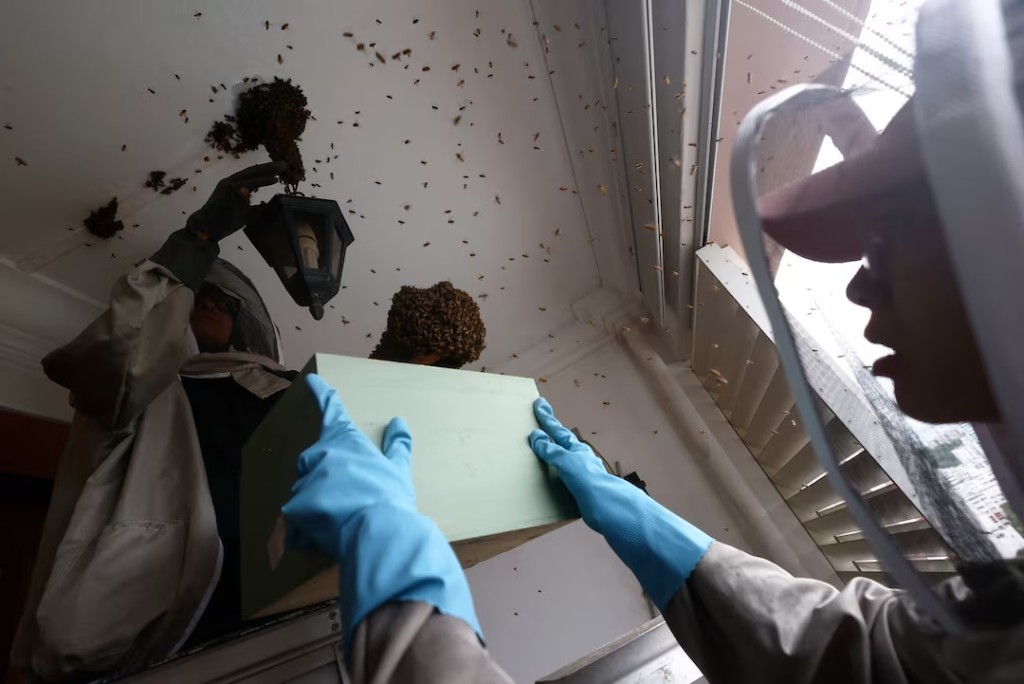
Armed with nothing but a bandana and his bare hands, 42-year-old Clarence Chua rescues bees, scooping them from nests into wooden boxes to relocate them, sometimes to his own backyard.
“What I like about them is if you respect them and you don't threaten their safety, they are totally OK with you being at close quarters with them,” Chua said.
When residents of tropical Singapore find bees nesting in their houses, they typically call pest control, which can exterminate nests in minutes for about S$80 to S$150 ($62 to $116). But Chua has convinced a growing number to allow him to rescue the bees for between S$100 and S$500.
In the last six years, he has safely relocated an average of 100 nests each year, which comes up to about 6 million bees saved. Humane relocations entail moving the whole nest, keeping the queen bee, babies and worker bees intact in their colony. They are then moved to three apiaries that he manages, one of which sits in his own backyard.
Chua has rescued bees from all sorts of exotic places, from a “spirit house” in a condominium to a plane’s engine, which could not take off until the swarm was relocated.
As awareness of bee rescuing improves, he noted that local town councils, which manage the public housing estates where almost 80% of the population live, have also begun engaging his services.
Still, the job is not without its dangers.
Once, he tried to rescue a swarm of what he assumed were docile bees on the ledge of a condominium, which attacked him instead. In the 30 seconds it took to undo his harness and escape, he was stung about 100 times.
“It really taught me to not underestimate nature,” he said, adding that he still approaches nests without a bee suit initially to better gauge their mood before donning one if the swarm seems agitated.
Chua advocates for bee rescues on social media. Videos of his exploits, some of which are taken from a first-person view with Meta glasses, have drawn some 20,000 followers.
“Without bees, there will be much less fruit or much more expensive fruit, because there's a lack of fruit in the world ... This is a mind-blowing amount of crop we depend on for our own survival,” he said.
Reuters