Read More
King Charles III was crowned on Saturday in Britain's biggest ceremonial event for seven decades, a sumptuous display of pageantry dating back 1,000 years.
ADVERTISEMENT
SCROLL TO CONTINUE WITH CONTENT
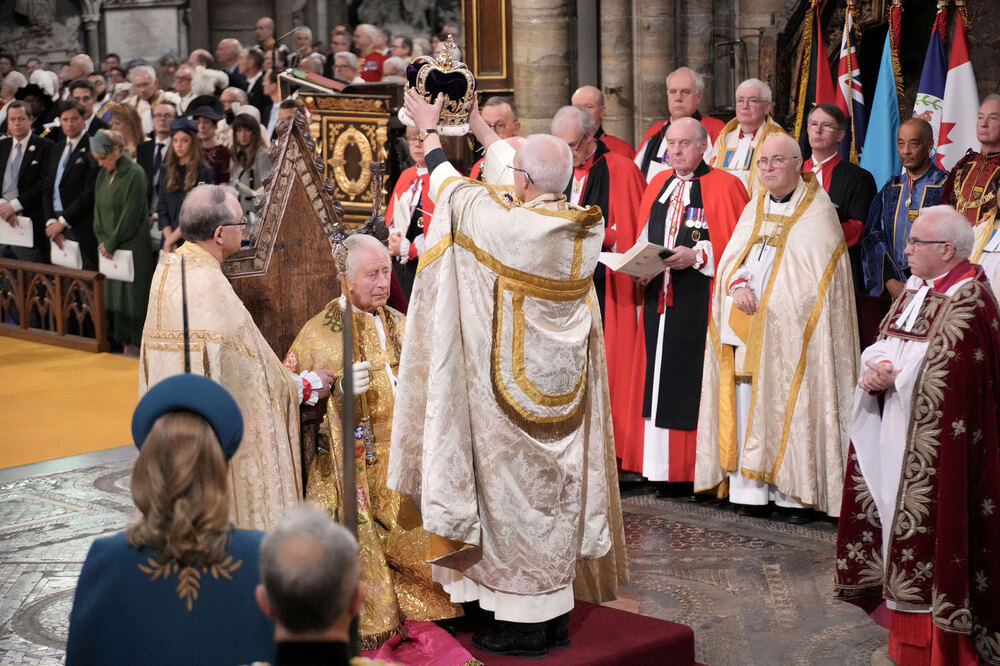
In front of a congregation of about 100 world leaders and a television audience of millions, the Archbishop of Canterbury, the spiritual leader of the Anglican Church, slowly placed the 360-year-old St Edward's Crown on Charles' head as he sat upon a 14th-century throne in Westminster Abbey.
Trumpets sounded inside the medieval abbey and the congregation shouted “God save King Charles” as the ceremony began in front of more than 2,000 guests, including world leaders, aristocrats and celebrities. Outside, thousands of troops, tens of thousands of spectators and a smattering of protesters converged along a route that the king traveled from Buckingham Palace in a gilt-trimmed, horse-drawn carriage.
It was the final mile of a seven-decade journey for Charles from heir to monarch.
To the royal family and government, the occasion — code-named Operation Golden Orb — is a display of heritage, tradition and spectacle unmatched around the world
The rite was expected to by watched by millions, though the awe and reverence the ceremony was designed to evoke are largely gone — and many greeted the day with apathy.
The historic and solemn event dates back to the time of the 74-year-old's predecessor William the Conqueror in 1066.
The symbolic peak of the two-hour service came halfway through when Archbishop of Canterbury Justin Welby placed the solid gold St. Edward’s Crown on the monarch’s head. Trumpets sounded and gun salutes were fired across the U.K.
Charles scrapped the traditional moment at the end of the service when nobles were asked to kneel and pledge their loyalty to the king.
Instead, Welby will invite everyone in the abbey to swear “true allegiance” to the monarch. He'll invite people watching on television to pay homage, too — though that part of the ceremony has been toned down after some criticized it as a tone-deaf effort to demand public support for Charles. Welby will now suggest people at home take a “moment of quiet reflection” or say “God Save the King.”
For a nation struggling to find its way in the political maelstrom after its exit from the European Union and maintain its standing in a new world order, its supporters say the royal family provides an international draw, a vital diplomatic tool and a means of staying on the world stage.
"No other country could put on such a dazzling display - the processions, the pageantry, the ceremonies, and street parties," Prime Minister Rishi Sunak said.
Despite Sunak's enthusiasm, the coronation takes place amid a cost-of-living crisis and public skepticism, particularly among the young, about the role and relevance of the monarchy.
Saturday's event was on a smaller scale than that staged for Queen Elizabeth in 1953, but still sought to be spectacular, featuring an array of historical regalia from golden orbs and bejeweled swords to a scepter holding the world's largest colorless cut diamond.
Charles automatically succeeded his mother as king on her death last September, and the coronation is not essential but regarded as a means to legitimize the monarch in a public way.
The king and queen left Buckingham Palace for the abbey in the modern, black Diamond State Jubilee Coach accompanied by cavalrymen wearing shining breastplates and plumed helmets.
Hundreds of soldiers in scarlet uniforms and black bearskin hats lined the route along The Mall, the grand boulevard to Buckingham Palace. Tens of thousands ignored the light rain to mass in a crowd more than 20 deep in some places to watch what some saw as a moment of history.
"The split-second glance of seeing the king is really important but I think the whole day as well ... the idea of the nation coming together. You very much feel the pride in the nation," said Mark Strasshine after the royal coach went by.
Inside the abbey, bedecked with flowers and flags, politicians and representatives from Commonwealth nations took their seats alongside charity workers and celebrities, including actors Emma Thompson, Maggie Smith, Judi Dench and U.S. singer Katy Perry.
Much of the ceremony featured elements that Charles' forebears right back to King Edgar in 973 would recognize, officials said. Handel's coronation anthem "Zadok The Priest" was sung as it has been at every coronation since 1727.
But there was also the new, including an anthem composed by Andrew Lloyd Webber, famed for his West End and Broadway theatre shows, and a gospel choir.
Charles' grandson Prince George and the grandchildren of Camilla acted as pages, and although a Christian service, at the end there will be an "unprecedented" greeting from faith leaders.
However, there was no formal role for either Charles' younger son Prince Harry, after his high-profile falling out with his family, or his brother Prince Andrew, who was forced to quit royal duties because of his friendship with late U.S. financier Jeffrey Epstein, a convicted sex offender.
They sat in the third row behind working members of the royal family.
Charles looked serious as he swore oaths to govern justly and uphold the Church of England - of which he is the titular head - before the most sacred part of the ceremony when he was anointed on his hands, head and breast by Archbishop of Canterbury Justin Welby with holy oil consecrated in Jerusalem.
After being presented with symbolic regalia, Welby placed the St Edward's Crown on his head and the congregation cried out "God save the King".
Thousands of people from across the U.K. and around the world camped overnight along a 1.3-mile (2-kilometer) route that the king and his wife, Camilla, traveled to reach the abbey.
At a traditional Anglican service slightly tweaked for modern times, Charles, clad in crimson and cream robes, swore on a Bible that he is a “true Protestant.”
But for the first time, a preface was added to the coronation oath to say the Church of England “will seek to foster an environment where people of all faiths and beliefs may live freely," and the epistle from the King James Bible was read by Prime Minister Rishi Sunak, Britain's first Hindu leader.
A gospel choir performed a newly composed “Alleluia,” and, for the first time, female clergy took part in the ceremony.
For 1,000 years and more, British monarchs have been crowned in grandiose ceremonies that confirm their right to rule.
These days, the king no longer has executive or political power, and the service is purely ceremonial since Charles automatically became king upon death of his mother, Queen Elizabeth II, in September.
The king remains the U.K.’s head of state and a symbol of national identity — and Charles will have to work to unite a multicultural nation and keep the monarchy relevant at time when support for it is waning, especially among younger people.
The public’s response to Charles, though, during the service and along the parade route, is key, said George Gross, a visiting research fellow at King’s College, London and an expert on coronations.
“None of this matters if the public don’t show up,’’ Gross said. ‘’If they don’t care, then the whole thing doesn’t really work. It is all about this interaction.’’
And today's public is very different from the audience that saw Elizabeth crowned.
Almost 20 percent of the population now come from ethnic minority groups, compared with less than 1 percent in the 1950s. More than 300 languages are spoken in British schools, and less than half of the population describe themselves as Christian.
(Agencies)
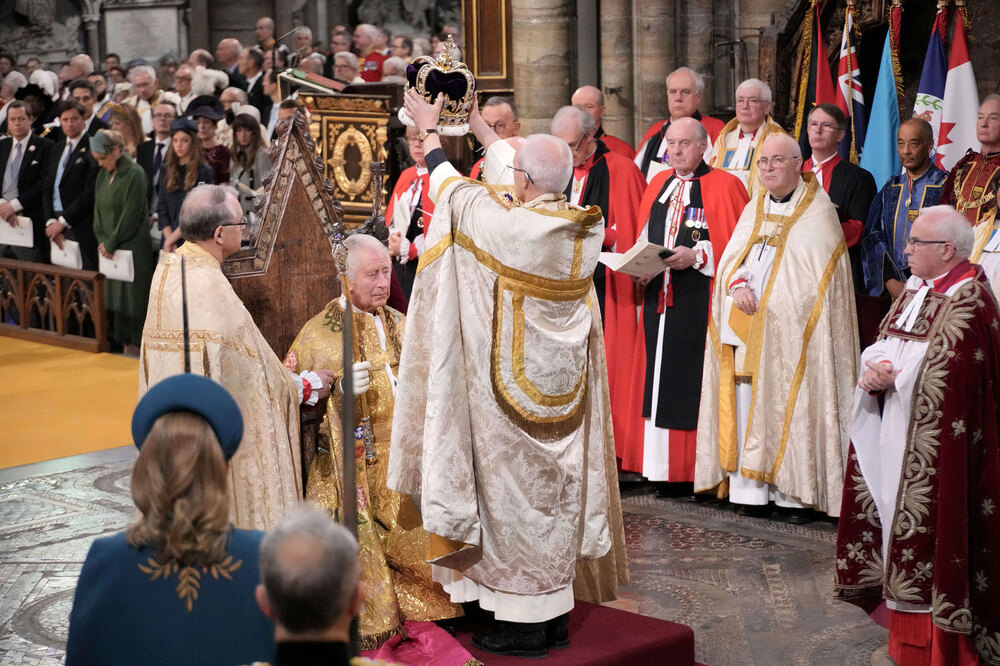
King Charles III receives St Edward's Crown. (AP)
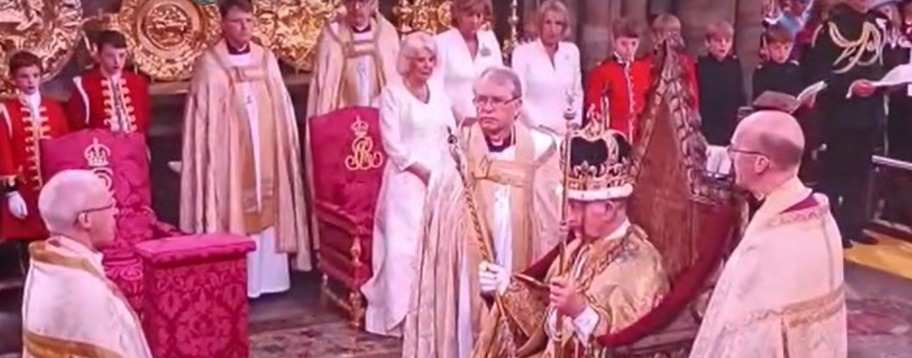
King Charles III receives St Edward's Crown. (Screenshot from live feed)