Read More



US core capital goods orders fall in April
28-05-2026 22:35 HKT
US first-quarter GDP growth revised lower to 1.6 percent pace
28-05-2026 22:22 HKT



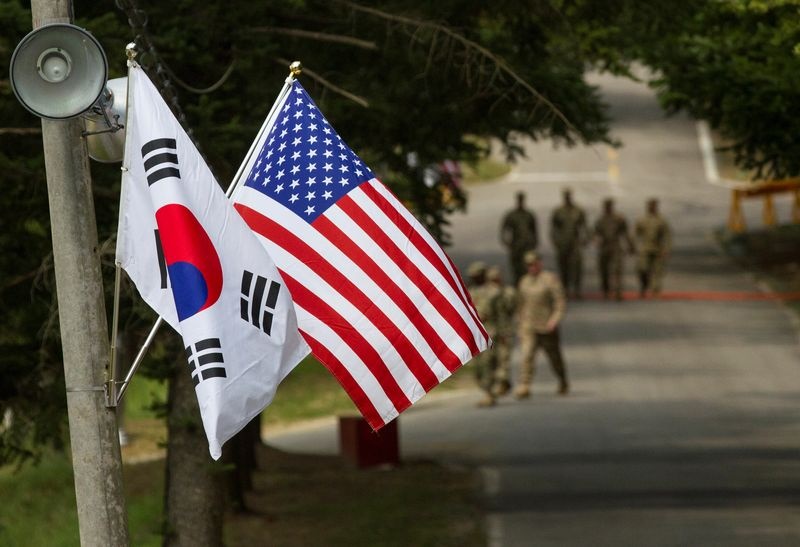
South Korea's President Lee Jae Myung faces a pivotal foreign policy test barely two months after taking office, with back-to-back summits in Tokyo and Washington that reflect the wider struggle of U.S. allies to navigate Donald Trump’s unilateral push to redefine postwar orders on trade, security and alliances.
The meetings come after Seoul and Tokyo reached trade deals with Washington that spared them from the Trump administration’s highest tariffs, but only after pledging hundreds of billions of dollars in new U.S. investments.
Trump’s transactional approach with long-standing allies extends beyond trade to security and has fueled fears in South Korea that he will demand higher payments to support the U.S. troop presence in the country, even as he possibly seeks to scale back America’s military footprint there to focus on China.
The looming concerns about a U.S. retreat in leadership and security commitments come as South Korea and Japan confront growing cooperation between their nuclear-armed adversaries, North Korea and Russia, partners in the war in Ukraine and in efforts to break isolation and evade sanctions.
Here is what is at stake for the Asian allies of the U.S. as they deal with an America-first president who's more unyielding than his predecessors:
A day after confirming his Aug. 25 summit with Trump, Lee’s office announced he will visit Japan on Aug. 23-24 to meet Prime Minister Shigeru Ishiba, a rare diplomatic setup that underscores how Trump is drawing closer two often-feuding neighbors with deep-rooted historical grievances.
The meeting on Saturday in Tokyo of Lee and Ishiba — who last met on the sidelines of the Group of Seven summit in June — is largely about projecting leverage as the countries seek to coordinate their response to Trump, said Choi Eunmi, an analyst at South Korea’s Asan Institute for Policy Studies.
“There is now the Trump risk,” Choi said. “There’s especially a lot of uncertainty in the business sector, so they might discuss ways to ease that uncertainty … not necessarily in joint efforts to confront Trump, but within the framework of trilateral cooperation.”
Yukiko Fukagawa, a professor at Japan’s Waseda University, said Lee’s visit to Tokyo will also be seen positively in Washington, long frustrated by its Asian allies’ persistent disputes over Japan’s colonial rule of Korea before the end of World War II, and the way these tensions hindered three-way security collaborations.
“Because they have to deal with increasingly challenging mutual counterparts, such as China and America, both Japan and South Korea are under pressure to set aside minor differences to cooperate on larger objectives,” Fukagawa said.
Yoshimasa Hayash, Japan’s chief cabinet secretary, said Lee’s visit will help promote the “stable development” of bilateral ties as their countries work together on international challenges by utilizing the “shuttle diplomacy" of regular summits.
Lee and Ishiba could discuss restarting long-stalled free trade talks and South Korea’s potential entry into the Comprehensive and Progressive Agreement for Trans-Pacific Partnership, or CPTPP, a 12-member Asia-Pacific trade pact that Ishiba has pushed to expand amid tensions over U.S. tariffs.
Ishiba, who has met Trump twice in person — at the White House in February and at the G7 in Canada — could also offer Lee tips ahead of his summit in Washington.
Seoul and Tokyo clearly share many crucial interests in the face of Trump’s efforts to reset global trade and U.S. security commitments.
They are both under pressure from Washington to pay more for the tens of thousands of American troops stationed in their countries and also to increase their own defense spending. Their vital automobile and technology industries are vulnerable to Trump’s tariff hikes.
They navigate a tricky balance between the U.S. and its main rival, China, a growing regional threat that is also the largest trade partner for Seoul and Tokyo. They are alarmed by North Korea’s accelerating nuclear program and its deepening alignment with Russia, which could complicate future diplomatic efforts after a long stalemate in U.S.-led denuclearization talks.
It makes more sense for South Korea and Japan to work with the Trump administration under a trilateral framework rather than engage Washington separately, especially given how Trump mixes security and economic demands, said Ban Kil-joo, a professor at South Korea’s National Diplomatic Academy.
For example, the countries could propose a trilateral scheme to support Trump’s push to expand natural gas and other energy production in Alaska, rather than negotiating potential investments bilaterally, he said.
“Beyond the drilling project itself, they would need to address security, including protecting maritime routes for the LNG shipments, and that responsibility could count toward defense cost-sharing or higher defense spending,” which Trump demands, Ban said.
Lee’s meeting with Trump could include talks to flesh out the details of South Korea’s $350 million investment fund for U.S. industries, centered on cooperation in shipbuilding, a sector Trump has highlighted in relation to South Korea.
Seoul has one of the largest trade surpluses among Washington’s NATO and Indo-Pacific allies, and Trump is eager to hear from Lee on how his country intends to quickly bridge the trade gap, said Victor Cha, the Korea chair at Center for Strategic and International Studies in Washington.
A more crucial topic for the leaders could be the future of their decades-long military alliance, a legacy of the brutal 1950-53 Korean War.
The U.S., which keeps about 30,000 troops in South Korea to deter North Korea, has long urged Seoul to accept greater flexibility to use them for missions beyond the Korean Peninsula — a demand that has intensified under Trump.
Comments by senior U.S. government and military officials suggest that, in addition to pressing South Korea to pay more for hosting American forces, the Trump administration could seek to reshape U.S. Forces Korea as part of a broader military focus.
AP