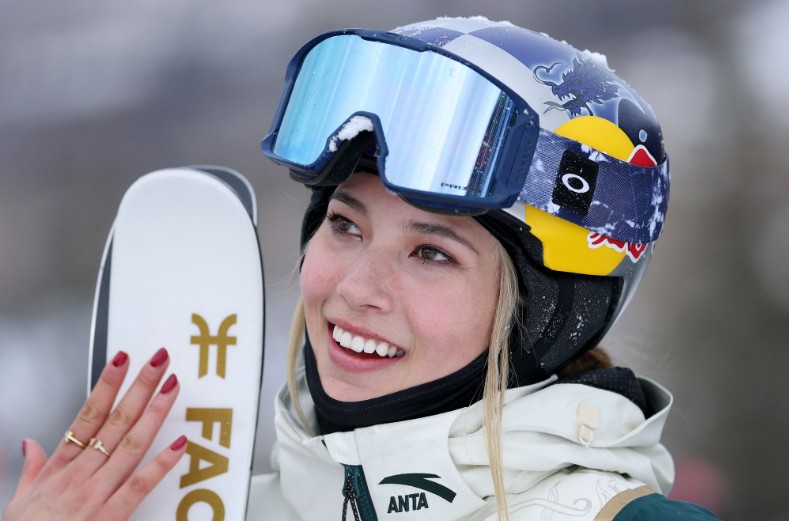
Whether she is walking a fashion runway, amping herself up at the top of a mountain or digging into one of those physics lessons she takes “for fun,” Olympic champion Eileen Gu can probably boil down her main goals to these: Do her best. And bring as many people along for the ride as possible.
The world’s best overall freestyle skier has made reaching those goals look remarkably easy over her frst four years in the spotlight. So easy, in fact, that it can sometimes also be easy to overlook how hard it really is.
"You know, we're all risking our lives out here," she said with a laugh, while contemplating a more in-depth answer about a question that everything eventually seems to come back to with her: How much weight does she put</a> into all the opinions about her choice to compete for her mother's home country, China, despite being born and raised in California?
The 22-year-old multitasker will, in fact, put her life on the line somewhere between 10 and 15 times at the Milan-Cortina Games, trying to duplicate her feat from four years ago when she won medals in all three of freeskiing's inherently dangerous disciplines - halfpipe, slopestyle and big air.
She will do it inside a cauldron of Olympic pressure, magnified by the geopolitical forces that typically come with the Games and, when the Winter Games roll around, often focus on her.
Lots of folks have takes on Gu. Some of it, she says, descends into “vitriol.” It ranges from “people who thought I wasn't Chinese enough” when she dyed her hair blonde to those who find fault in her choosing China over the United States, especially with the two major powers increasingly in conflict.
"I can focus my attention on the places where I personally have the most interest and impact, and work as hard as possible to make as much good in the world as I can,” Gu said. “And to wish the people who disagree with me to use that energy and make the world better in their own way instead of directing it at me. That’s all I can hope.”
As for her bigger goals - they remain on track.
She told of recently visiting a rural part of northern China and checking out a small ski hill they built for kids, where they offer free ski rentals and lift tickets. It was a strong indicator, she said, of the way snow and action sports are growing in China.
Gu did something unusual for herself this school year. The young woman who graduated high school a year early and was aiming for something similar in college gave herself a break at Stanford so she could focus on skiing. She also heeded the advice of friends (maybe professors and college counselors, too) and decided to major in international relations and simply take quantum physics classes "for fun."
"It's wonderful to see how the world works on a granular level,” she said.
Along with her classes at Stanford, she joined the chess club, a book club, a sorority and formed a basketball league. A highlight from a recent trip to Saas-Fee in Switzerland, where Olympic daredevils go to train, was rounding up a physio trainer from the Chinese team, a Brazilian athlete and some members of the US team for a pickup hoops game at a local school. “The idea of sports being able to bring people together really is somehting I subscribe to wholeheartedly," she said. "I've implemented it pretty naturally throughout my life, in different ways. I just believe in it.”
The same woman playing hoops in Saas-Fee was the one you've seen on dozens of magazine covers, or modeling in Paris, Shanghai, Barcelona and on runways in Milan, the global fashion center that is also co-host of the upcoming Olympics. Some athletes feel suffocated by the obligations that fame brings. Gu says she embraces it.
She posts handwritten journals on her social media feeds on topics like mental health, communication through sport and overcoming obstacles.
"I really try to do something with my platform. That makes (fame) feel fulfilling and meaningful, as opposed to this deadweight burden, which I've never felt.”
ASSOCIATED PRESS