Read More


Hang Seng HK-US TECH Index to add SpaceX
15 hours ago


Nine-day rainy spell to hit HK with heavy showers and thunderstorms expected
11-06-2026 22:45 HKT

ICC chief hails Hong Kong as dispute resolution hub
08-06-2026 07:20 HKT
When Beijing's private tutoring overhaul caught education companies and global investors off guard at the end of July, Alice Sui, a stay-at-home mother, was thinking: where should I send my daughter to continue her lessons?
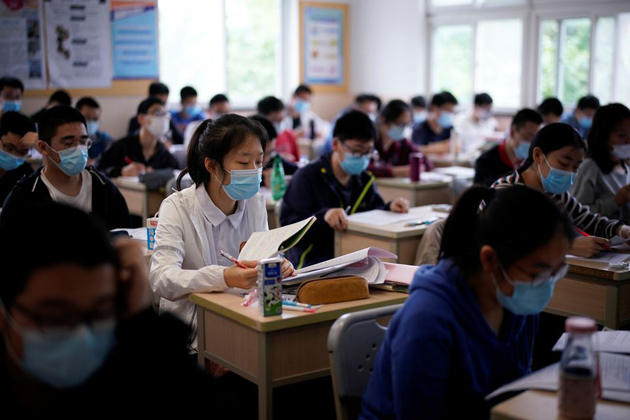
Sui's 13-year-old daughter has spent at least 25 days each summer vacation in cramming classes since she was a pupil. Even in the summer before middle school, the young girl was learning math, Chinese, English from 7:30 am to 3:30 pm each day in New Oriental Education & Technology's (9901) tutoring center in Dalian, Liaoning province. After classes, she did homework and revision till bedtime.
The 33-year-old mother worried her only child would fall behind her classmates.
"Other children are all taking extra classes, and so must we. If she doesn't get prepared, how can she get into a senior high school?" Sui asked.
Beijing said the sprawling tutoring firms are mainly to blame for rising education costs and mounting parental pressure, which would deter people from having more children and exacerbate ongoing population aging. The recent clampdown is China's latest effort to make education more affordable and fairer, as top economists in the country warn that the third-child policy can't reverse the falling birth rate.
However, investment houses said new regulations are far stricter than expected. After losing billions of dollars, some private equity funds are seeking to claw back their money. Tutoring companies are struggling to survive and might be forced to lay off staff, cut tuition fees, give up the most lucrative business, or delist from the secondary market.
The new policy is less likely to alleviate parents' anxiety, many of them said. It will treat a symptom but not the cause of education inequality, scholars added.
On July 24, the State Council released a notice to lighten the burden on homework and after-school tutoring for young students. The new rules ban after-class tutoring firms from providing subject classes during weekends, public holidays as well as summer and winter vacations, while interest classes like sports and art are not affected.
Companies teaching compulsory subjects are not allowed to raise funds from stock markets and foreign investment, which is the main reason behind a stiff sell-off from Wall Street to A-share markets. Two of the largest players, New Oriental and TAL Education, have slumped by about 70 percent in Hong Kong and New York.
"The off-campus tutoring sector has been hijacked by capital," a spokesman of the Ministry of Education said earlier. Fueled by capital, these companies keep burning money for advertising and marketing, which ramped up parents' anxiety, the spokesman said, citing President Xi Jinping's comments in March.
Children's education has become the "most commonly seen anxiety" among China's middle-class people, with 45 percent prioritizing it in their daily lives, according to Hurun Report's survey in 2019. In the same year, a report from Shanghai Consumer Council showed that 78.4 percent of families in Beijing, Shanghai, and Shenzhen sent their kids to cram schools. They spent 16,000 yuan (HK$19,200) per year for additional education on average, accounting for 9.4 percent of household income.
China offers nine-year compulsory education for free, covering six years in primary school and three years in junior secondary school. Tuition for a senior high school student is a few hundred yuan a semester.
Children in China are facing fierce peer competition. Only half of students can enter senior high schools and get the ticket to Gaokao, the college entrance examination, as Beijing has been encouraging vocational education in an effort to reform its exam-focused education system.
About 10 million students attend Gaokao every year. Only around 40 percent of them can proceed to undergraduate education, less than 2 percent can move to the 39 top universities.
Ambitious parents are not willing to see their kids becoming blue collars.
Patricia Chen, a senior treasury manager at a listed company in Fujian province, said she can't accept her three-year-old daughter going to a technical school. "My bottom line is tier-one universities. To be fair, my company will not consider candidates who don't graduate from there," she said.
Institutional investors had seen mainland parents' demand as a huge opportunity. Chinese educational companies raised a total of 63.8 billion yuan in 2020 from high-profile investors, including Softbank, Tencent (0700), Sequoia Capital, and Hillhouse Capital, according to ITJuzi, a business data provider. About 73 percent of money flowed into the K12 companies, which provide school subjects during compulsory education and senior high schools.
The coronavirus pandemic further boosted the valuation of online learning providers. By charging tuition upfront, tutoring firms are easier to achieve strong financial data. The mainland online education market is estimated at 485.8 billion yuan in 2020, double the size in 2016, according to consultancy iiMedia Research.
After the July's statement, nearly all major investment houses and rating agencies downgraded education stocks to "underweight". Goldman Sachs expects the whole mainland tutoring market will shrink by 76 percent to US$24 billion (HK$187.2 billion) in 2025 from US$100 billion last year.
"Few of us expected the regulator would take such a one-size-fits-all approach. We thought they might shorten the school hours, rather than banning classes the whole vacations and holidays," a banker said.
Listed private education providers have warned the new regulation will have a significant impact on operations and finances. New Oriental and TAL Education canceled their earnings releases. New York-listed Gaotu Techedu is reportedly slashing more than 10,000 jobs or a third of the staff. Dali, the education arm of ByteDance, issued layoff notices last week.
The major K12 companies would switch their business to quality education, high school subject courses, vocational training, and technology to facilitate teaching and learning in public schools, as the new rules do not apply to these areas, analysts from CITIC Securities expect. But as long as the current exam-oriented system is unchanged, demand from parents will remain high and the market will become more fragmented, they said.
"The boom of tutoring school is the consequence of parents' anxiety, rather than the cause," said Yi Lin, Professor and head of department of sociology at Xiamen University.
Education has long been seen as the only tool for social mobility in China, Yi said. Achieving a high score in Gaokao is considered the only way to break the class ceiling by many poor or average families.
To some degree, Gaokao does help to achieve equality, but this is fragile, he said. As long as families don't have similar resources and cultural capital, children would always live with unfair competition, so it has been becoming harder for poor students to get into a good university.
In 2020, nearly 50 percent of Beijing students went to the tier-one universities. That compared with 13.6 percent in Henan, one of the poorest provinces in China.
"We should stop instrumentalizing education and provide more diversified options for children,'' Yi said. "The best way to do that is giving play to the private sector, however, it is what regulators don't want to see."
"We have to dance with shackles," he said.
Sui's daughter continued her studies in tutoring schools this summer, as the local government has not yet implemented the new rules. But she might seek some one-on-one tutors for the next few years.
"No matter what, parents will figure out new ways to tutor their children, and we will follow them," she said.