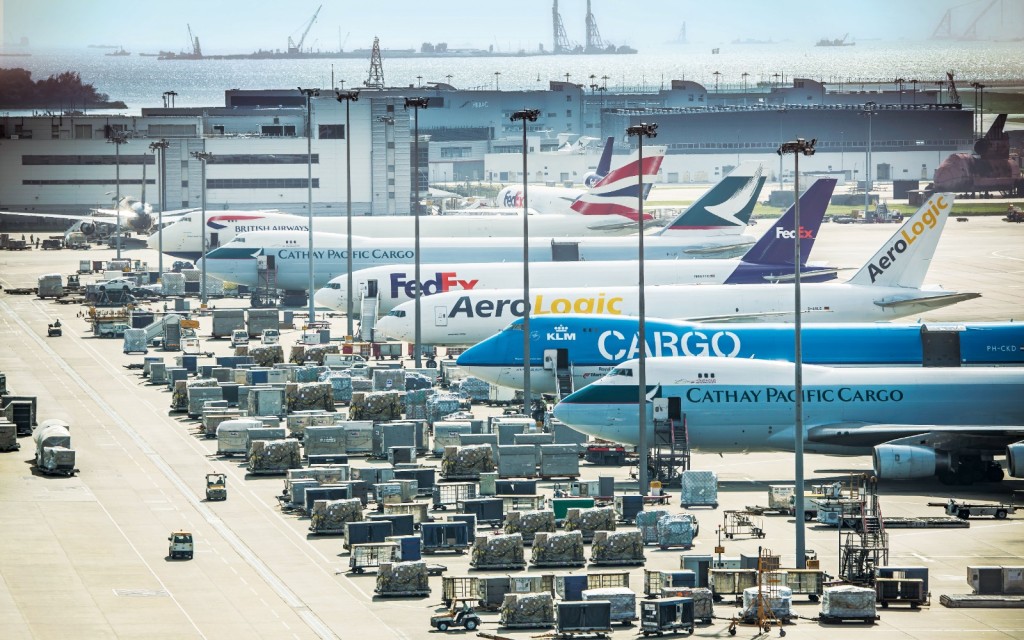
The Hong Kong International Airport, with 4.9 million tonnes annual international freight throughput last year, was named the world’s busiest international cargo airport again. The HKIA has claimed this position 14 times since 2010, benefitting from an advantageous geographical location that enables its flights to reach half of the world’s population within five hours, and an extensive airlines network that connects over 200 destinations around the world.
Despite the uncertain global economic environment, the HKIA, not wishing to rest on its laurels and with the need to face keen competition among other airports, continues with its fast momentum to retain this world-leading position.
The third runway, commissioned last November, raises HKIA’s cargo handling potential to 10 million tonnes annually. Recently, it was reported that Airport Authority Hong Kong and the Civil Aviation Department have been working together on new measures to flexibly allocate the use of the three runways to further enhance their efficiency.
The South Runway, nearest to the cargo apron, will continue operations after midnight when cargo handling is busiest. From 2am until 7am, the South Runway will be on standby, while the North or Centre Runway will operate in single-runway operation mode.
Since 2021, AAHK has introduced “HKIA Cargo Data Platform,” seamlessly connecting airlines, freight forwarders and cargo terminal operators into a unified digital network. The platform was recognized as the “Air Cargo Technology Provider of the Year” at an international awards ceremony last year. Now, it serves over 530 freight forwarders and related companies, more than 130 airlines, and three air cargo terminals.
AAHK chairman Fred Lam and staff at a data summit. (Photos courtesy of HKIA)
This year, AAHK takes another step forward to roll out “HKIA Cargo Connect” scheme– the world’s first airport-led initiative –facilitating airline partnerships through an innovative, intelligent and interconnected digital ecosystem.
By connecting airlines across the globe, HKIA Cargo Connect aims to reinforce HKIA’s position as a preferred global air cargo hub and help reshape the international air cargo landscape.
It will enable intelligent matchmaking for airline partnership and induces more interline transshipment opportunities for airlines using HKIA as their cargo gateways. Leveraging this digital connectivity, airline communication can be strengthened to foster more business opportunities for all.
Streamlined data means more than speed as it allows easier trade. HKIA Cargo Data Platform provides a basis for AAHK to further collaboration with banking and financial institutions, such as the Hong Kong Monetary Authority’s Commercial Data Interchange Platform, to help streamline trade finance processes and enhance credit risk management.
This empowers small and medium-sized enterprises in the logistics and trading sector, giving them more convenient and timely access to capital that fosters growth and long-term competitiveness.
In this digital age, the e-commerce revolution is redrawing the global cargo map. Hong Kong is well-positioned at the node of the global network as it is one of the few airports in the world that are busy in both passenger and cargo traffic.
The versatility of e-commerce is particularly important, as with both cargo freighters and passenger flights operating at high frequencies to major cities, HKIA offers an efficient conduit for online purchases, ensuring goods will reach various destinations across continents with remarkable speed. In this era where convenience and connectivity drive expectations, such an advantage will obviously be welcome.
Leading operators in this sector have already taken note of Hong Kong’s potential and launched developments in HKIA. These include Cainiao Smart Gateway, a world-class advanced premium logistics facility developed by Alibaba Group’s logistics arm, the expansion of DHL’s Central Asia Hub, and United Parcel Service’s new facility. The active participation of these giants signals an emerging, integrated fulfillment center for Asia, if not the world.
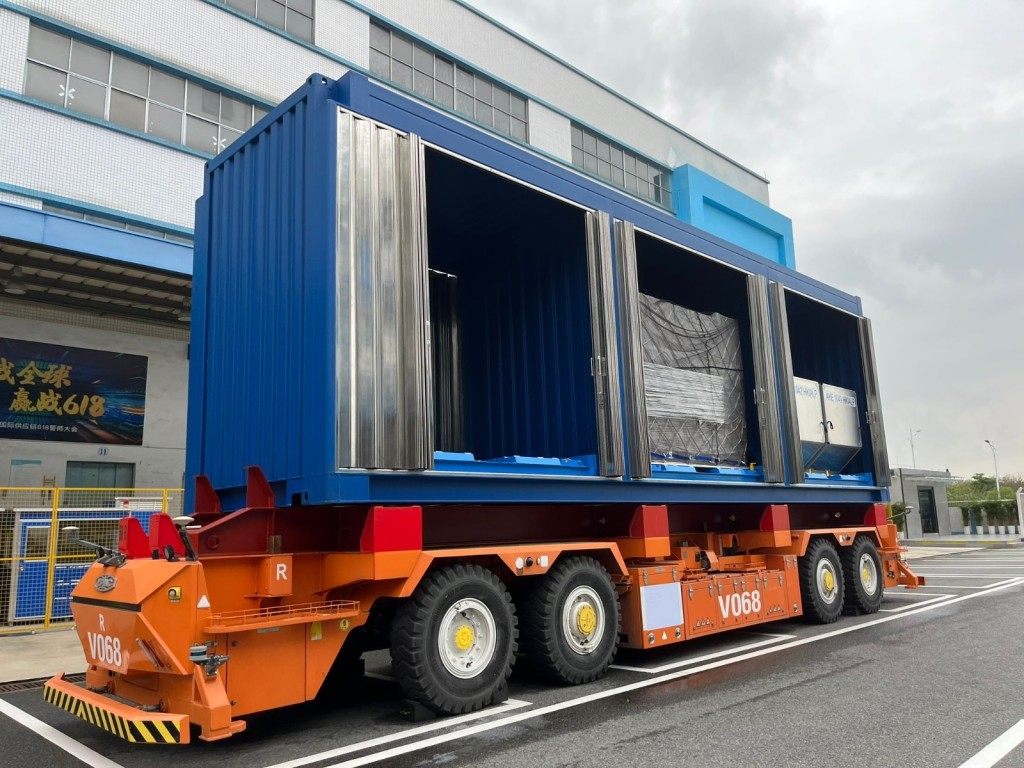
an automated guided vehicle and customized container at Dongguan Logistics Center. (Photos courtesy of HKIA)
Hong Kong’s strategic position has made it the gateway to the Greater Bay Area. The HKIA already handles around 70 percent of the GBA’s international air cargo. To make the most of this opportunity, a pioneering sea-air transshipment model has taken shape: cargo is processed upstream at the HKIA Dongguan Logistics Park, with security screening, palletization and cargo acceptance activities, before being sent downstream by sea to the HKIA for onward air shipment across the globe.
This innovative approach is expected to trim operational costs by roughly 50 percent and slashes handling time by nearly 33 percent, underscoring Hong Kong’s role as an agile and cost-effective logistics powerhouse. According to AAHK’s figures, from April 2023 to June 2025, the value of cargo shipped using this service grew to around 30 billion yuan (HK$32.78 billion).
There are now over 25 airlines and over 130 international cargo forwarders operating in this park. The construction of the permanent facility for the park commenced in December last year. When the first phase of this permanent facility is completed, it should be able to handle one million tonnes of cargo annually.
Flexible use of three-runway system, cargo trade digitalization, e-commerce and connectivity to GBA are the prime movers of this air cargo business. The collective efforts from the airport community in these areas not only keep Hong Kong atop the cargo world but will provide a strong driving force to Hong Kong’s economy.
Veteran engineer Edmund Leung Kwong-ho casts an expert eye over features of modern life