There is no dispute that STEM education is vital to prepare our schoolchildren for the future when technology will be an essential element of basic knowledge. But the present STEM education tends to train children for IT and software knowledge, ignoring the need to acquire the necessary electrical and mechanical engineering skills that are based on foundation knowledge of chemistry and physics they learn in their school curriculum.
No matter how knowledgeable they may be in software program and IT, eventually all systems depend on the application of electrical and mechanical engineering principles to convert their software programming ideas into actual work done. Pure software knowledge of STEM education therefore has a lot of limitations unless they can be integrated with application hardware.
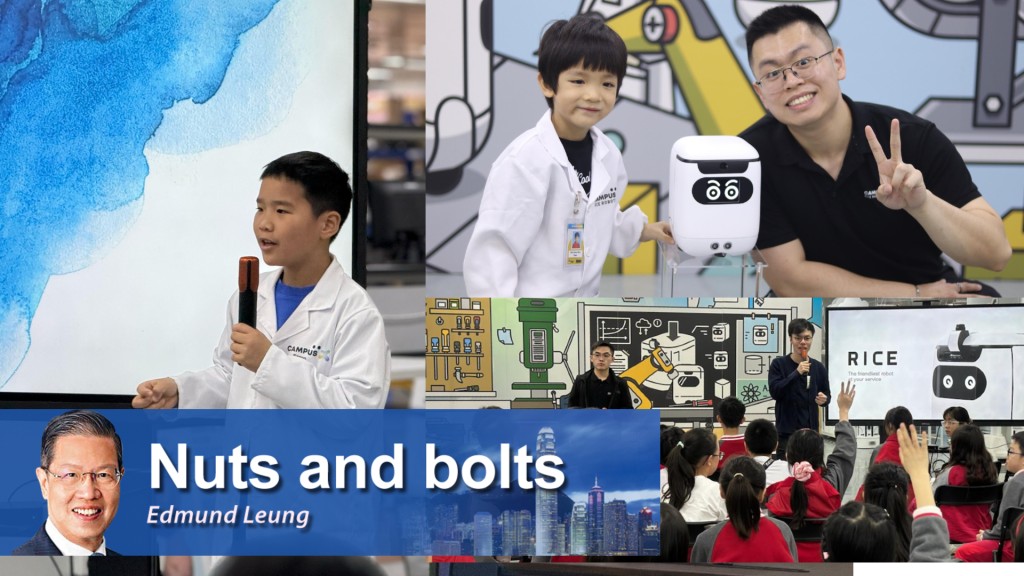
It is gratifying to find an organization that believes in this and trains children to apply their thoughts to actual physical operations. They use robots as a tool.
As an associated organization to a robot manufacturing factory in Tsuen Wan, its STEM education initiative draws on the factory’s technological expertise and access to professional equipment.
By leveraging available resources during the quieter weekend periods, the program allows primary and secondary school students to explore how their ideas can be translated into functional robotics applications, bridging classroom knowledge with real-world engineering experience.
The company manufactures robots for a wide range of commercial applications, from vendor to delivery and patrol purposes. But for STEM training, the smaller handheld robots are used to help children develop their skills in entrepreneurship, hardware and software engineering, as well as machine learning.
Simple tools for grabbing objects, for holding mobile phones and video cameras for surveillance allow the robots to perform some superficially simple tasks designed by these schoolchildren. Examples can be for 24-hour surveillance of their grannies in case of a fall, picking up food plates or cups, and a whole variety of other useful actions.
The tools and components which accept the software commands from the robots are usually made by 3D modeling followed by printing, as it allows complicated shapes and forms to be manufactured in small quantities for this purpose.
The training staff provides expert advice to guide children to produce effective designs that are nimble enough to move in a wide variety of modes and directions, mimicking the movements of human limbs, to grab objects or to take video shots.
Another example of STEM education includes a robot that moves along a certain path to reach a destination for delivery or for surveillance. Children learn how to measure and plot the locus of the route, converting the circumference of the robot wheels to linear distance and the direction of travel.
Mathematics theories they learned in school are applied in actual physical models, significantly inspiring them to understand the theories of mathematics and the basic scientific knowledge they learn in schools.
Their training is comprehensive, robust but practical, covering a whole range of skills including product design, software development, hardware engineering and presentation skills.
Children who complete the full training course will not only reap the benefits of a STEM education, but also gain communications skills honed during the presentation of their projects.
Trainers have been pleased to see that autistic children saw marked improvements in communicating with other people – talking with ease and confidence – after these robot training lessons.
Another innovative element of the program is giving children the opportunity to pitch their ideas directly to professional investors.
These sessions introduce them to the concept of an “elevator pitch,” a concise and persuasive presentation of their product idea, typically delivered within a minute or two, aimed at capturing the interest of potential backers. Investors are invited to offer real monetary support to help promising student projects move from prototype to small-scale production.
This hands-on exposure to entrepreneurship not only builds confidence but also gives children a head start in understanding how to communicate, persuade, and launch their own innovations. Additional encouragement comes in the form of exclusive masterclasses delivered by leaders in the technology and finance sectors.
This initiative, launched just over a year ago, received an enthusiastic response with over 3,000 registrations during its inception. In its first year, the program successfully served more than 400 local students through hands-on robotics training.
Most participants have described the experience as both inspirational and rewarding.
Building from this momentum, the team is now expanding its reach to international markets, with upcoming programs planned in the United Kingdom, China and Singapore.
I had the opportunity to visit their training site and witnessed their training activities and am convinced that this is a novel but effective training course for schoolchildren. I also admired and envied that they have gained robust and practical STEM knowledge while engaging in their weekend hobby exercise.
I hope these children will grow up to become leading innovation and technology expert engineers one day.
Veteran engineer Edmund Leung
Kwong-ho casts an expert eye over features of modern life