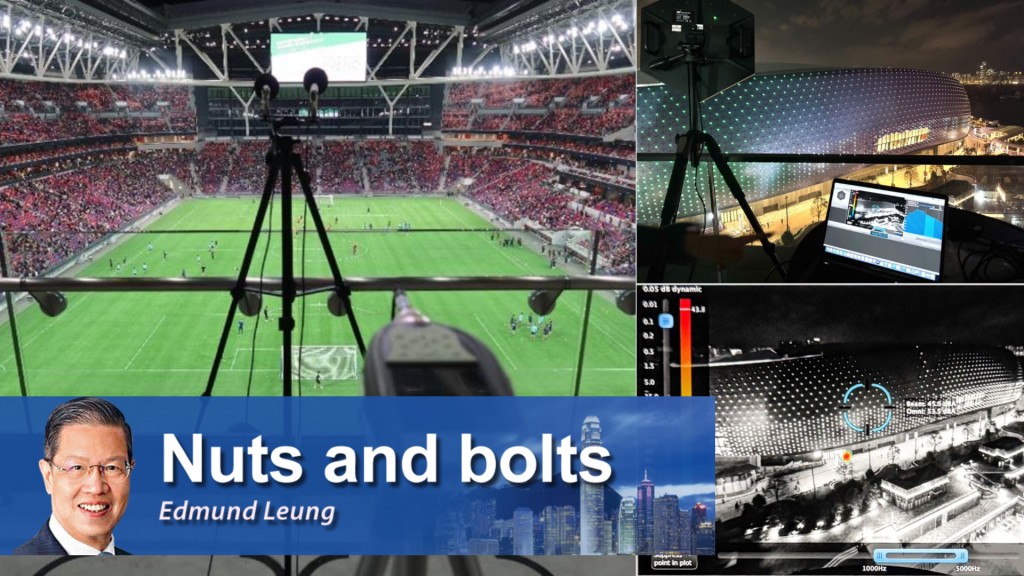
The new Kai Tak Sports Park has now opened for world-class sports and music events to be held at its 50,000-seat main stadium, together with ancillary facilities for regional and local events.
Some of us may remember another venue, the So Kon Po Stadium – slightly smaller, but originally conceived for similar purposes. Located at the bottom of Happy Valley, it ultimately failed to deliver as the noise generated during events, especially those with musical performances, adversely affected residents in the neighborhood.
Unfortunately, with the standard stadium design in that era, it did not allow for the attenuation of noise to its surroundings. The noise generated during events proved to be a nuisance to Happy Valley residents, even from hundreds of meters away. The facilities were therefore underutilized, much to the disappointment of performers, companies renting suites, and the general public.
For the Kai Tak Sports Park, its developer and the government ensured that these specific shortcomings would not materialize. The stadium’s design incorporates an acoustic enclosure, with service areas, function rooms and suites in the outer part, forming an effective sound barrier, shielding all four sides of the stadium proper to contain any noise generated within.
The open roof incorporates a retractable covering that can be closed for weather protection, but even when fully open, noise will not spread horizontally to neighboring residential and commercial buildings. The many sports and music events held there successfully since it opened have proven that noise levels in the surrounding areas did not exceed specified limits.
In fact, the enclosure is acoustically so effective that it can contain loud noises inside the sports park of up to 120 A-weighted decibels – equivalent to percussive piling noises – such that in nearby residential buildings, sound can be attenuated to about 60 dBA, with the roof closed. This is possible because the nature of sound propagation is generally in a straight line, and therefore, as a rule of thumb, what one cannot see cannot be clearly heard.
There is a huge glass window at one side facing the harbor, but with double glazing, the noise that escapes through it will only travel toward the direction of the water, and not to the neighborhood.
The movable roof cover is 1.5 meters thick, made from layers of acoustic fiber, cement boards, and air spaces, with aluminium sheets outside, light enough to open and close as necessary. The composite materials have proven to be excellent in filtering out noises – equivalent to sound being muffled by a 400-millimeter concrete wall.
Noise measurements in nearby residential buildings showed that, at full play in the stadium with the roof open during the Rugby Sevens, the noise only reached 55 dBA to 58 dBA as per ambient noise level, much lower than the specified level of 65 dBA by the Environmental Protection Department. Similarly, during a music performance, the sound emitted was not detectable from a hotel almost adjacent to the stadium.
Given the first-hand experience, events can basically be held around the clock with the roof cover closed from a noise perspective, while the open roof can serve all kinds of daytime activities, making it a truly multipurpose stadium. So far, the only noise complaint was from activities outside the sports park.
But would this acoustic design – attenuating noise propagation – affect the enjoyment of those attending events? Not at all.
A carefully placed speaker system within the stadium ensures that even when bands play at full blast, spectators would enjoy an optimum sound experience at the stands, while noise levels in the park’s vicinity fall well within statutory limits, garnering continual approval for this facility to be used for mega music events.
Once again, it has been successfully demonstrated that with effective planning under the Environmental Impact Assessment Ordinance and the Town Planning Ordinance, it is possible for engineers, architects and planners to design facilities that allow full enjoyment for spectators while ensuring that any noise generated does not adversely affect residents in surrounding neighborhoods.
A modern city needs sports and events facilities, but with limited available land, residential and commercial buildings are likely to be in close proximity.
Successful coexistence of mega-event venues and neighborhoods that guarantee the necessary comfort for its occupants is a challenge. It is gratifying to see that in this instance, it can be achieved successfully.
Veteran engineer Edmund Leung Kwong-ho casts an expert eye over features of modern life