
Read More
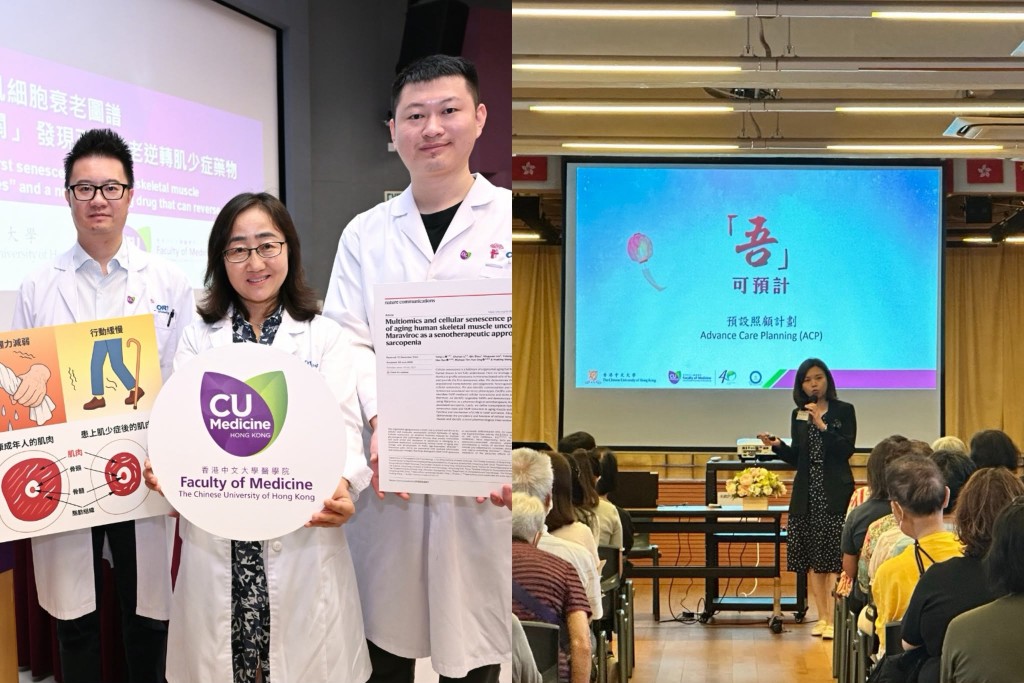
Two interdisciplinary research projects led by The Chinese University of Hong Kong (CUHK) have secured about HK$46.3 million in funding from the Research Grants Council (RGC) to tackle age-related muscle loss and improve end-of-life care planning through artificial intelligence and biomedical technologies.
ADVERTISEMENT
SCROLL TO CONTINUE WITH CONTENT
The grants were awarded under the council's Strategic Topics Grant for 2026/27.
The first project, titled “Combating Aging-Associated Sarcopenia: From Knowledge Discovery to Intervention Testing,” received HK$24.925 million.
Led by Professor Wang Huating of the Department of Orthopaedics and Traumatology, the project aims to combat sarcopenia, an age-related muscle loss condition affecting up to 27 percent of older adults.
The multidisciplinary team will combine AI engineering and biomedicine to understand muscle deterioration, build an AI-assisted drug discovery system, and conduct clinical trials for new treatments.
Another project, titled “Building an Artificial Intelligence-Enhanced Platform for One-Stop Advance Care Planning Model,” was awarded HK$21.4 million.
Led by Professor Helen Chan Yue-lai of the Nethersole School of Nursing, this team will develop an AI-powered platform to streamline end-of-life decision-making.
The platform will include AI decision-support tools for families, automated documentation, and communication training for healthcare staff. It will be piloted across 24 local community care units and residential homes.
CUHK Pro-Vice-Chancellor Professor Jiang Liwen welcomed the funding, noting that an aging population is a vital catalyst for healthcare innovation.
“These projects showcase CUHK’s unique interdisciplinary strengths and synergy across AI, geriatrics, nursing and translational clinical research, while transforming research results into tangible societal benefits,” Jiang said.