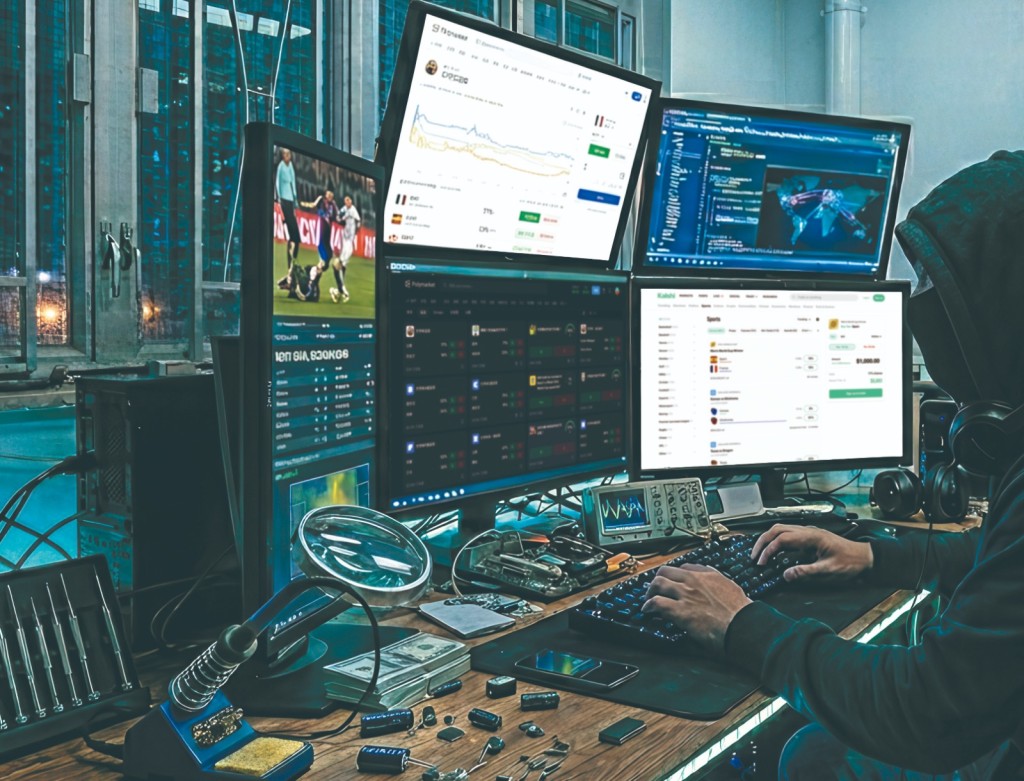
As the 2026 World Cup prepares to kick off with an expanded format, experts are warning that illegal gambling syndicates are infiltrating cryptocurrency-based prediction markets.
These platforms are increasingly being used to manipulate in-game micro-events, putting everyday retail bettors at significant risk of being exploited by large-scale operators with insider information.
The allure of a growing gambling landscape
The highly anticipated 2026 World Cup will begin with the opening match between Mexico and South Africa in the early hours of June 12, Hong Kong time.
A major change in this year's tournament is the expansion of the finals from 32 to 48 teams, increasing the total number of matches to 104.
While this expanded format is expected to yield unpredictable results, insiders warn it also elevates the risk of illegal gambling syndicates manipulating games.
Prediction market platforms, which have surged in popularity recently, are expected to be flooded with trap bets focusing on micro-events like corner kicks, yellow cards, red cards, and offsides, specifically targeting addicted gamblers.
These cryptocurrency prediction platforms have rapidly transformed into a new type of casino for younger demographics. A recent university graduate in Hong Kong, operating under the pseudonym Jayden, shared his experience of falling into this gambling habit.
He was introduced to a platform called Polymarket six months ago through his cryptocurrency investments. Initially gambling on which artificial intelligence model would win a tech evaluation, he lost his money but formed connections with international users.
Despite not being a traditional gambler, the young user soon found himself gambling on various sports simply to support his favorite teams. He developed a severe habit, placing wagers ranging from hundreds to thousands of dollars even while at work.
The platform's extremely low entry barrier, which allows bets of less than a single US dollar, and its simple interface fueled his continuous gambling. He eventually suffered significant losses during the NBA playoffs after blindly gambling on a team without realizing their star player was injured, highlighting the dangers of gambling without adequate research.
Micro-events and market manipulation
The prediction market industry has experienced explosive growth, with trading volumes jumping 300 percent to US$64 billion last year, covering virtually every sport imaginable, from football and basketball to esports and horse racing. Individuals familiar with illegal gambling operations indicate that the most significant hidden dangers in the upcoming World Cup stem from these platforms.
Promoted under the guise of decentralized predictions and smart contracts, they trick many into believing they are fair, transparent arenas, while actually breeding a new generation of gamblers and serving as fresh territory for global crime syndicates.
The expansion to 104 World Cup matches creates numerous low-stakes games, such as final group stage matches between already-eliminated teams or fixtures with massive skill disparities but little star power.
Insiders suggest these specific matches provide perfect opportunities for illegal bookmakers to set massive trap bets on prediction markets.
While traditional betting markets focusing on final scores face strict scrutiny from regulatory bodies and organizations like FIFA, prediction markets heavily feature micro-events that are much easier to manipulate.
Syndicates take advantage of the vast wage differences between elite European leagues and the regional leagues of weaker national teams.
By offering relatively small bribes, they can compromise players on weaker teams to intentionally commit fouls for yellow cards or deliberately concede corner kicks.
While such actions might not yield massive returns in traditional betting, they generate enormous profits in the micro-event markets.
Syndicates often manipulate retail bettors by placing large, visible bets on outcomes they know will lose, tricking regular users into following perceived data trends.
The syndicates then quietly place massive wagers on the guaranteed outcome, successfully sweeping up the retail investors' funds.
The illusion of a level playing field
Data strongly supports the notion that these markets are heavily skewed. An analysis of 1.6 million Polymarket accounts dating back to November 2022 revealed that 67 percent of the platform's profits were captured by just 0.1 percent of its users.
This elite group of roughly 2,000 accounts amassed nearly US$500 million, demonstrating that successful trading on these platforms is largely restricted to professional entities equipped with massive data resources or insider knowledge.
Additional financial analyses covering the period from early 2025 to April 2026 showed that over 100,000 active wallets on Polymarket lost at least US$1,000 each.
Academic experts emphasize that retail investors naturally become prey in these markets due to severe information asymmetry. Hui KaI-lung, Associate Provost (Academic Development) at the Hong Kong University of Science and Technology, noted that large-scale operators often possess insider knowledge allowing them to anticipate or control outcomes.
Furthermore, he pointed out that many prediction events lack sufficient analytical data, making participation essentially pure gambling.
Tracking the untrackable
Despite the risks, the blockchain technology underpinning these platforms offers a silver lining for law enforcement.
Hui explained that match-fixing is a historical problem, but utilizing transparent blockchain ledgers can actually assist authorities in tracking illegal activities.
He referenced a recent case where an American soldier was caught profiting from insider information regarding the arrest of the president of Venezuela, Nicolás Maduro, on Polymarket, proving that these cryptocurrency transactions are not entirely untraceable.
Calvin Tsai, co-founder of the Hong Kong Program Trading Research Centre, elaborated that blockchains function as immutable ledgers, permanently recording transaction times, amounts, and wallet addresses.
He noted that using blockchain explorers makes tracking the flow of funds significantly easier than in traditional financial markets.
However, the ultimate success of an investigation relies on whether the tracked funds eventually interact with accounts requiring real-name authentication, such as licensed cryptocurrency exchanges in Hong Kong.
If illegal operators transfer funds to these compliant exchanges, law enforcement can easily identify the individuals involved.
The major challenge arises when syndicates utilize complex laundering techniques and cryptocurrency mixing tools to obscure the money trail. Choi cautioned that public perception often suffers from survivor bias, recognizing only the solved cases, while in reality, a vast number of sophisticated match-fixing operations remain entirely undetected.