Hong Kong’s cruise industry is gradually rebounding. The city will welcome 135 international ship calls in the upcoming six-month peak season, which begins in November, comparable to pre-pandemic level of the same period in 2018 and 2019. The fact that various cruise ships will be homeporting in Hong Kong successively confirms the city’s status as an Asian cruise hub. Meanwhile, in late October, Hong Kong welcomed Seatrade Cruise Asia Pacific 2023, the city’s first post-pandemic cruise gathering and Asia’s largest in the industry.
We spoke to two senior executives of cruise companies who attended the conference:
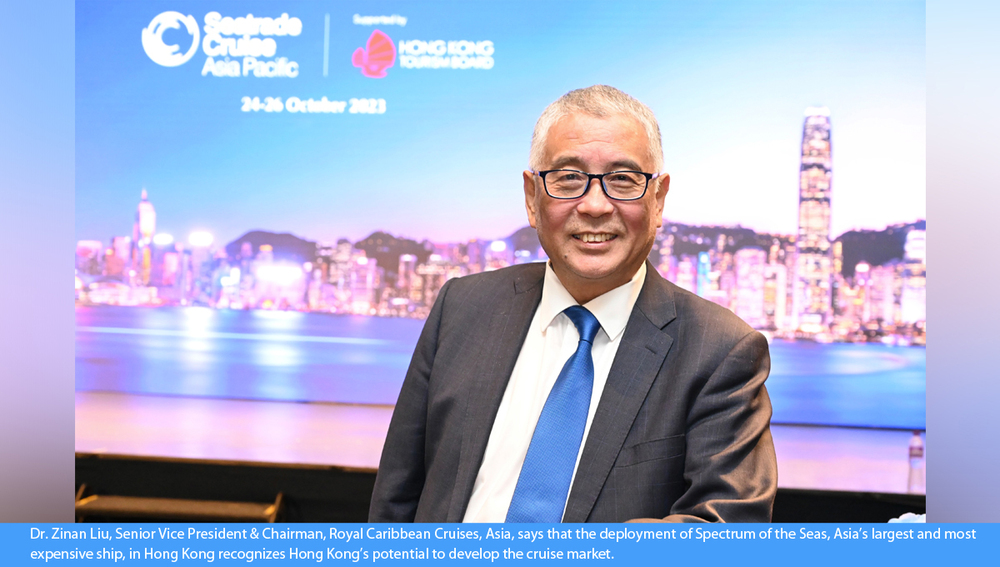
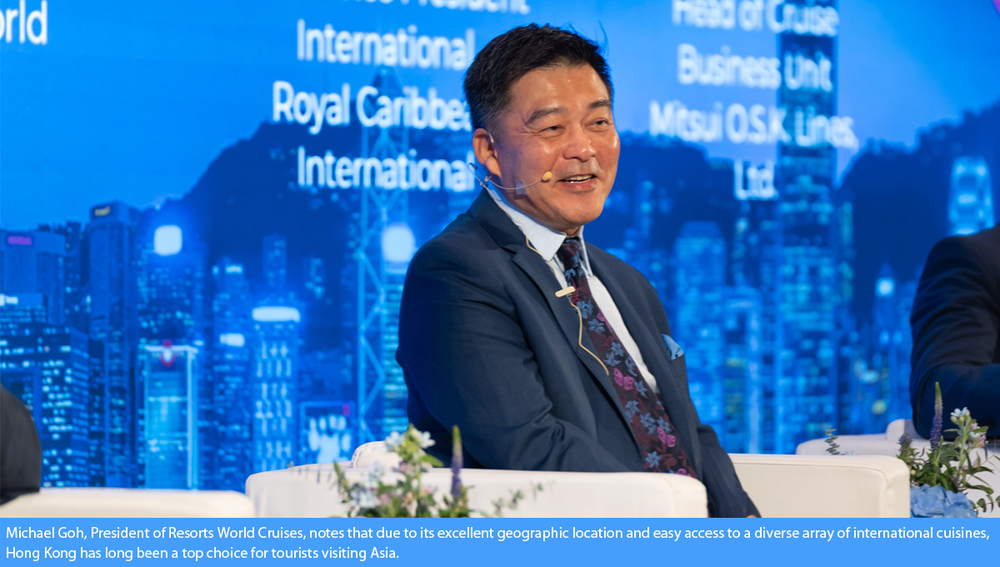
Dr. Zinan Liu, Senior Vice President & Chairman, Royal Caribbean Cruises, Asia, and Michael Goh, President of Resorts World Cruises. Both expressed confidence in the future growth of Hong Kong’s cruise industry, promising further efforts to strengthen Hong Kong’s role as a premier home port destination within Asia.
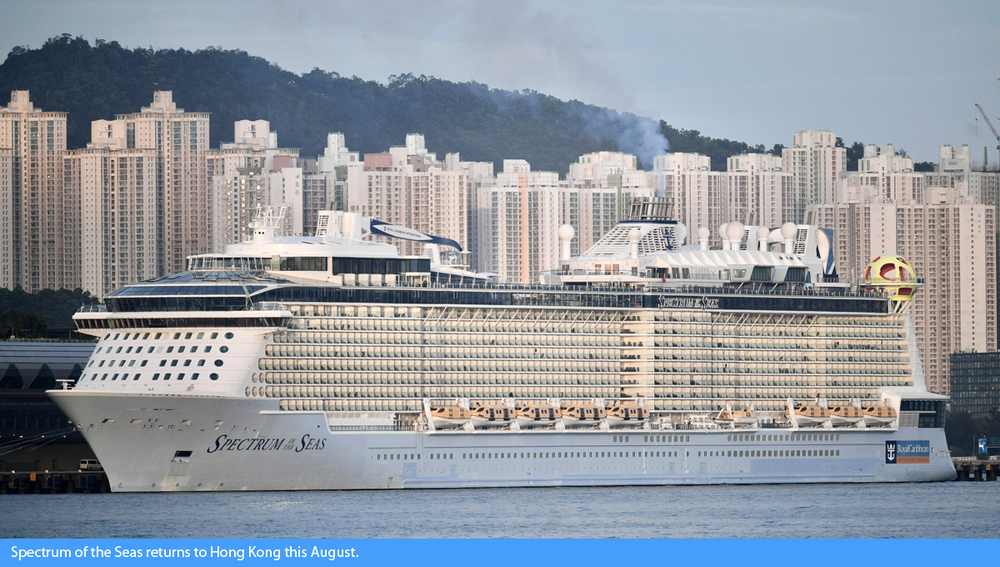
Royal Caribbean Cruises’ Spectrum of the Seas will commence homeport sailings from Hong Kong by the end of next year and early the following year. When speaking about Hong Kong’s cruise potential, Liu claimed that the company positioned its largest and most advanced Asian cruise ship in Hong Kong because they are confident in the untapped growth opportunities ahead for the local market.
He elaborated on factors that make Hong Kong an ideal cruise hub, including its reputation as Northeast Asia’s most cosmopolitan city with versatile transportation interfacing with Mainland and the globe. Additional strengths include its robust local, Mainland, and international sourcing atmosphere alongside a highly internationalized business environment. These attributes, Liu believed, uniquely enable Hong Kong’s potential as a cruise force within the region, emphasizing that he “could not see how Hong Kong’s cruise tourism not flourishing.”
Liu also highlighted that Hong Kong rivals the scenic allure of Miami, the largest cruise origin worldwide. He noted many new drawcards have established in Hong Kong as well, such as the West Kowloon Cultural District generating widespread discussion on social media platform Xiaohongshu. Liu believed Mainland tourists view Hong Kong as possessing distinct advantages over rivals like Singapore, foreseeing brighter prospects for its cruise segment with its allure that differentiates the city internationally.
Liu outlined plans to deepen cooperation across the Greater Bay Area, such as establishing the “Hong Kong-Macao Joint Tour”, which not only aims to highlight Hong Kong’s diverse onshore activities in arts and culture, natural beauty, and other core experiences, but also showcases Macao’s integrated resorts, cultural landmarks and historic districts. The goal is to lengthen travellers’ pre- and post-cruise stays across the two cities when using Hong Kong as the home port. “Accessing both Hong Kong and Macao with cruise experience in one single flight journey provides strong value and appeal to Mainland consumers,” Liu noted.
Similarly, Goh observed Hong Kong’s reputation as global travellers’ top destinations in Asia, with comprehensive development in its aviation hub, attraction, and robust economy from not only the local population but also the vast Mainland and overseas consumer bases, as well as its advantageous geographical location, adding that these are the foundation for unlocking the city’s immeasurable growth potential in cruise tourism.
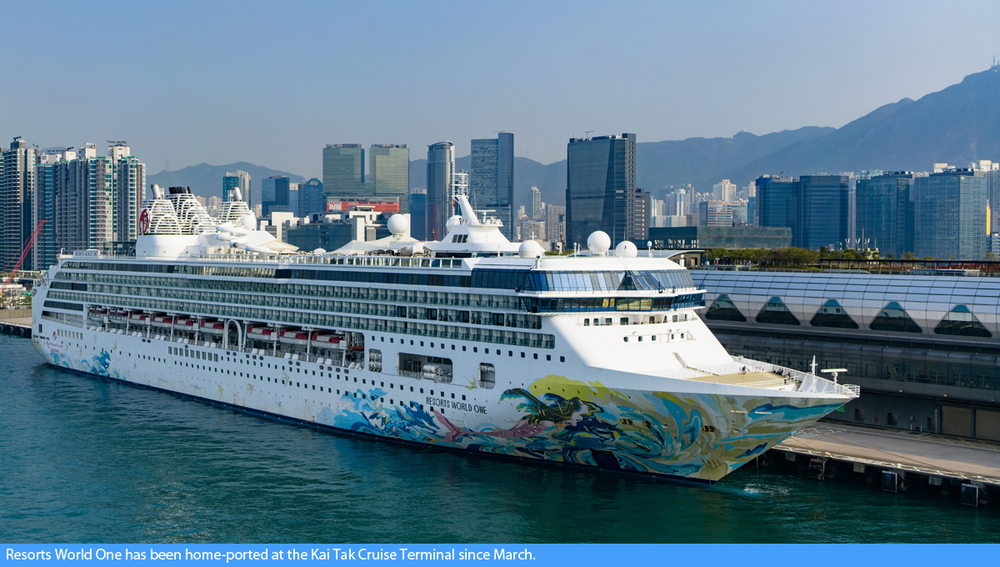
Additionally, Goh highlighted Hong Kong’s distinct East-meets-West cultural dynamics and diverse culinary landscape, allowing travelers to indulge in a variety of global fare at multiple price points, from high-end to local. He personally enjoys Hong Kong breakfast staples like congee and chow mein (fried noodles). Given its strong food culture credentials, Goh noted their company’s Resorts World Cruises tailors unique onboard its cruise Resorts World One with dining experiences and activities for guests, spotlighting the destination’s culinary expertise.
When discussing growth prospects, Goh highlighted the Greater Bay Area as an equally pivotal market. In addition to tight collaboration with Mainland cities like Sichuan, Chongqing, Zhejiang and Hubei, the company has invited businesses throughout the Greater Bay Area aboard its vessels to experience voyages from Hong Kong firsthand, strengthening partnerships across the entire region.
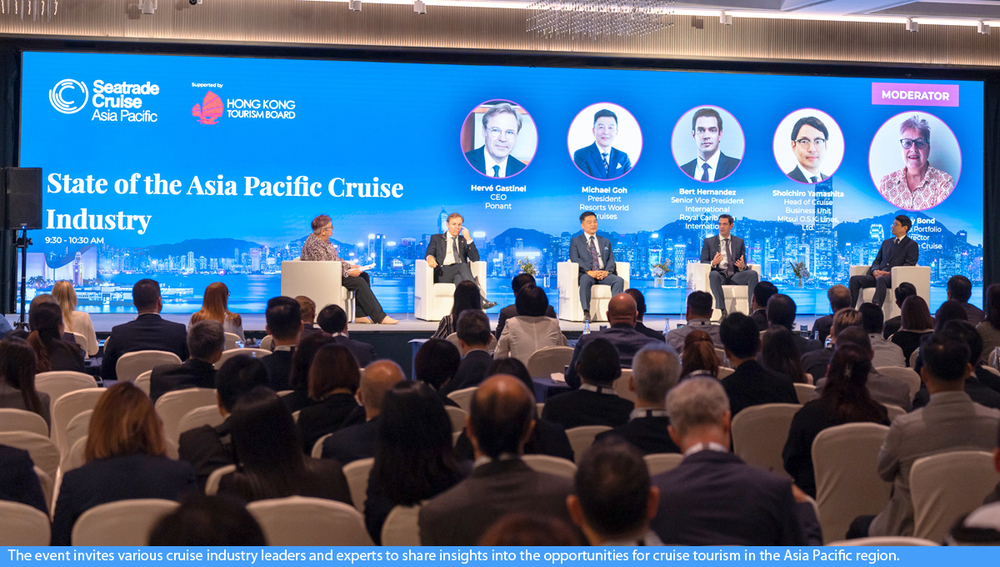
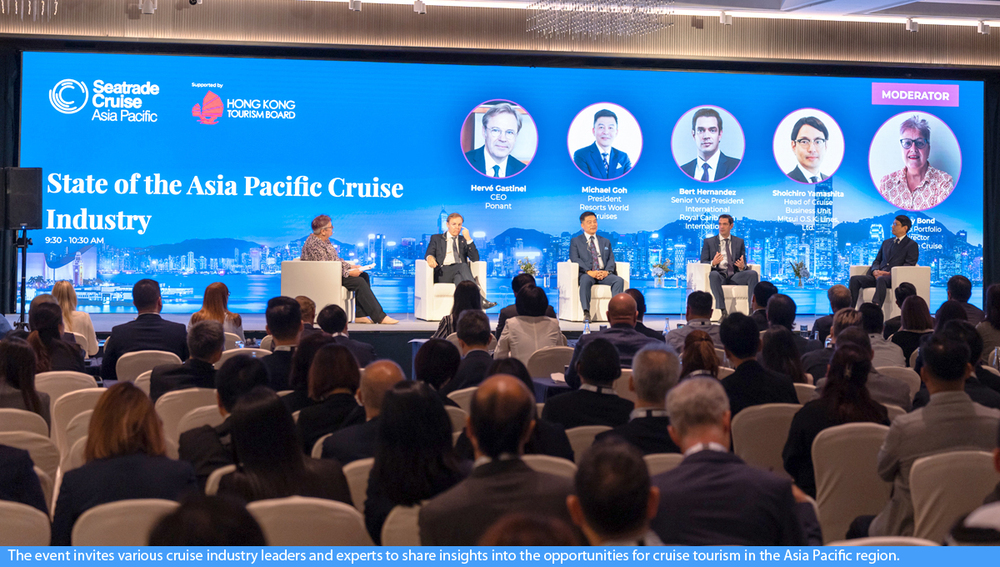
Having taken a four-year pause, Seatrade Cruise Asia Pacific 2023 reconvened under the theme “Rebuilding Asia Cruising Together”. the conference brought together some 300 leading decision-makers from across the global cruise sphere, C-suite representation from 20 international cruise companies, as well as cruise port operators in Asia Pacific and delegates from tourism marketing bodies.
Liu said that the pre-pandemic conference was held in Shanghai. The organizers initially proposed hosting in the Philippines, but Liu felt there were more suitable alternatives. He proposed Hong Kong as a more internationalized locale which could foster deeper, specialized discussions and draw in attendees from destinations worldwide. He described the gathering in Hong Kong as a truly “Asian event”.
HKTB introduces three strategies to boost cruise tourism
To catalyze Hong Kong’s cruise sector recovery, the HKTB has participated proactively in global conferences while enhancing promotions in source markets, To attract ship calls to Hong Kong and boost visitor figures, the HKTB additionally unveiled various funding supports.
Specifically, the HKTB participated in Seatrade Cruise Global 2023 – the premier global cruise conference – in March this year. At the event, the HKTB ramped up promotional activities while showcasing Hong Kong’s comeback onto the world cruise stage through luncheons, panel sessions, and themed programming. Kenneth Wong, General Manager, MICE & Cruise of the HKTB, claimed that cruise firms responded positively during April meetings in Europe with senior leadership from 13 companies, where the HKTB pitched Hong Kong’s prospects of becoming Asia’s premier cruise hub.
The HKTB also treated industry leaders to a snapshot of Hong Kong’s nighttime splendor as it fully endorsed hosting Seatrade Cruise Asia Pacific in Hong Kong. The HKTB hosted the attendees in the “Hong Kong Wine & Dine Festival” at Central Waterfront Event Space. There, they sampled global fare as well as specialties from Hong Kong and Mainland.
Thematic itineraries like this exposed the cruise industry moguls to the destination’s offerings in a way they could then convey enthusiastically to global cruise travelers.
Moreover, the HKTB incentivized businesses to develop attractions and boost ship calls in Hong Kong with supports in finance and visitor experience . Subsidies are provided to cruise lines willing to call on Hong Kong or increase ship calls to the port . Port call fees were also waived on overnight cruises with 24-plus hour stays. Together, these initiatives aimed to maintain strong momentum and support Hong Kong’s emergence once more as a premier Asian cruise destination.
According to Wong, to incentivize cruise firms to establish Hong Kong as either a homeport or departure port while sustaining and increasing cruise calls, the HKTB would remain in close communications. Wong further noted the HKTB would deepen cooperation across the Greater Bay Area to develop industry alliances and jointly run promotional campaigns. The goal was attracting more Mainland and overseas cruise travelers through teamwork with regional lines and ports.