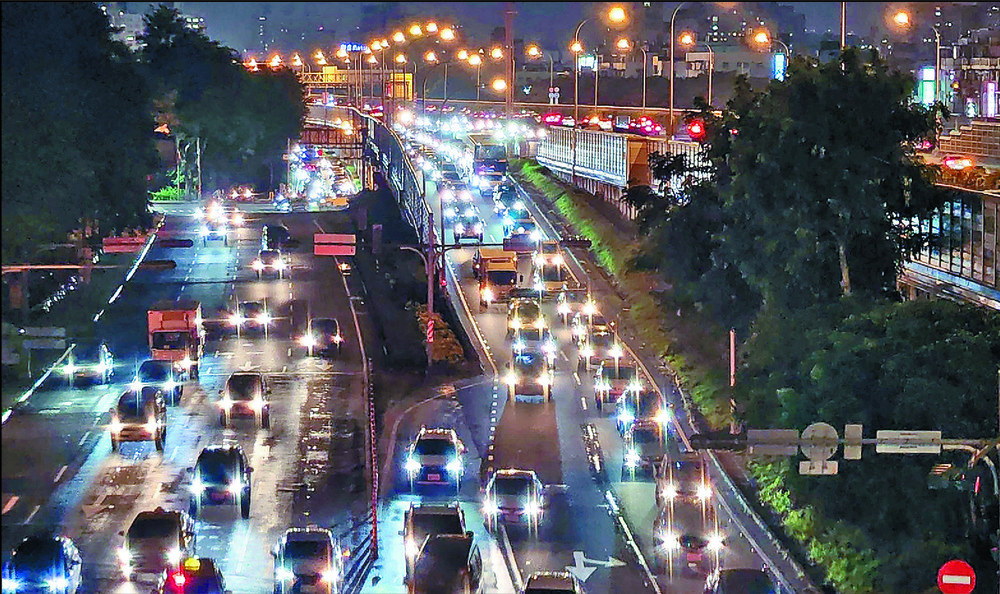
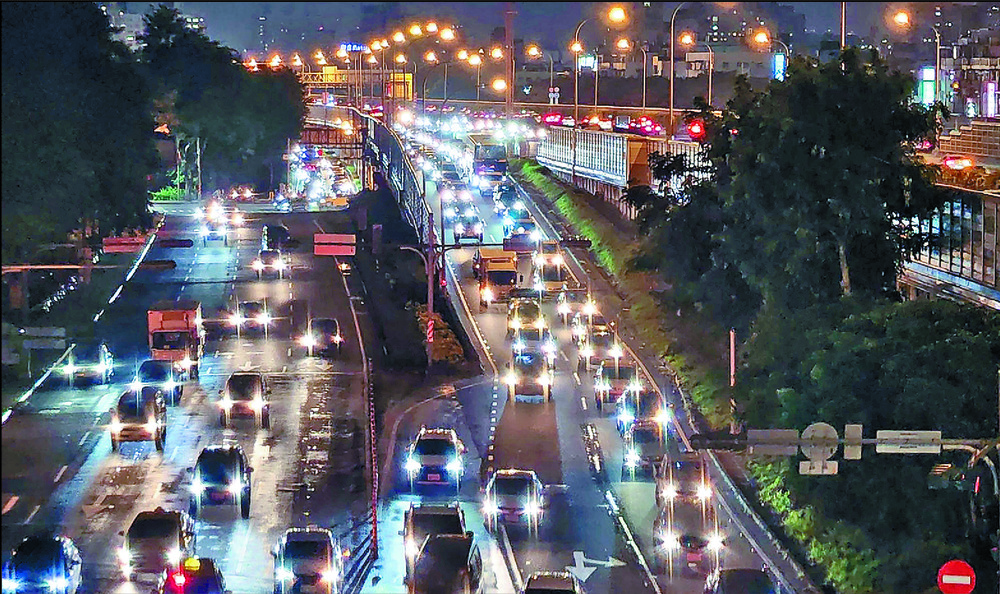
As we all know, lighting is essential for traveling by road at night.
To save on costs, some rural roads do not have lighting, and the use of headlights may not be desirable as the partial illumination that they offer can be uneven and cause glare to oncoming traffic.
For urban roads, where traffic is heavy and there is often pedestrians and other users, such as cyclists, effective lighting is essential to ensure good visibility.
The detailed aspects are complex and require professional engineers with specialist skills to design, but I shall try and explain some of the basic principles.
Put simply, the key to highway lighting is to provide adequate and uniform luminance on roads but without the glare, while footpaths use backward facing lighting for security purposes.
To achieve this, the lamps are shielded by specially designed reflectors to project beams at accurately controlled angles, that is only on the road.
This is to avoid making building walls brighter than road surfaces, distracting drivers from focusing on the path ahead and making them miss sight of pedestrians, cyclists or other obstructions.
For urban highways, lampposts are typically located along the sides to light up continuous stretches.
Typical would be posts with lamps mounted six meters high for residential areas, eight to 12 meters for urban highways and 15 to 35 meters for motorways.
The distances between posts vary with the luminance value of the lamps and could be from 100 meters to 300 meters, depending upon the type of lighting.
For roundabouts, large intersections and toll plazas, where wider areas need to be lit, high-mast lighting is used.
These have clusters of lamps casting beams to wider areas instead of the relatively narrow widths of highways.
Highway lighting is designed to minimize glare, both direct and indirect, to provide clear visibility.
Reflectors at the back of the lamps also prevent spill light to minimize ineffective usage and to avoid causing nuisance to buildings and other users.
Highway lighting went through a similar evolution as domestic and office lighting.
Traditional incandescent lamps had been used for decades, but they were soon replaced by tungsten quartz lamps for far higher efficiency and brightness.
With gas discharge lighting, further efficiency gains were achieved with low pressure sodium lamps.
Unfortunately, earlier versions of such systems, with low color rendering indexes, may emit monochromatic lights and cause road surfaces to take on an orange hue, undesirable for drivers looking to recognize objects on the road.
They were soon replaced by high pressure sodium lights for most of our highways.
The advent of LED lighting - with LED luminaire significantly reducing energy use and offering a far longer typical lifespan of 50,000 hours compared with 12,000 hours for gas discharge lamps - significantly reduces the need for maintenance. We expect LED lighting to totally replace other forms of highway lighting in the near future.
Like all city infrastructure, extensive research and design developments have ensured efficient lighting systems for the comfort and safety of drivers and other road users.
Safe night driving at high speeds is only possible with such extensive developments and drivers these days seldom notice a reduction in visibility when driving at night on highways and motorways.
Veteran engineer Edmund Leung Kwong-ho casts an expert eye over features of modern life