My article last week described the technical characteristics of a road vehicle tire. Let me now try and describe the difference between that and aircraft tires.
As aircraft tires are only used just for takeoffs and landings, its requirements are very different, though the need to support the weight of the aircraft and provide adequate grip and resilience for comfort are similar.
First, the speed of travel is different.
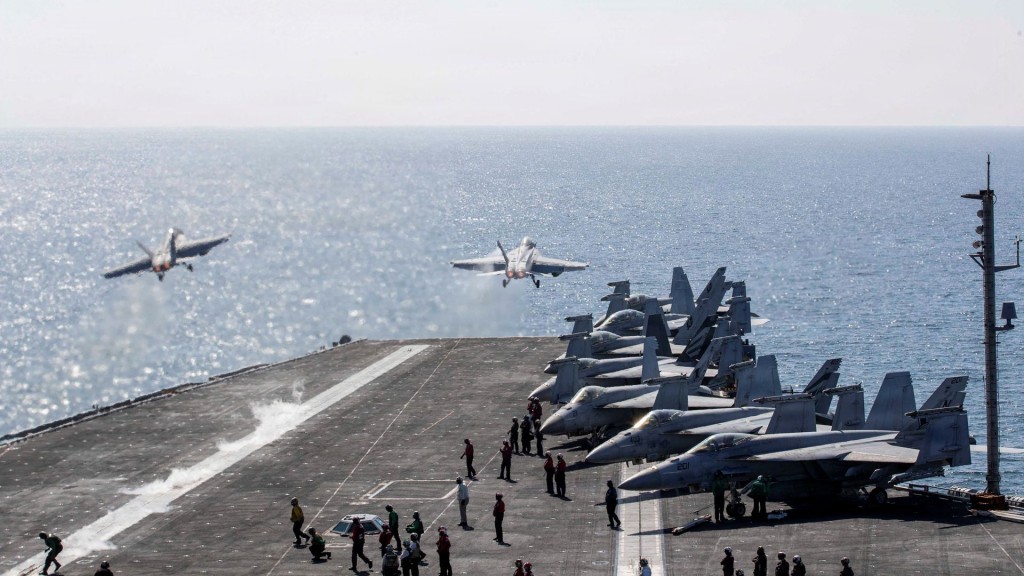
When aircrafts land, speeds can be up to 350 kilometers per hour, much like that for Formula One racing cars.
Second, at such speeds, aircrafts are predominantly traveling in straight lines, so cornering speed loads are low. Cornering control is then less important.
Third and most important, safety requirements are even more stringent, not only because of the speed and weight, but mainly as the life and safety of hundreds of passengers rely on it.
Commercial aircraft tires have diameters of about 125 cm, making them only twice those of motor vehicles.
To support a far higher weight, in the range of 20 tonnes each, compared to 0.5 tonnes for road vehicles, aircraft tires are pumped up to about 15 bars, at least six times more than vehicle tires.
To cater for extreme temperatures ranging from minus 50 degress Celsius to over 200 degrees, and to withstand the high pressures, its rubber compound is specially formulated, and the tire crowns are reinforced with robust steel mesh.
Instead of air, which also contains oxygen and moisture, aircraft tires are filled only with nitrogen gas. Nitrogen being inert, will not cause corrosion or support combustion. Also, ice would not form as there are no water vapor in it.
Something immediately noticeable is that aircraft tires only have straight cut parallel grooves on the tread, but no transverse patterns. Grooves on tire treads are mainly used to displace water to avoid aquaplaning, in which layer of water builds up between the tire and the runway, resulting in the tire failing to grip the runway and a loss of control.
However, with transverse cut grooves as in a vehicle tire, a few problems may occur.
Transverse grooves can hold loose gravels or other foreign objects, and when they fly out, it will likely damage the undercarriage, especially the fuel tanks in the wings.
It could also deteriorate easily to create flat spots, causing bumps that would be most undesirable for high-speed landings. The absence of transverse grooves may reduce cornering control, but as aircrafts do not do high-speed turns on tarmac, it is not a key issue.
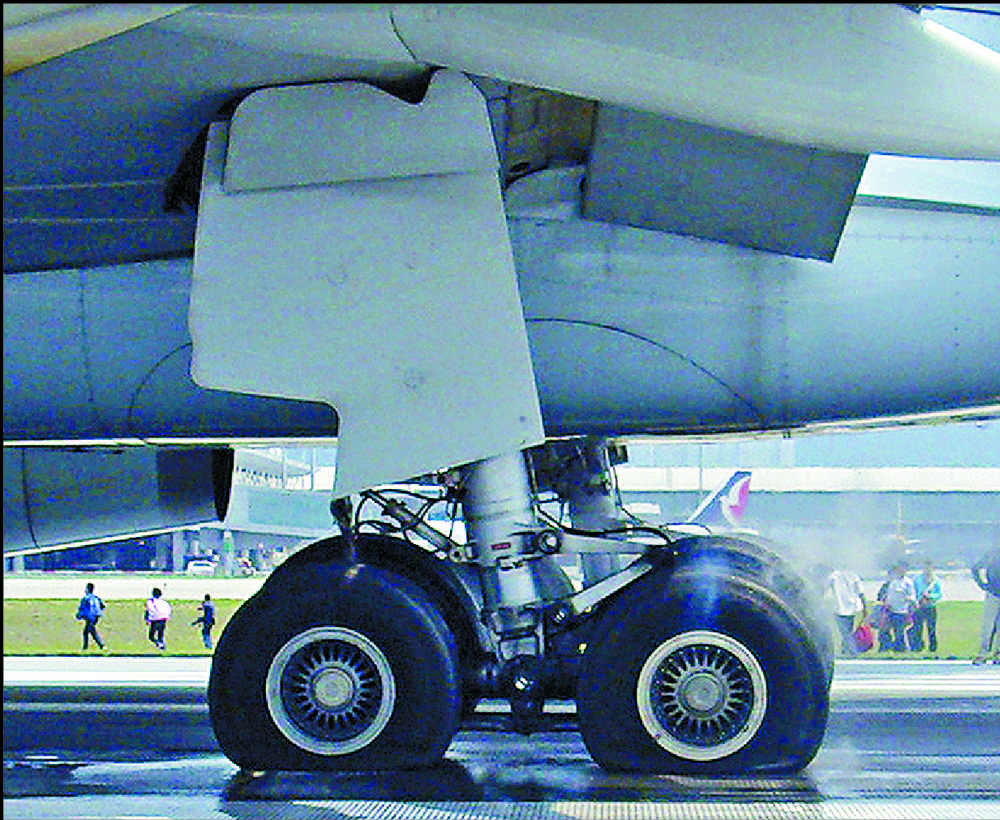
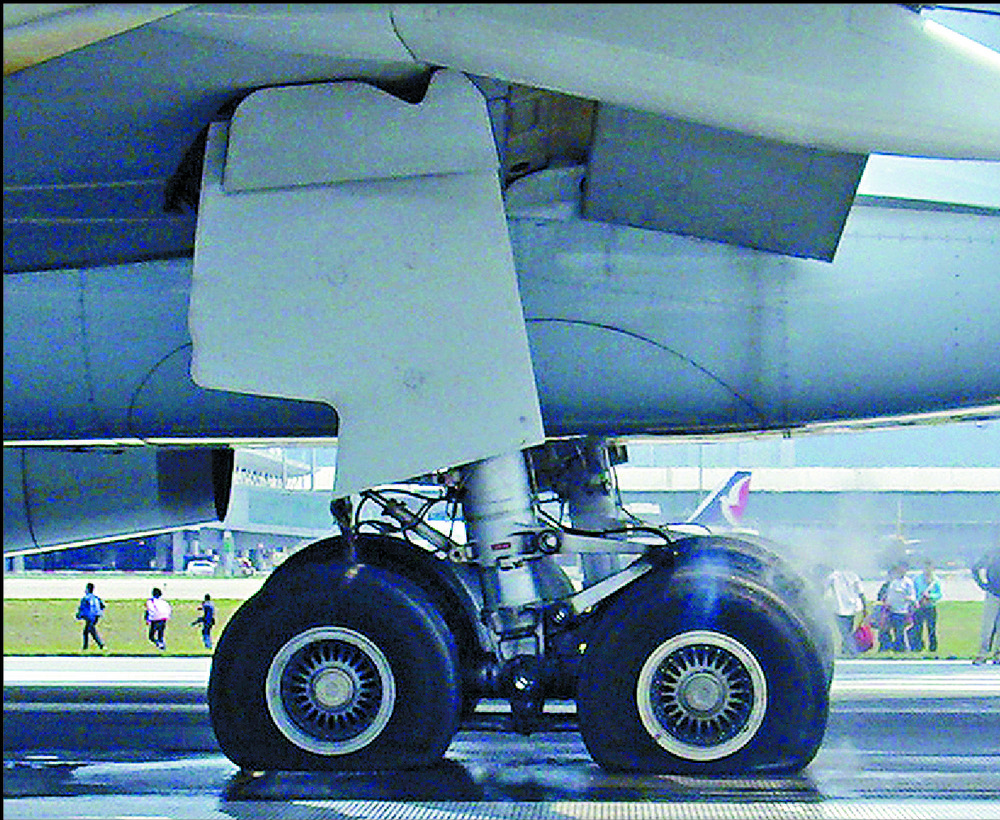
Even all these technical features may still not prevent an emergency landing for an aircraft, which will cause high temperature in tires, resulting in blow-outs. A pressure release valve, in the form of fusible plug, allows controlled loss of pressure in that particular tire.
Needless to say, these vital components are thoroughly checked after each landing to ensure there are no cuts, no bulges and no flat spots, and that no foreign objects are trapped in grooves or embedded in the tread surface. With correct use, these tires can be used for up to 150 landing cycles.
All mechanical components on aircraft are carefully designed and maintained to ensure a high level of safety.
Engineers spend years of research and development to perfect them to ensure they function correctly and reliably to ensure safety for all.
Veteran engineer Edmund Leung Kwong-ho gets behind the wheels of aircraft takeoffs and landings
A Cathay Pacific flight was forced to make an emergency landing in Hong Kong in 2010 due to engine failure, resulting in its tires bursting.