The Civil Aviation Department, in conjunction with the Electrical and Mechanical Services Department, won a gold medal award at the 50th International Exhibition of Inventions Geneva held earlier this year and the prestigious Prize of the Republic and Canton of Geneva at the event. The latter prize is special recognition by the Canton Government of Geneva, a first for a department of the Hong Kong Special Administrative Region government.
The significance of this award shows that Hong Kong can be a global pioneer in technology in some sectors. It is also a showcase to our citizens that a government department has the ability and the resolve to develop an innovative idea that can help to reduce energy consumption.
When proven, this idea can be scaled up to serve data centers and other complex air traffic control systems or large-scale IT installations, as a viable cooling solution to cope with the ever-increasing waste heat generated especially from the increasing use of artificial intelligence.
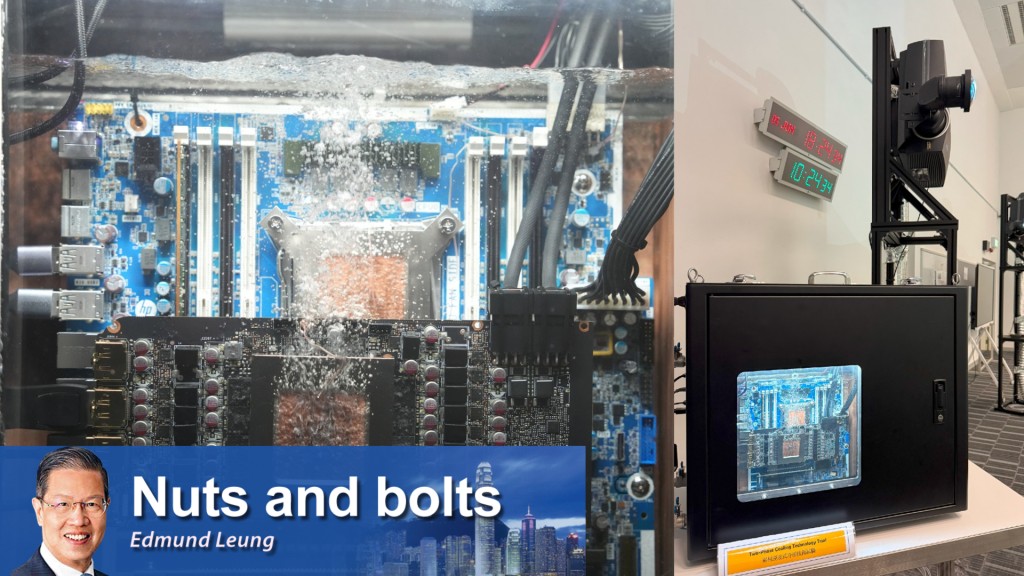
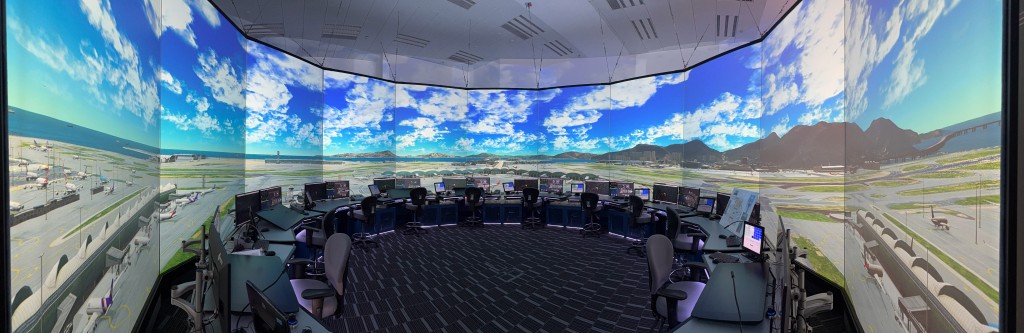
The essence of this innovation is a two-phase immersion cooling system for the high-performance image generator workstation of the 360-degree projection system for the control tower simulator in the CAD’s headquarters on Lantau Island. By simulating various operational environment and conditions, the CTS is an essential and advance system to train air traffic controllers on directing on-ground air traffic.
panoramic view of the control tower simulator, which is 9 meters in diameter
Traditionally, computer hardware is cooled by ambient air. The disadvantages of air-cooling are noise, dust and warm air dissipation to the vicinity. The air conditioning system for cooling it consumes energy, with a large amount expelled as waste heat to the environment.
To reduce energy consumed in cooling, some modern data centers have started using liquid cooling to reduce energy waste.
Liquid cooling saves space and allows higher-speed hardware processing without overheating, reducing the frequency of failure of some components which may result in costly maintenance and loss of service. It also eliminates dust settling on the surface of these electronic components and provides a shield against corrosion, extending equipment life and even eliminating routine cleaning. The total immersion of the components in fluid also ensures that the hotspots can be cooled directly without risk of heating up other components in its vicinity. The absence of cooling fans also makes for a quieter environment.
In this two-phase cooling system, the computer hardware is totally immersed in a dielectric bath inside a sealed container. What is so unique about this technology is the application of two-phasing phenomenon of the cooling fluid to offer a much higher cooling rate and capacity, using latent heat of evaporation to extract heat.
Students of physics will remember that latent heat of evaporation carries a far larger heat capacity compared to liquid circulation, and this principle offers more efficient cooling with much less dielectric fluid compared to single-phase cooling, which works by continuously pumping the dielectric fluid through the computer equipment without inducing liquid-to-gas-liquid phase cycling employed in the two-phase cooling approach.
A fluorocarbon fluid, specially formulated by the Nano and Advanced Materials Institute under the auspices of the Innovation and Technology Commission, is used for this purpose. It has excellent electrical insulation properties and is non-toxic and non-corrosive. It has a low boiling point of only 50 degrees Celsius with earth-friendly and recyclable characteristics.
As the dielectric fluid evaporates on contact with the “hot” hardware components to remove heat, the enclosure and its contents remain at a temperature around the boiling point of the dielectric fluid. The close circuit cooling cycle of this two-phase system needs no maintenance.
Exterior to the enclosure is a separate but small cooling water system with a radiator to expel the waste heat carried by the evaporated dielectric to the outside for sustained operation.
This innovative cooling method has been in use since November and is undergoing a proving test for one out of 12 image generators of the CTS with the remainder presently air-cooled.
The novel two phase cooling system was developed jointly with EMSD, which provided the expert engineering support. The transparent case provides the necessary enclosure to contain the fluid and the full set of computer hardware complete with its high-performance graphic card, motherboard and add-ons. Expectedly, the graphics processing unit and central processing unit are the hottest components of the image generator and where evaporation occurs.
Initial findings of this prototype demonstrated efficient cooling of power usage effectiveness at 1.03 with significant energy saving at about 30 percent compared to traditional air cooling.
The CAD plans to scale up this cooling system in the CTS, and other large-scale applications in the future. When proven, this system can be promoted as a viable cooling alternative to many other applications, including data centers and other large computer complexes.
The prestigious award is an international recognition of this innovative technology developed locally in Hong Kong. It is gratifying to see government departments having the enterprise spirit to try out innovative technologies that have not been proven in other applications.
Veteran engineer Edmund Leung Kwong-ho casts an expert eye over features of modern life