In our daily life, one potential factor that affects our peace is unpleasant noise. We enjoy strolling in the park and beaches with a pleasant “soundscape,” the mixture of enjoyable soothing natural sounds. The sound of leaves blown by breezes, birds singing and other natural noises are generally soothing rather than upsetting.
But within the city, noises generated by machines, whether it be from vehicles, construction machinery or other human activity, could be a lot more upsetting as they are not only of unpleasant frequency and tone, but also of a much higher volume.
We often experience sound levels of over 80 A-weighted decibels – or dB(A) – especially when noisy construction equipment such as percussive piling machines or large breaking machines are operating, which could easily exceed 85 dB(A).
Apart from controlling such activities to within the working day to provide residents with a reasonably acceptable level of noise, the Environmental Protection Department also advises the industries with a variety of mitigation measures and state-of-the-art technologies to minimize disturbance to the neighborhood. Construction sites, therefore, are often requested to fit noise barriers to reduce the excessive noise.
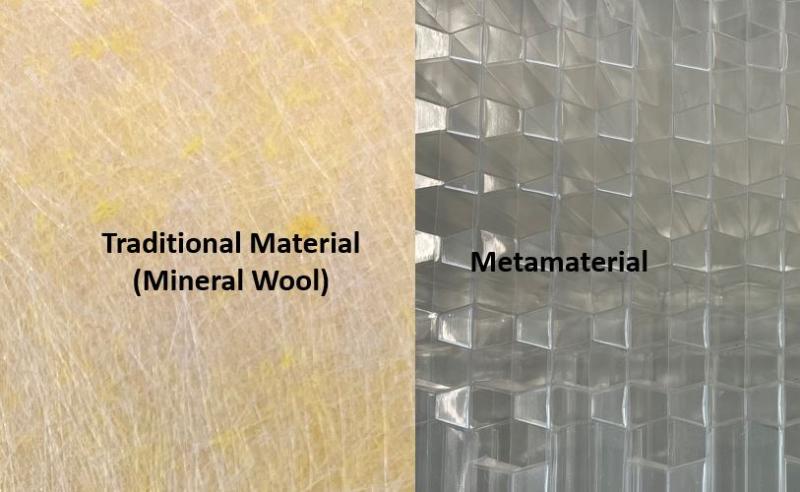
Traditionally, such noise barriers were made of acoustic fiber. Though effective in absorbing noise, they tend to absorb moisture and disintegrate with time and require frequent replacement when used in outdoor applications.
They are also effective only in absorbing noises of a limited range of frequencies, making them unsuitable for reuse in other applications. This does not help in reducing construction material waste as they add to the load of the landfills.
Recognizing the need for improvement – not only to find better sound-absorbing materials for a wider range of noises but also ones that are more durable and versatile for reuse – a group of Hong Kong-based acoustic engineers conducted extensive research and invented a novel composite material. For easy identification, they call it a “metamaterial.”
Instead of relying on material mass for sound absorption, this composite is made of layered recycled plastics. The absorption layers are manufactured with especially designed structures and surfaces formulated to absorb a broad range of frequencies. The metamaterial can also be tailored to target specific noise spectrums.
The interlacing air pockets in these layers of plastics work in unison with the plastic layer to form a composite panel with much more effective sound absorption. The panels are wrapped in waterproof plastic covering, resistant to weather and robust enough to stand up to rough site conditions.
Designed for repeated use in different locations and a wide range of applications, these panels are made in handy sizes similar to standard wooden planks, and with easy assembly fittings, often using Velcro strips.
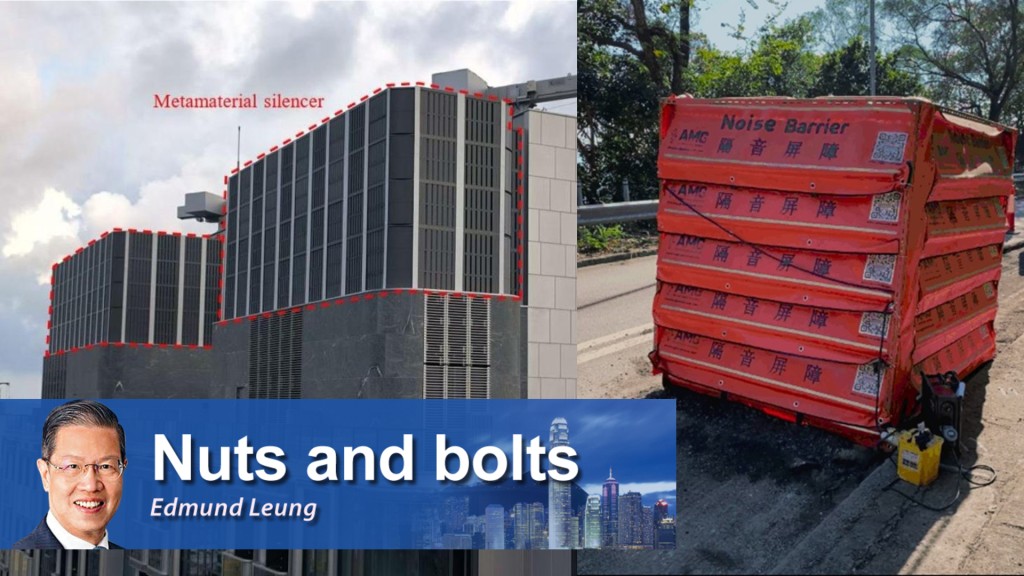
This makes them easier for transportation and installation to facilitate repeated use in other locations. In consideration of metamaterial’s highlighted features, trials were made to adopt metamaterial enclosures for mitigating noise from construction equipment such as hand-held breakers. It was found that the metamaterial enclosures could help to reduce the noise level ranging from 15 to 25 dB(A), which effectively minimizes noise nuisance for neighbors.
With its cost competitiveness compared to traditional materials, metamaterial has now become a go-to solution of noise barriers and enclosures, effectively reducing the impacts to adjacent residents arising from road maintenance works in mid-night, especially as this metamaterial could provide better ventilation and hence a more worker-friendly environment.
A much wider everyday application of this type of metamaterials is for shielding air-conditioning plants, as they are often located in roofs of commercial buildings, at close proximity to other occupants. The proven advantage in sound absorption, the much thinner material, and resistance to weather have made them most suitable for such application.
Actual measurement on site confirmed that they can effectively reduce noise level by at least 15dB(A), and require far less maintenance and replacement as, unlike acoustic fiber materials, they do not absorb moisture and rainwater. At 150 millimeters they are also thinner than acoustic fiber – which is usually over 300mm – making the total equipment size much more compact.
Also, the weight of metamaterial barriers is about seven kilograms per panel, which is about 60 percent lighter than traditional ones. They can also be manufactured with covers of different colors to blend with the surroundings, much to the delight of architects and property owners.
Continuous development and use of Hong Kong-developed materials is a useful recent trend, and in the case of this metamaterial, it will find a lot of other applications to improve our daily life.
City residents demand and deserve a much quieter neighborhood, and hopefully with modern technology they will see continuous improvements in this aspect.
With this metamaterial barrier available, road maintenance work could be carried out with enhanced efficiency and flexible scheduling, striking a good balance between accelerating road repair progress and minimizing the disruption to residents..
Veteran engineer Edmund Leung Kwong-ho casts an expert eye over features of modern life