Health professionals will always promote that good quality sleep is essential for maintaining top health for all people of all types and ages.
But what constitutes good quality sleep? Is it the darkness of the room, the serenity without noise, air quality, or others? Many will agree that the bed is singularly the most effective tool to achieve it.
From the time when people slept on wooden planks to the development of soft bedding that gradually evolved into mattresses, beds have increasingly played a significant role in determining the quality of sleep people get.
Mattresses were originally made of layers of cotton materials, but later foam mattresses and spring mattresses became the norm as they provide a soft cushion to support the human body.
They also allow the weight of the body to be supported evenly, freeing the bone structure from stresses, helping the backbone to align to a straight line, correcting any unnatural bending due to bad posture, and allowing muscles to relax and relieve any back pain. But as different people have varied preferences, mattresses cannot be a one-size-fits-all. Some prefer a harder material for better support, and others prefer a softer mattress for less reaction force to their body weight.
Also, it would be nice if the strength of support could be adjusted to suit different occasions and at different times, depending on how tired the user feels and whether the individual is athletic or an elderly person who lacks physical exercise.
In this respect, foam mattresses are less desirable as they only provide a fixed degree of softness that can only suit certain conditions for some people.
A selection that appears suitable at the time of purchase could soon become uncomfortable with time, even without allowing for deterioration with age.
There is now a solution to these issues: the smart mattress.
Big data and extensive analyses by health professionals enable the smart mattress to be developed to provide a wide variety of support forces desired by different people, catering to different phases of their sleeping cycle.
They are able to determine the optimum support characteristics of the mattress across the whole sleeping cycle and provide softer support to coax a person to fall asleep, but gradually stiffen up to provide healthy support for the spine when the person is in deep sleep.
Obviously, it is capable of finer adjustment to cater for the age and fitness of the particular person, initially based on an algorithm derived from big data, but refined to allow for fine tuning to cater for individual needs.
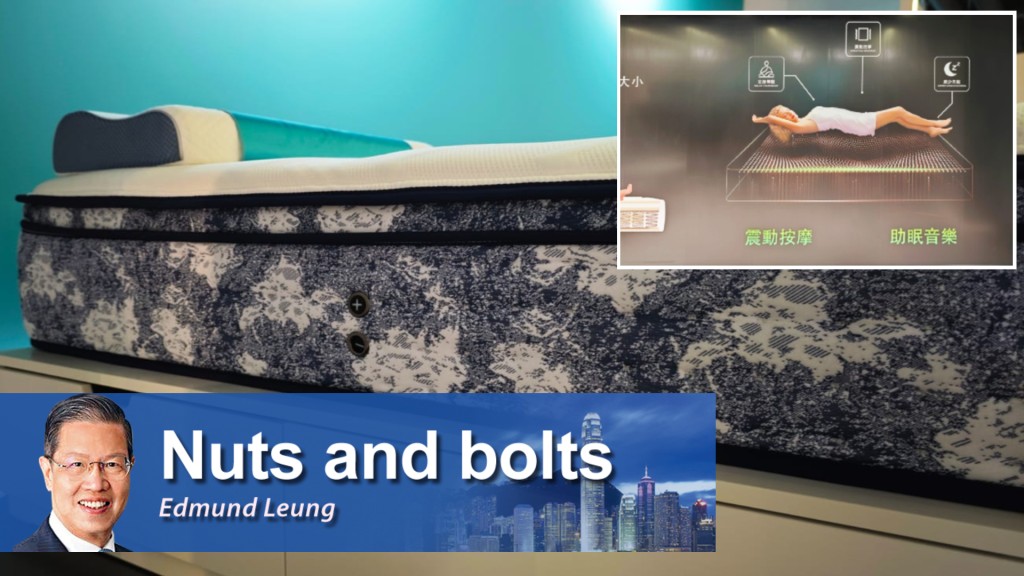
Sensors controlling the pressure of air bags installed within the smart mattress allow various parts of the mattress along its length to provide different strengths of support for the shoulders, the back, and the legs to achieve this goal.
These strengths can be adjusted either through a remote control for tuning to suit particular requirements, or via pre-set programs with an app that allows scheduled phases of a sleeping cycle – providing not only softness control but also additional desirable functions such as wave or rocking motion massage actions to relax the body muscles and lull the person to sleep.
The mattress can also be equipped to detect snoring by raising the head section slightly to reduce the effect, for better sleep quality and to minimize disturbance to others.
Additionally, the mattress materials are specially selected to absorb sweat and moisture and to provide effective heat insulation to keep the body warm for best comfort and to minimize catching cold due to temperature changes in the night.
This new type of mattress is already available on the market. They can be ordered in different sizes to suit the compact bedrooms typical of Hong Kong.
Double bed mattresses can also be made to allow separate control of softness and massage actions so that two parts of the bed can operate separately to suit individual needs.
As these smart mattresses develop, they can also trigger bed lights to operate and curtains to be raised to gently wake the occupant. Other welcoming features, such as a monitoring device to check sleep quality, can be added to cater to individual needs easily.
We are so fortunate to live in this modern world, with mod cons that improve our lives. Variable support strength mattresses, with massage functions and anti-snoring features, are an innovation that improves sleep quality and helps maintain excellent health.
This is another example of modern engineering technology that improves our lives.
Veteran engineer Edmund Leung Kwong-ho casts an expert eye over features of modern life