More Chinese real estate companies favor the use property technologies, a survey of 200 companies by a leading professional services firm that specializes in real estate and investment management has found.
Jones Lang LaSalle, says in its latest 'Reimagine the Future of Real Estate,' report, that about 55 percent of Chinese real estate firms plan to increase their proptech budget by 10 to 30 percent in the next two years, according. They believe that the use of proptech could mitigate potential market risks and maximize long-term asset value.
In 2018, only 37 percent of Chinese real estate firms surveyed planned to increase their proptech budgets by over 10 percent in 2019 and 2020, JLL says.
Gavin Morgan, Chief Operating Officer at JLL in Greater China, said: “China’s commercial real estate market faces internal pressures from intensifying competition as well as rising uncertainties from the global economy. By enhancing the resilience of commercial property, proptech can mitigate potential market risks and maximize long-term asset value in four key areas: human experience, health and safety, operational excellence, and digital drive. ''
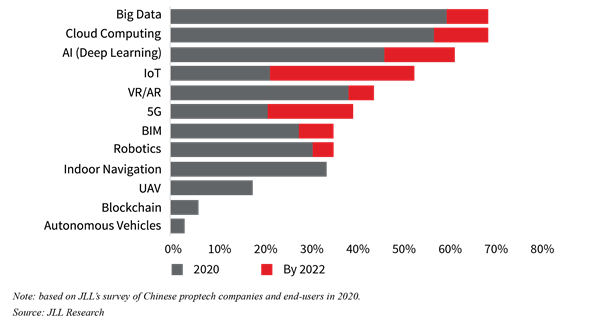
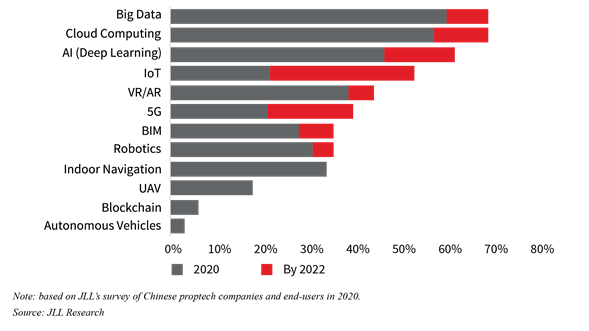
The JLL report summarises 12 key property technologies and categorises them into four types: “ubiquitous” (such as cloud, big data and artificial intelligence); “catalyser” (Internet of Things and building information management); “contextual” (virtual reality/augmented reality and indoor navigation, robotics); and “frontier” (5G, blockchain, unmanned aerial vehicles and autonomous vehicles).
Jll says that In China, key proptech players consist of equipment manufacturing, software development, internet and start-up companies. When choosing which partners to work with, real estate companies need to maintain a clear vision and redefine purposes for proptech innovation or digital transformation.
It is foreseeable that the development of cutting edge IoT and AI applications will accelerate in China due to 5G deployment, and the marginal cost of adoption will drop rapidly, JLL says.
Based on existing and future trends in the office, retail and logistics markets, the report summarises a series of proptech solutions that address specific “pain points” in each of the sectors.