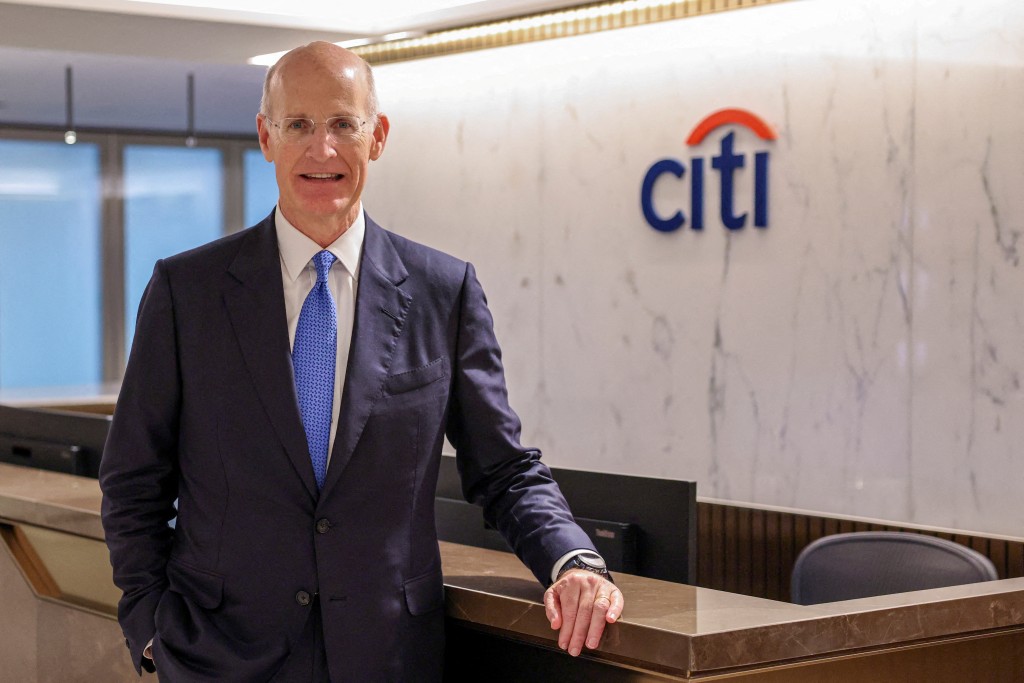
Citigroup plans to allocate a significant portion of its global wealth management hiring to Asia, where its private bank is growing faster and generating higher productivity than in other regions, the bank’s global wealth head Andy Sieg said.
The US bank’s recently unveiled hiring plans would be “anchored” in Asia along with other regions, said Sieg, who formerly led Merrill Lynch’s wealth business and was brought in by Citi CEO Jane Fraser in 2023 to lead a revamp of the wealth unit.
Citi plans to hire about 100 private bankers globally, alongside roughly 400 other specialists, as part of a broader effort to lift returns in its wealth business, he said at the bank’s investor day event earlier this month.
“In the private bank, our business in Asia is the fastest growing part of our private bank,” Sieg said in an interview in Hong Kong. “It’s the most productive area of the private bank.”
He declined to elaborate on the hiring plan in the region, but said “a significant percentage of the hiring will be here in Asia, you know, commensurate with the fact that this is a large percentage of our global business.”
Citi this month set a target of return on tangible common equity for the wealth unit of 15 percent to 20 percent in 2027 and 2028 and above 20 percent over the medium term. The wealth unit delivered a net income rise of nearly 50 percent to US$1.5 billion in 2025 from a year earlier.
Asia is a key pillar of that strategy, Sieg said.
The bank’s Asia wealth business, including Japan, Asia North and Australia and Asia South, generated about US$3 billion in revenue in 2025, or about 35 percent of Citi’s global wealth revenue, the bank’s latest official filings show.
Sieg said Indonesia was a good example of how Citi can support wealthy clients during periods of market and policy uncertainty.
“It’s also complex right now,” he said. “Markets have been volatile, political and policy changes being announced every few days.”
Citi has retained its wealth, cards and retail banking operations in Hong Kong and Singapore, even as it moved in recent years to exit consumer banking in 14 markets across Asia, Europe, the Middle East and Mexico as part of Fraser’s strategy to simplify the firm and focus capital on higher-return businesses.
The bank is seeking to increase income from existing clients, having merged retail banking into the wealth unit in the US in the first quarter.
“Jane and the board, they will not be satisfied with a business which is only marginally advanced from where we are today,” Sieg said.
“They expect us to build an industry leader in wealth management.”
Steven Lo, Head of Citi Private Bank for Japan, Asia North & Australia and Asia South, said: “Asia remains a compelling growth opportunity for Citi Private Bank, and we are investing with clear intent – including selective hiring across key hubs such as Hong Kong and Singapore."
"As we expand, we are focused on attracting top-tier talent who can bring clients the full value of One Citi, connecting our private bank with Citi’s broader global capabilities. Our priority is to deepen client relationships, scale our platform, and deliver consistent, high-quality execution as we grow in the region,” Lo added.
Artificial intelligence is an increasingly important part of how Citi serves its wealth clients, and the group continues to invest in both technology and talent to support this, said Vicky Kong, Citi's head of Wealth for Asia North and Australia
In Hong Kong, tools such as AskWealth support our frontline teams with fast and consistent information, enabling more effective client engagement, she said, adding that this is particularly important as clients look for more timely and relevant insights and trusted advice in a more dynamic market environment.
Reuters and staff reporter