Read More
Taiwan on Sunday praised the "positive and friendly" wording about the island on the US State Department's updated website, which has removed the phrase that Washington does "not support Taiwan independence".
ADVERTISEMENT
SCROLL TO CONTINUE WITH CONTENT
The United States has long been Taiwan's most important backer, despite dropping diplomatic recognition of the self-ruled island in 1979 to establish formal relations with an ascendant China.
Official language used to describe US-Taiwan relations is highly sensitive and previous changes to the State Department's fact sheet on the island have provoked an angry response from China.
Among other tweaks, the latest update removed the line stating "we do not support Taiwan independence", AFP analysis of the previous version of the page shows.
The page still states Washington only recognises Beijing as China's government under its "longstanding one China policy" and its opposition to "any unilateral changes to the status quo from either side".
Taiwan's foreign ministry said the "positive and friendly" wording in the fact sheet that was updated on February 13 was a reflection of the "close and friendly Taiwan-US partnership".
Foreign Minister Lin Chia-lung thanked US President Donald Trump's administration "for its commitment to peace and stability in the Taiwan Strait, Taiwan-US economic, trade, and technology partnership and Taiwan's international space", the ministry said in a statement.
The American Institute in Taiwan (AIT), Washington's de facto embassy, said the update was "routine".
"We have long stated that we oppose any unilateral changes to the status quo from either side," an AIT spokesperson said in a statement to AFP.
"We do not comment on every hypothetical. China presents the single greatest threat to peace and stability in the Taiwan Strait."
Taiwan has sought to get onside with Trump whose transactional style of diplomacy has raised concerns about his willingness to defend the island from China.
Trump has rattled nerves by suggesting Taiwan should pay the United States for protection and accusing the island of stealing the US chip industry.
President Lai Ching-te vowed Friday to boost investment in the United States and on its own defences, after Trump threatened to impose tariffs of up to 100 percent on its semiconductor chips.
It is not the first time the United States has dropped the line about not supporting Taiwan independence. In May 2022, then president Joe Biden's administration removed it, angering Beijing. It was later reinstated.
The dispute between China and Taiwan dates back to 1949 when Chiang Kai-shek's Kuomintang nationalist forces fled to Taiwan after losing the Chinese civil war with Mao Zedong's communist fighters.
Taiwan, which has its own government, military and currency, calls itself a sovereign nation. But it has stopped short of formally declaring independence, which is a red line for Beijing.
(AFP)
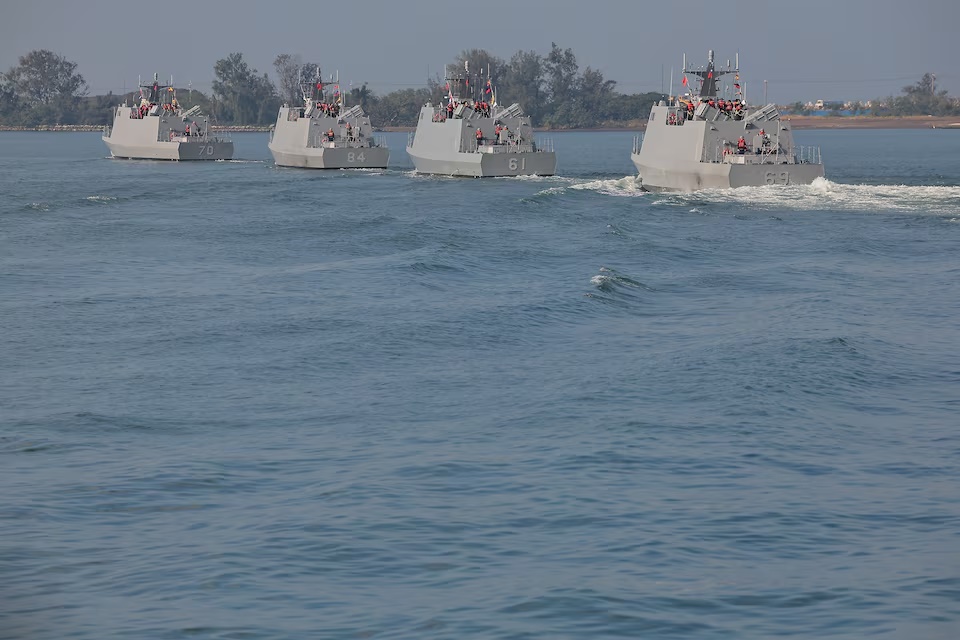
Taiwan military demonstration, Kaohsiung, January 9, 2025. (Reuters)