Coronavirus infections in South Korea have overwhelmed its health care system, while millions of children in Japan stayed home and Indonesia reported the first infections today.
Indonesian President Joko “Jokowi” Widodo announced that two Indonesians tested positive. He said that the two people, a 64-year-old and her 31-year-old daughter, had been in contact with a Japanese who tested positive in Malaysia on February 27, after visiting Indonesia in early February, the Jakarata Post reported.
“We have prepared over 100 hospitals with isolation rooms with good isolation standards. We also have equipment that meets international standards,” he said.
Thailand said a 22-year-old woman who worked as a tourist assistant to an infected driver of tourist, is also infected.
Health officials are struggling to contain the coronavirus epidemic in more than 60 countries, including the United States, where two people have died and signs of a bigger outbreak loomed.
As new battle fronts against the coronavirus that emerged from Wuhan in China opened with surprising speed around the world, recovered patients left China's hastily built hospitals and isolation wards.
Outbreaks are surging in other countries, with South Korea, Italy and Iran seeing sharp increases.
The United States counted 80 cases as of Sunday and two deaths, both men with existing health problems who had been hospitalized in Washington state. The US total includes evacuees from a virus-stricken cruise ship and from Wuhan, but new cases among California health workers, in New York, Rhode Island and Washington raised concerns on both U.S. coasts.
The second U.S. fatality was a man in his 70s from a nursing facility near Seattle where dozens of sick people were tested for the virus, Washington state health officials said. Researchers said earlier the virus may have been circulating for weeks undetected in Washington state.
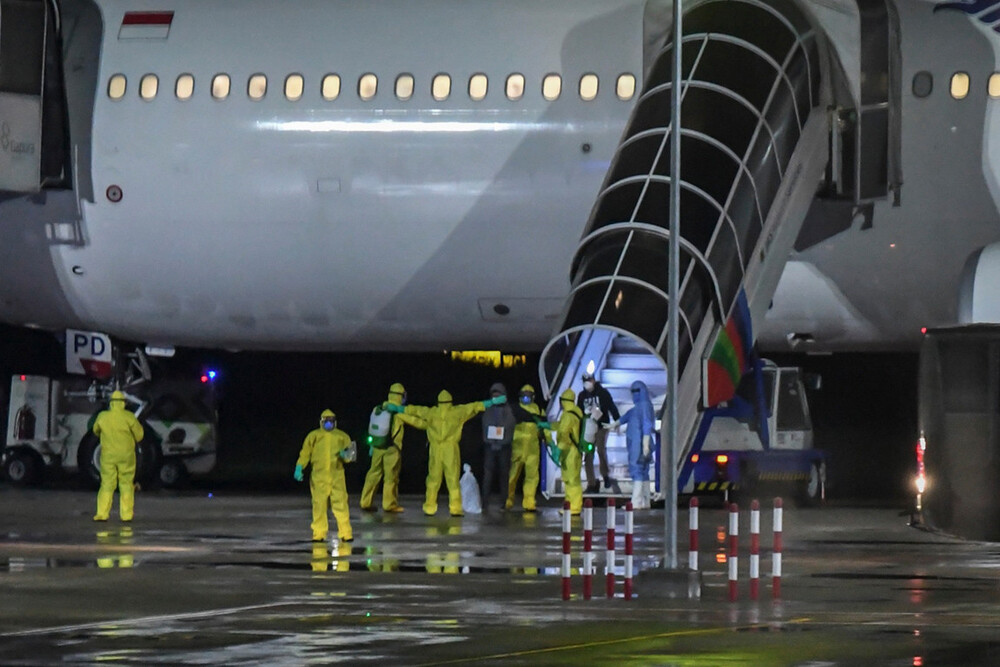
Indonesia confirmed its first cases today, in two people who contracted the illness from a foreign traveler.
In South Korea, at a hastily arranged news conference, the 88-year-old leader of the Shincheonji church, a religious sect which has the country's largest cluster of infections, bowed down on the ground twice and apologized for causing the “unintentional'' spread of the disease.
“I don't know what words of apology I should offer. ... We also did our best but weren't able to contain it fully,'' Lee said, wearing a white face mask. “We immediately cooperated [with quarantine efforts], but there's really nothing I can say.''
Lee's church is viewed by mainstream Christian organizations as a cult. As he spoke today, some people shouted “Cult'' and “Disband the Shincheonji church.''
South Korea on Monday reported 476 new cases for a total of 4,212, most of them in the southeastern city of Daegu and nearby areas. More than half of the cases had links to a Shincheonji branch in Daegu. The city's first known patient is a church member who had attended services before being diagnosed with the disease on February 18. Before her case was confirmed, South Korea had reported only 30 cases.
South Korea's surging outbreak has overwhelmed its health system. At least four infected elderly people have died in Daegu while waiting to be hospitalized.
Kim Gang Lip, South Korea's vice health minister, said hospitals' capacities from now on will be reserved for patients with serious symptoms or preexisting medical conditions, while mild cases will be isolated in designated facilities outside hospitals.
“Considering our limited medical resources, it will be crucial to make quick assessments of patients' conditions and provide quick, professional and active treatment to those with serious symptoms and minimize fatalities,'' Kim said. “If we continue to hospitalize mild patients amid the continued surge in infections, we would be risking overworking medical professionals and putting them at greater risk of infections.''
South Korea's education minister, Yoo Eun Hae, said the start of the new school year will be delayed by two more weeks until March 23. South Korea previously delayed the start by one week.
A sense of a burgeoning crisis around the globe has sent financial markets plummeting, emptied major streets and tourist attractions and forced millions of people to adjust their daily lives.
In Japan, many schools began following through on Prime Minister Shinzo Abe's plan to close them for more than a month through the end of the Japanese academic year.-AP/The Standard. Photo: Antara
Indonesian crewmen evacuated from the Diamond Princess crusie ship are disinfected as they disembark on Sunday, at Kertajati International Airport in Majalengka, West Java.