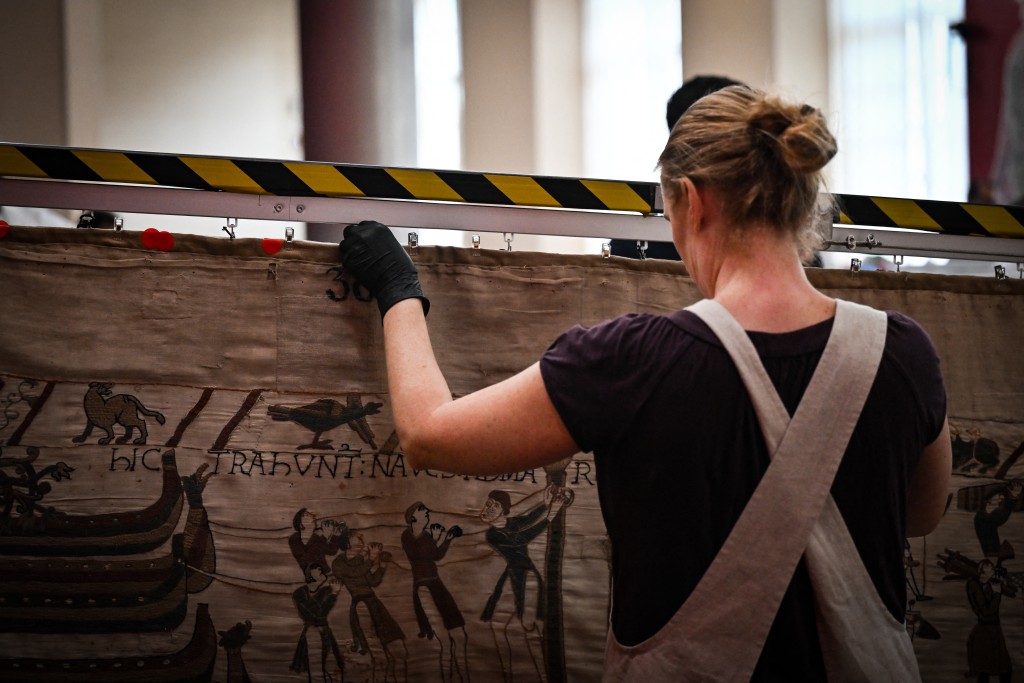
Every English schoolchild knows the story of 1066, the Battle of Hastings and the Norman conquest of England. It's told in incredible detail in the 11th century Bayeux Tapestry.
Now the priceless work has made a perilous journey from its home in The Bayeux Museum in Normandy, northwestern France, to the heart of London.
Here are some facts about the almost 1,000-year-old artwork that will go on display at the British Museum:
- 1066 and all that -
Embroidered in wool thread, the tapestry depicts how in 1066 William the Conqueror defeated England's King Harold and changed the course of history for England, France and Europe.
It tells its story in words and images, but its origins are shrouded in mystery.
"Most scholars today think the tapestry was made in England, probably in or around Canterbury, because of the influence on its design of illuminated manuscripts made in .. monastic libraries in Canterbury," the museum says on its website.
According to some historians, Bishop Odo of Bayeux -- William's half-brother -- commissioned the work in 1077 to decorate the new cathedral in his hometown, Bayeux.
The artisans' identities are lost to time, although the British Museum says scholars believe "it was made by English women, whose needlework skills were admired across Europe".
The tapestry is 68 metres (224 feet) long, 50 centimetres (20 inches) wide and weighs 350 kilogrammes (772 pounds).
- Arrow in the eye -
Made of nine panels, the work is an "embroidered story", said Antoine Verney, head conservationist at Bayeux Museum.
The tapestry features 627 figures and 737 animals including horses, dogs and birds, according to the British Museum.
Only six women are depicted on it - one is being possibly assaulted, one crying and one fleeing a burning house clutching a child.
Some accounts say that England's King Harold died after being struck in the eye by a French arrow -- a scene apparently shown on the tapestry though the arrow may have been added later.
The tapestry also captures an image of Halley's comet.
- London exhibition -
In an unprecedented display of French-British diplomacy, the tapestry goes on display at the British Museum from September 10 to July 11, 2027.
It will be displayed flat for the first time, rather than hanging on a wall.
In return, the British Museum will loan France the Sutton Hoo collection of Anglo-Saxon artifacts discovered in 1939 - one of England's most important archaeological finds.
Around 7.5 million people are reportedly expected to flock to the museum during the exhibition, up from the usual annual figures of around 6 million.
So it could break the record of 1.69 million visitors for a single exhibition set in 1972 for an exhibition of ancient Egyptian king Tutankhamun.
"It is a defining piece of our nation's history and a truly once-in-a-lifetime experience," said the museum's chairman of trustees George Osborne.
The first tickets from the opening of the exhibition to the end of December sold out on July 1, the day they went on sale.
Prices range from £25 to £33 ($33-$44) with under 16s free.
More tickets will be released in October and January for the rest of the exhibition.
- Risky journey -
There had been two previous plans to loan the tapestry to Britain which never went ahead: one in 1953 for the coronation of Queen Elizabeth II, and one in 1966 for the 900th anniversary of the Battle of Hastings.
The tapestry has only left Bayeux twice, to be displayed at the Louvre in Paris: once in 1803, on Napoleon's orders, and once in 1944, in tribute to the British and US troops who fought to free France from Nazi German occupation.
The Bayeux Museum, its home since 1983, is closed for a 38-million-euro renovation due to end in 2027.
The late artist David Hockney had added his voice to concerns that the strains of the journey could imperil the fragile work.
The UK government is insuring the tapestry for an estimated £800 million while it is on loan.
And the exhibition is being sponsored by Belarus-American billionaire Igor Tulchinsky, founder of global hedge fund WorldQuant. The Financial Times has reported that Tulchinsky's sponsorship is worth £5 million.
AFP