What is now the world's largest iceberg has broken off from an ice shelf in Antarctica and is floating in the Weddell Sea.
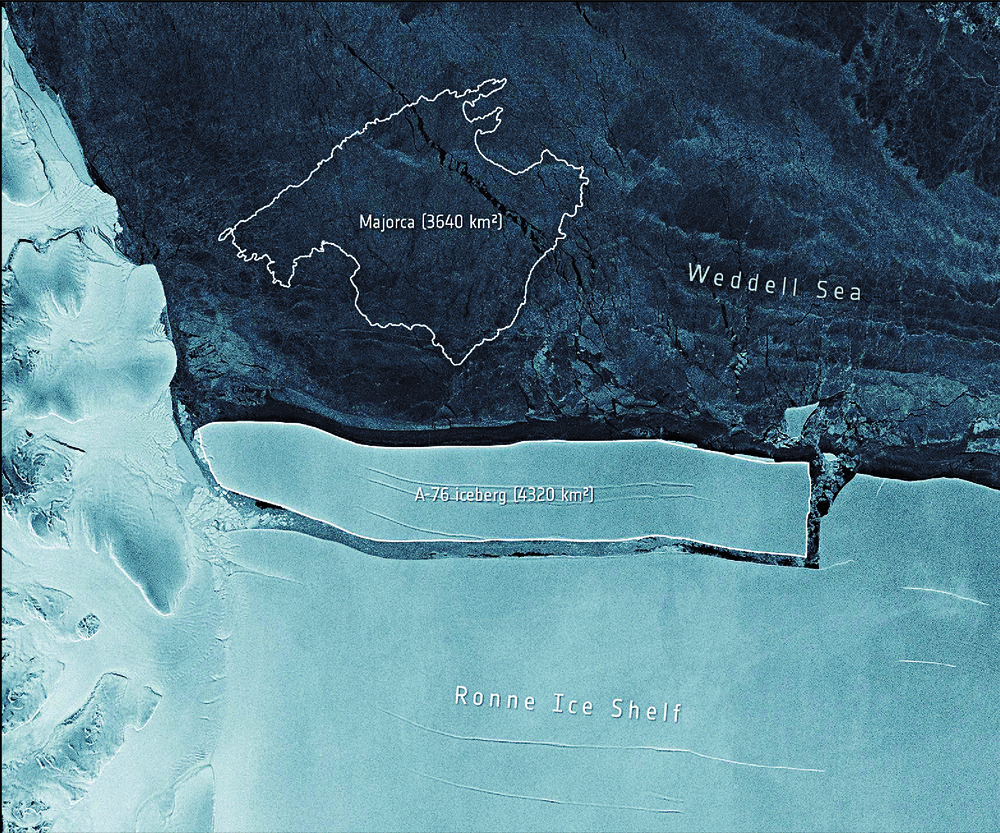
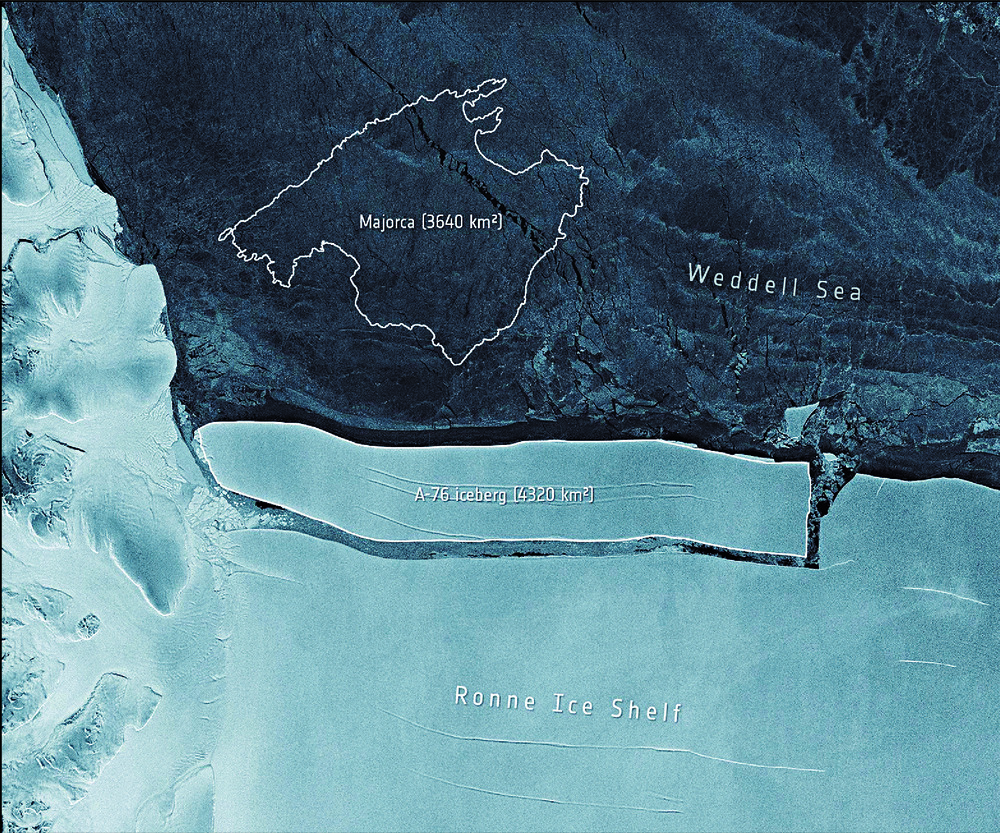
Called A76 and the shape of Manhattan but more than 70 times bigger, it was picked up by satellites and is "currently the largest berg in the world," the European Space Agency said.
It is around 170 kilometers long and 25km wide, with an area of 4,320 square kilometers, slightly larger than the Spanish island of Majorca.
The berg, which broke off the western side of the Ronne ice shelf, was first spotted by the British Antarctic Survey and confirmed by the Copernicus satellite.
It takes the place as the world's largest from the A23A iceberg - approximately 3,880 sq km in size - also in the Weddell Sea.
Most giant icebergs have broken off the Larsen ice shelf, , which has warmed faster than any other part of the southernmost continent.
Earth's average surface temperature has gone up by 1 degree Celsius since the 19th century, enough to increase the intensity of droughts, heat waves and tropical cyclones. But the air over Antarctica has warmed more than twice that much.
Major chunks of the Larsen ice shelf, which had been stable for more than 10,000 years, disintegrated within days in 1995 and again in 2002. That was followed by the breakup of the nearby Wilkins ice shelf in 2008 and 2009.
A process known as hydrofracturing was likely the main culprit in both cases. That occurs when water - heavier than ice - pours through cracks in the surface of ice shelves caused by surface warming, forcing the fractures to zip open and causing an iceberg to break off.
The A76 iceberg is slightly larger than the Spanish island of Majorca. AFP