Three decades after he landed on Hong Kong shores as a child refugee, Vo Van Hung is fighting efforts to deport him back to Vietnam now he has finished a prison term for murder.
Vietnam's boat people exodus ended long ago. But Vo, 41, is one of a handful of remaining refugees whose fate is undecided.
And his battle against deportation dredges up memories of a grim chapter in Hong Kong's recent history.
Since arriving in Hong Kong as a 12-year-old unaccompanied refugee in 1991, Vo has spent his life behind barbed wire and then bars.
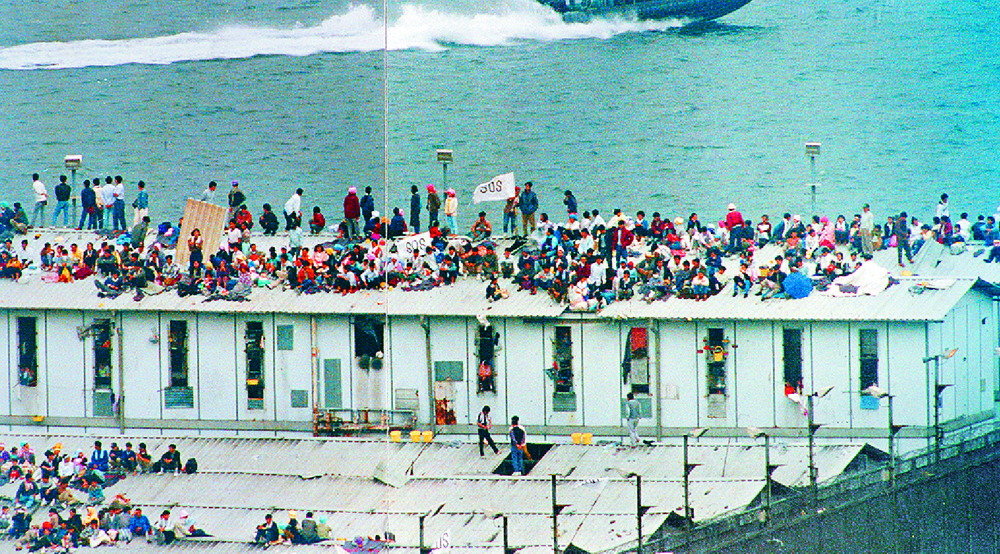
He was first housed in a notoriously violent refugee camp where tens of thousands of Vietnamese were placed, often for years, until their cases were decided, most with asylum in other countries.
But Vo soon ended up in prison - for 22 years - after being convicted as a teenager of murdering a fellow camp inmate during an argument.
Since completing his term four years ago, he has been in an immigration center pending deportation - a move he's fighting in court.
Instead of going back to Vietnam, "I would rather be locked up here for the rest of my life," he says from behind a plexiglass barrier separating immigration center inmates from visitors. "I have no family and friends in Vietnam."
In the years after the Vietnam War, some 200,000 Vietnamese arrived in Hong Kong. Most made dangerous voyages across the South China Sea on crammed and rickety boats, which earned the demographic their moniker.
By the time the last refugee camps were closed in 2000, some 144,000 Vietnamese were resettled in third countries, 58,000 were repatriated and 1,400 integrated locally. Prisoners were a gray area.
In 2003, SAR authorities said 15 inmates were eligible to stay in Hong Kong after release, while 18 would be deported.
Vo, who speaks Cantonese better than Vietnamese, was never told of his status.
So when he walked from a cell in 2016, he expected to be a free man. But at the prison gate, "a number of immigration officers waiting there handcuffed me and told me I would be taken to the detention center."
In 2018 he won a judicial review against an initial decision to deport him. A second hearing has been delayed by the Covid-19 crisis.
The security bureau says there are 18 Vietnamese nationals ineligible for local resettlement.
Vo argues he might face persecution if repatriated as his father was a South Vietnamese soldier who fled overseas and left him in the care of adoptive parents, who sent him alone to Hong Kong.
He also fears being prosecuted a second time for the murder.
Asked about that killing, he replies: "I certainly regret it. I did not know how to behave properly. [Violence was] my only way to protect myself."
Vo was in the Whitehead camp at Wu Kai Sha in Sha Tin, which accommodated 28,000 people. It was a rough place, with violence and rape commonplace.
"People were fighting for everything all the time," Vo recalls. Hunger strikes and riots that broke out in 1994 and 1996 were only ended when tear gas wielding police were sent in via helicopters and armored trucks.
Supporters of Vo say he reformed himself in prison, learning skills like book-keeping, hair-styling and sewing.
Vo recalls spending time using his Cantonese to help fellow refugees with paperwork.
Vu Van Lao, an ex-convict and former Vietnamese refugee, has been a friend of Vo for nearly 20 years since they met in prison.
"Vo has learned to behave after he grew up and studied in prison," says Vu, asking: "Why can't he be given a chance?"
Vu was given the chance to settle in Hong Kong after his sentence and became a construction worker.
Asked what deportation would mean for Vo, Vu replies: "It would be another sentence of life imprisonment."
AGENCE FRANCE-PRESSE
Riots and protests were common at the Whitehead detention camp, which was notorious for its deplorable conditions. sing tao