As Hong Kong prepares the first local Five-Year Plan, there are many who are ready to back Hong Kong to venture further into developing the commercial aerospace industry. Space is no longer confined to government programs or scientific exploration. Globally, the sector is moving from government-led programs toward market-led initiatives, including in satellite communications, Earth-observation data, space insurance and finance, in-orbit servicing, and debris mitigation, all of which are increasingly becoming priced, outsourced, and traded along an emerging value chain.
The question is not whether Hong Kong should participate – Hong Kong already does – but what deeper, more substantive investment and participation should look like, and how to move from concept to implementation.
A clearer policy signal is beginning to emerge. Cheuk Wing-hing, Deputy Chief Secretary for Administration, has said that the HKSAR government will complete within this year a study on streamlining applications for low-Earth-orbit (LEO) satellite licenses. The government expects that a simplified regime can attract investment and talent to use Hong Kong as a base for developing LEO satellite business. Once the rules are clearer and the pathway is predictable, companies will be far more willing to commit real plans, capital, and teams.
Hong Kong’s competitive advantage in this “space” is unlikely to be in mass manufacturing entire rockets, but rather in helping to give a boost to cross-border and international space projects to take off with rule-based, predictable, and enforceable transactions. Satellite data supply contracts hinge on quality and availability; ground-station services raise cybersecurity and compliance issues; components, software, and algorithms implicate intellectual property, export controls, and confidentiality; and multi-party, multi-jurisdiction projects make liability allocation inherently complex. When something goes wrong, if disputes can only be fought across multiple courts in multiple places, risk is priced in as higher costs – and investment and collaboration slow accordingly.
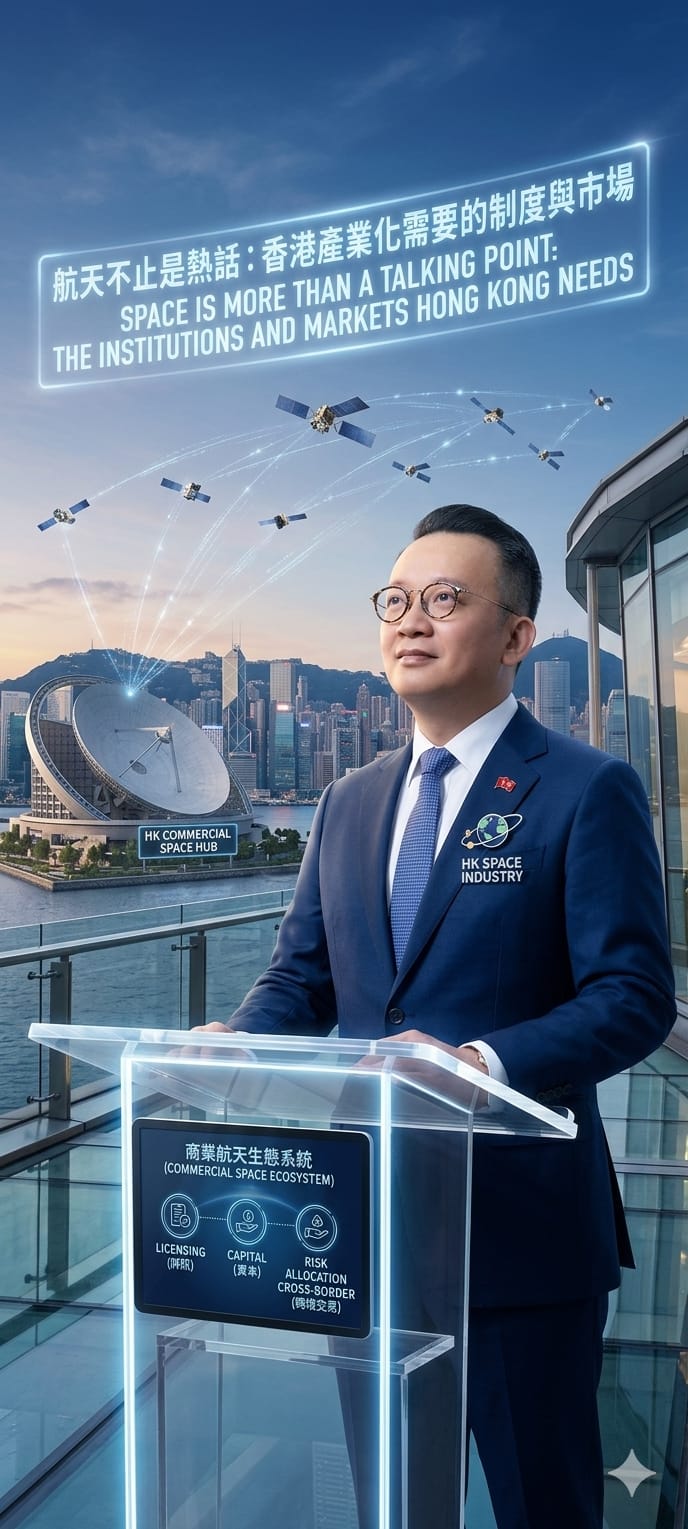
That is why a successful and vibrant space ecosystem in Hong Kong should comprise talent, capital, and research, as well as institutional infrastructure: clear risk allocation, workable cross-border and international arrangements, and dispute-resolution mechanisms that balance confidentiality with efficiency.
In this context, the 49 countries-backed Asian-African Legal Consultative Organization, through recent annual discussions and Secretariat research, has brought outer space legal issues onto a shared agenda for Asian and African jurisdictions. It highlights a practical and persistent challenge as commercial space scales up: risks associated with space debris. Orbiting debris can collide with satellites and disrupt crewed missions; yet incidents are difficult to resolve cleanly, because attribution can be uncertain, fault hard to establish, and debris removal might require consent from the state of registry.
For Hong Kong, the point should not be misconstrued as “only providing services.” Hong Kong can and should leverage its strengths in finance, law, insurance, and dispute resolution, but the objective is broader: to support the growth of the entire aerospace industry locally, from R&D and talent development to testing and engineering capability, satellite operations and downstream applications, and supply chain and commercialization support. As the LEO licensing regime moves toward simplification and predictability, Hong Kong should seize this window to connect technology, capital, and markets – so that space becomes not a passing headline, but an industry that can generate companies, projects, and orders.
Crucially, this also aligns with the direction set out in the Policy Address and with the “go global” mindset emphasized in the country’s 15th Five-Year Plan. Hong Kong should deepen capabilities at home while building pathways for businesses and proven practices to reach regional and overseas markets, so that Hong Kong can both “bring in” and truly “go out” within the global space value chain.
Nick Chan is Director of Asian-African Legal Consultative Organization Hong Kong Regional Arbitration Centre