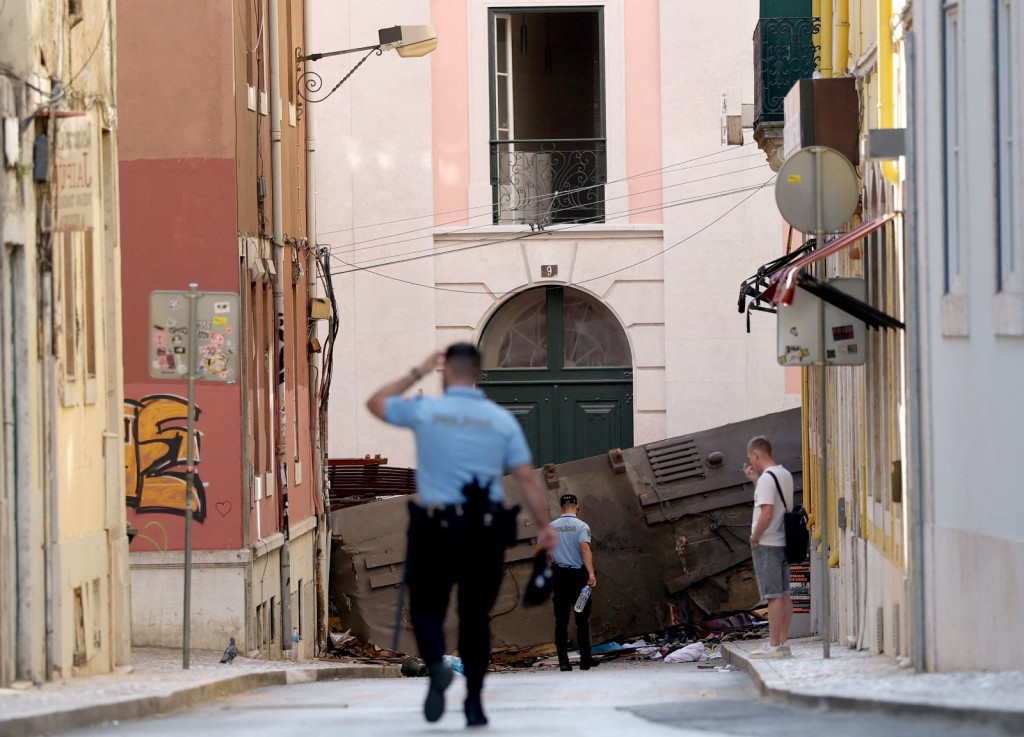
Lisbon suffered a tragic incident on September 3 this year when a funicular railway car smashed into a building structure, killing 17 and injuring some 20 persons who were tourists to the city.
The Elevador da Gloria, as it is called, is often regarded as a symbol of Lisbon and has attracted millions of tourists since it first opened in 1885. As technology progressed, the motive force for the system evolved from water power to steam power at first, but by 1915, the system turned to electric power for more efficient operation.
The system comprises two streetcars, connected together by cable to move up and down in tandem along a 275-meter route on a steep slope, on a narrow street up the hill. The cable is not used for hauling, but only to connect the two vehicles to run in opposite directions in counterbalanced mode, to minimize power requirements. Each car receives its own power supply through an overhead catenary to power its own wheel axle, driven by electric motor.
To ensure safe operation and to hold the cars in stationary positions at the boarding stations, there are wheel brakes operated pneumatically by the driver. There is also another braking system which use wooden blocks to act against the cable trench sides, to hold the vehicle in case of pneumatic power failure.
Such systems had been proven for use for many funicular railway systems and regarded as safe enough for passenger operations.
It was reported that, at the time of the incident, the cable snapped as the vehicles started to leave the station, resulting in a sudden loss of counterbalancing force, rendering the vehicle in the descending path in a “runaway” mode. The driver tried to apply brakes but failed to restrain the movement. The vehicle gathered speed and rushed down the slope and eventually smashed into a building, severely damaging itself and falling on its side. The other vehicle in the lower station was somehow able to stop and hold its position without causing damage.
The official investigations as to the cause of this incident will take many months but I could hazard a guess of what could have gone wrong to cause this tragedy.
Looking at the history of operation of this system, the railway had been operating without major incidents for some 200 years. The only recorded incident of derailment occurred in 2018, and it was concluded that insufficient wheel maintenance was the cause.
The system undergoes general maintenance on a four-year cycle; the last of this occurred in 2022. There are interim repair activities undertaken every two years and the last activity was in 2024. The cable and braking systems are supposed to be checked every day before commencement of operation. The cable replacement schedule is every 600 days and at the time of this incident, the present cable had been in use for 377 days. All of these appear to be following a planned schedule without breach.
For the cable to break midway in its useful life, one can assume that it could be due to overloading or inferior manufacture or materials. We can almost rule out the possibility of overloading as it is a passenger carrying system and not for transport of goods, as the number of seats would limit the maximum weight carried. Cable materials and manufacture could be an issue, but this is an area to be checked in the investigation.
Inadequate maintenance would appear to be the most likely cause, as there was already one recent incident of derailment attributed to this.
Media reports revealed that the maintenance work has been subcontracted out, but there is no information as to when they have started doing this, and how competent the contractor is.
There have been many cases of transport infrastructure owners subcontracting out maintenance work. This could be due to the need to procure specialists’ skills, but more often to meet the desire to control costs.
There are a lot of cases of transport system owner-operators gradually changing from technical leadership to financial leadership in their management. Maintenance activities have long term effects and cutting maintenance costs to boost short-term financial results often do not show problems immediately. But when the system deteriorates and failures finally occur, it will be a few years down the line and the manager who decided to cut maintenance activities will be promoted or transferred, ridding them of the responsibility.
The final investigation results, hopefully, would reveal the main problems that led to this tragic incident, but meanwhile, the loss of life and property cannot be reversed.
This is a lesson for directors of these organizations. Cost control is essential, but unduly cutting costs for short-term financial results must not be encouraged.
Commuters and tourists innocently use these transport activities, but they have no choice and often are not aware of the danger looming when they embark on these iconic facilities to enjoy their day. Owners and operators have the sacred responsibility to protect them and must ensure their duties are discharged appropriately.
Veteran engineer Edmund Leung Kwong-ho casts an expert eye over features of modern life