In my days as a building contractor, I often felt that our construction industry had not progressed much from the last few decades. We continued to do building work like playing LEGO, and whenever there was a highly technical task, we would appoint a specialist subcontractor to do the work. Use of new technology was not common then.
Fortunately, the Construction Industry Council – CIC – has now spent a lot of effort in bringing the industry up to modern standards, with wide application of innovative technology.
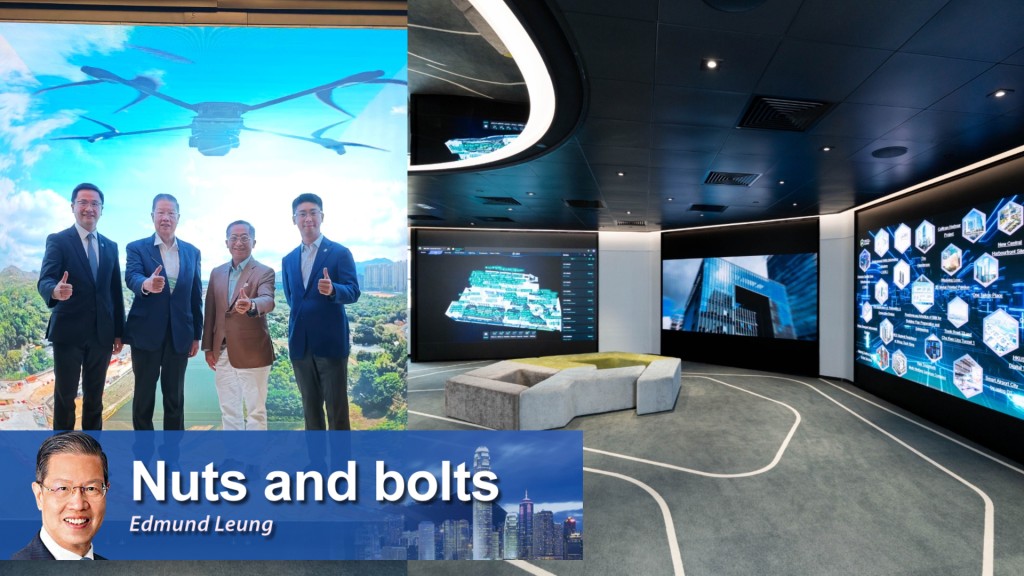
I was invited to visit the CIC’s new Centre for Future Construction, which is a new initiative of its Hong Kong Institute of Construction in Kowloon Bay.
The center consists of a Digital Twin Hub, a 4S Hub, an AI Hub, a Robotic Hub, and an Immersive Cave, and it plans to receive some 24,000 visitors in the next year.
The Digital Twin Hub promotes the use of high definition and interactive video pictures to capture both design and construction data to enhance building information modeling – BIM – and multi-trade integrated mechanical, electrical and plumbing – MiMEP – activities.
Engineers can now plan out and modify their design work in great accuracy without the need to lay it out on site. They use a new term called city information modeling – CIM – a development of the established BIM system.
I saw a video showing a construction activity on Fanling Highway, where they simulated the rotation of huge viaducts on a computer screen to plan the actual site work. This allowed for precise checks of details like clearance and headroom to enhance their confidence before executing the real construction with full assurance.
With accurate Geographic Information Systems – GIS – data incorporated in the system, accurate distance measurements, in three dimension, were available to allow planning of transport and lifting of heavy and bulky pieces of components.
The data available allow high granularity for accurate planning, with fine details that would not be possible from design drawings that can only show two dimensions and in small scale due to limits of print size of paper.
The use of common spatial data infrastructure ensures accurate and contemporary information can be made available to all branches of the construction team: from architects and design engineers to site construction personnel, without risks of using obsolete information, limited by availability of printed drawings.
Especially impressive was CIC’s Immersive Cave, a room with 360-degree image projection which enables site personnel to visualize the actual site conditions as if he is physically present there. This enables effective training of site personnel in total comfort of an air-conditioned room instead of a worksite.
With these facilities, the pitfalls of drawings that do not match actual site conditions, the difficulties in visualizing actual conditions from paper drawings and the ability to try out minor adjustments to original design can be easily performed.
CIC plans to encourage all future construction projects worth over HK$300 million to use Digital Twin technology for better performance and safety.
The AI Hub employs a system of retrieval of augmented generation – RAG – working with a large language model to help construction personnel use Prompt Engineering to guide the AI system to analyze and solve problems encountered in construction activities.
We often come across inefficient use of generative AI systems due to the inability to ask the relevant questions, leading to inaccurate and misleading responses. The RAG system enables effective training so that the relevant inputs can be quickly injected to the AI system for best results.
The Robotic Hub, an excellent complement to the AI Hub, is where various types of new construction equipment are on display, ready for use in training site personnel.
Robots for drilling holes and for painting are available. They can help to test those tedious site activities to save site labor and to improve quality. Robots can also work around the clock with no deterioration in quality arising from tiredness and inattention of manual workers.
Sensors and monitors to ensure 4S site conditions are also displayed and can be used for testing and training. With a centralized management platform, and widespread use of IoT equipment for site construction, safety is ensured and efficiency enhanced.
With increasing difficulties in recruiting people to join the industry, there is hope that the future generation of construction activities can be performed with wide application of digital technology and off-site training. It will mitigate the need for a number of skilled site labor. Experienced engineers will also benefit from less need to be full time on site, improving working conditions and reducing tiredness, which may lead to possible occurrence of errors.
It was so gratifying to see the application of innovative technology in our construction industry. We can expect improvements in quality and reduction in costs. Construction works need not be sweaty and tiring for the future.
Veteran engineer Edmund Leung Kwong-ho casts an expert eye over features of modern life