As we increasingly use public transport, walking is becoming a popular and healthy way to commute for work and leisure.”
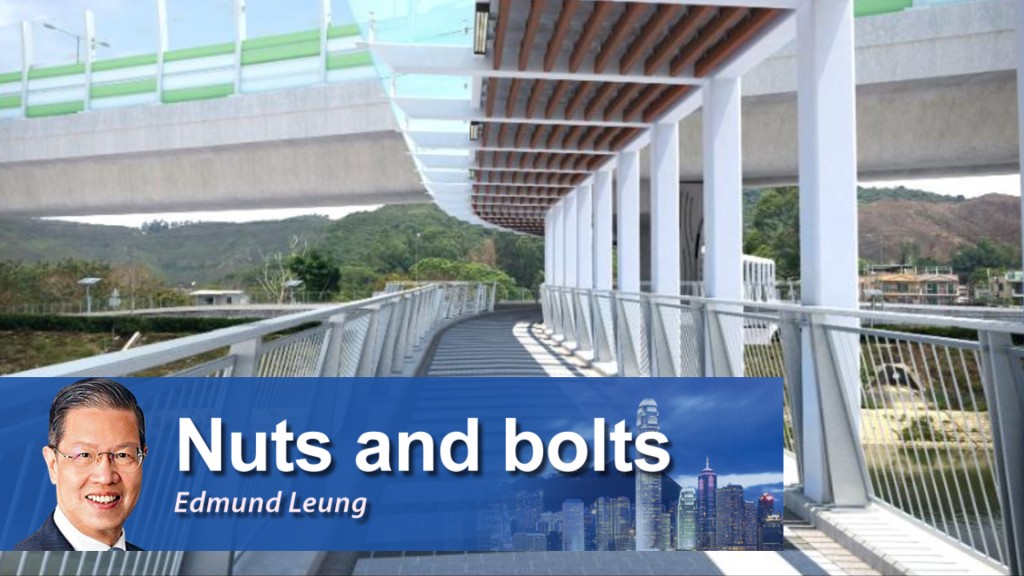
If the transport infrastructure systems are designed such that transport interchanges are at walking distance from residential areas, generally regarded to be within one kilometer, elevated footbridges would be a lot more comfortable than walking at pavement at ground level as they can avoid the need for road crossings.
Elevated walkways with canopies but no walls can shelter pedestrians from direct sunlight and rain to allow a breezy journey, which is especially welcome in summer.
But as elevated footbridges become longer, their structure and supporting column can become very massive and could take up a lot of space. The adverse visual impact would be unwelcome, and the need for rerouting electric cabling, water and drainage pipes would be a cost and time handicap in construction. At busy locations with highways and railways already in place, the diversion activities to allow for columns supporting the footbridge structure can become prohibitive.
Fortunately, engineering technology can come to the rescue.
With wider adaptation of high tensile strength steel, bridges can be made much lighter and with longer spans.
As an example, for the F4 and F6 footbridge network of the Fanling bypass, by employing S960 steel to fabricate the bridge structure, it has successfully allowed slim and visually pleasing structures in the layout.
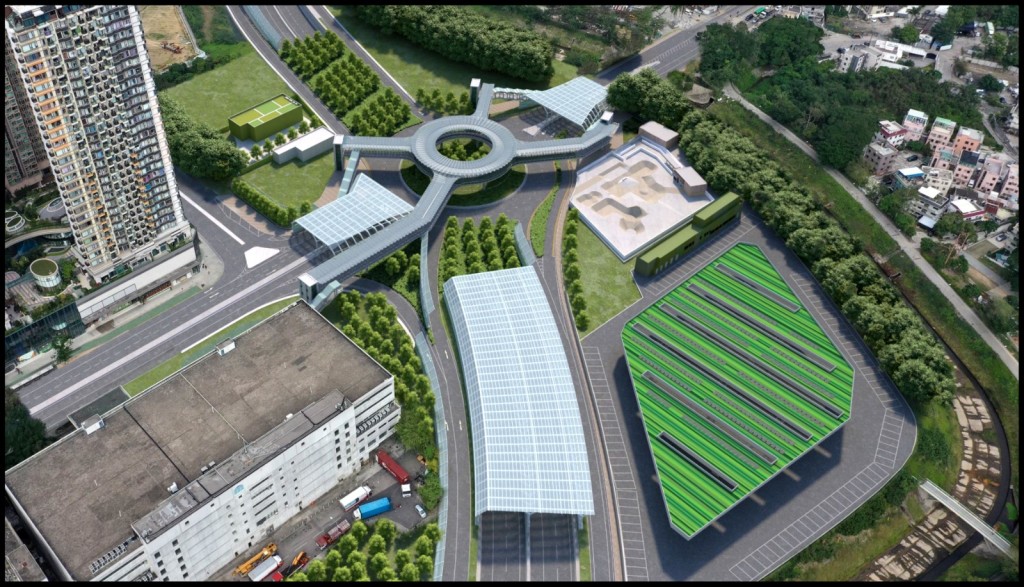
An artist's impression of the F6 network
As I have explained in a previous article last year for the Fanling Highway viaducts, the numbering denotes the tensile strength in newtons per square millimeter. So S960 steel essentially has almost three times the tensile strength of the conventional S355 structural steel.
By using this modern material, the bridge depth can be substantially reduced from 1.8 meters to just one meter. Columns can be placed much further apart, minimizing use of ground space, and the slim structure reduces materials and construction time, making it possible to reduce the total number of supporting columns from six to four. The cost and time savings are substantial and the environmental impacts much reduced.
The only aspect that needs more attention is the need for very skilled welding techniques to join the component members of the steel structure on site. Argon arc welding is used, but to run six to seven passes of fine welds while leaning away from a natural posture on site at height to access the welding points cannot be easy. Such difficult activities also increase the need for remedial work to repair failed welded joints with porosity and other weaknesses.
The Hong Kong Metal Engineering Contracting Association was formed to promote good fabrication and welding workmanship to ensure these high tensile steel structures can be erected reliably for transport infrastructure application. Working in conjunction with the Hong Kong Institute of Technology, a subsidiary of the Construction Industry Council, and supported by professors at Polytechnic University, they aim to train at least 200 expert welders capable of the most demanding skills.
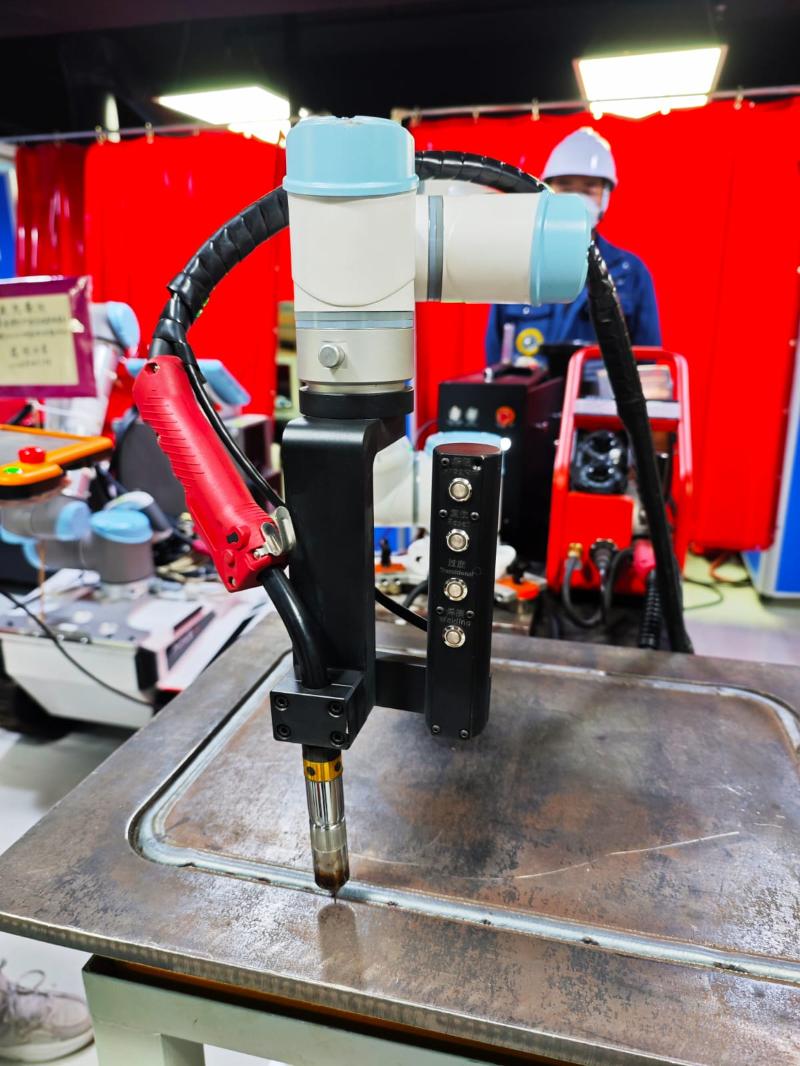
To ensure consistent quality while working at site conditions with difficult access, they have developed a system of robotic arms that can perform the actual welding exercise. The welding process remains under close supervision of the expert welders, but without the need for welders to work in difficult site locations.
In a recent demonstration in their association premises, held to show clients, consultants, contractors and other stakeholders, they were able to show how such accurate welding procedures, including the necessary pre-heating and post-heating steps, can be executed without risks of human error.
The S960 steel has been approved by CEDD for use on the Fanling Highway project as an alternative design. After careful evaluation, authorities are satisfied that the lighter but equally strong structure is robust and safe, and meet their stringent standards for construction and operation. It not only reduces costs and time of construction but should also be capable of a long service life without any special maintenance requirements.
A robotic arm demonstrating welding
The construction industry in Hong Kong, as a whole, supports the use of this new high tensile steel, as it will open up a lot more opportunities for innovative design of bridge and viaduct structures, enabling a much more versatile design over difficult sites, minimizing the need to divert existing facilities that need to be crossed over, thus substantially reducing valuable time and costs resources.
The manufacturing processes has long been proven in various applications in the mainland and with the use of robotic arms, good quality construction can be assured even with the limited availability of specialist expert welders presently in Hong Kong.
New technologies can facilitate better living, but it can only be achieved with the close collaboration of the construction sector including the design consultants, contractors and suppliers.
The technical and research support from the academic sector is vital to ensure speedy and reliable application, as they are able to conduct the necessary proving tests using scale models to confirm the theoretical analyses, providing accurate and comprehensive data to allow the authorities to approve them for use, for the benefit of all.
Veteran engineer Edmund Leung Kwong-ho casts an expert eye over features of modern life