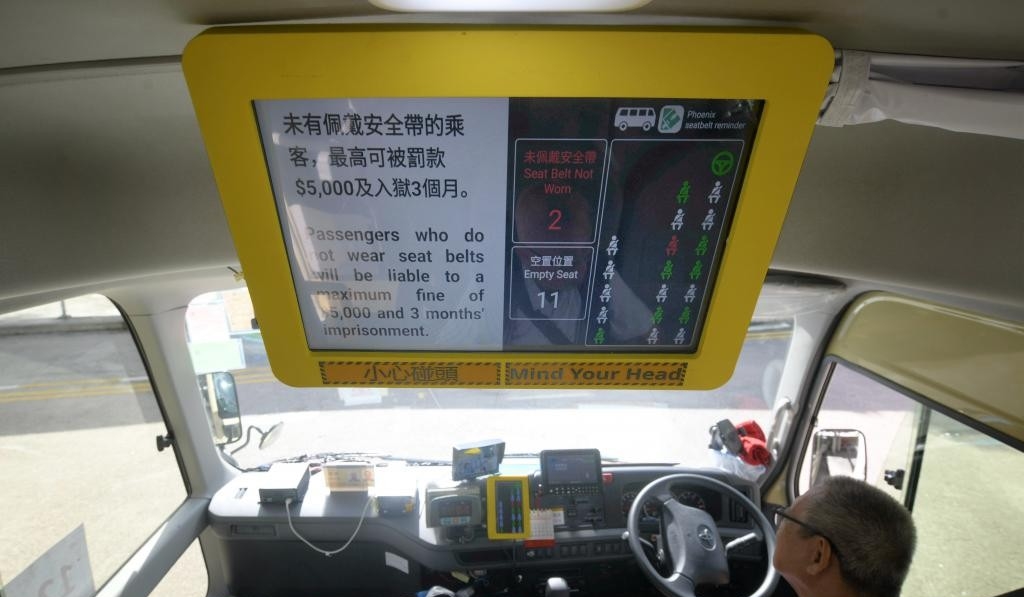
As Hong Kong prepares to implement mandatory seat belt regulations for all passengers on commercial vehicles starting January 25, industry stakeholders are raising concerns about potential safety risks and operational challenges.
The new regulation, which requires passengers to wear seat belts on all public transport, carries penalties of up to HK$5,000 and three months' imprisonment for violators.
Ho, a researcher at a non-governmental organization Liber Research Community, noted that Hong Kong adopted a uniform standard after referenced overseas models with differentiated rules based on vehicle type and route.
Expecting a longer boarding time, Ho believed that passengers possibly chose to stand to avoid hassle, potentially increasing safety risk during travel.
School Bus dilemma
As the mandate extends to the school bus, operators are warning of practical difficulties, considering that compliance may hinder their ability to respond to emergencies.
According to Tang from the Concord Bus Company Limited, children often unbuckle their seat belts once the bus leaves their parents' sight.
She noted that younger children often need help fastening belts, while older ones often unbuckle seat belts during rides to chat with friends, worrying that the new regulations will bring challenges to supervision on the school bus.
"Accidents typically occur when students unbuckle their seat belts, and we are concerned about the penalties if children fail to comply," she noted.
Although the Transport Department has stated that the responsibility for seat belt compliance lies with the student, the current Juvenile Offenders Ordinance allows courts to impose fines on parents or guardians for children under 14 who commit offenses.
"We support the new regulations but just hope authorities could define where the liability lies clearly," said Tam Wai-chiu of the Motor Transport Workers Generation Union Non-franchised Bus Branch School Children Vehicle Section.
On the other hand, school bus nannies raised concerns about emergencies on the vehicle, like motion sickness. "If a child feels nauseous, we need to act immediately. With the new rules, we may not be able to reach them in time," one shared.
Echoing a similar sentiment, Tang highlighted the increasing travel time with more cross-border students, which brings more challenges to supervise both kindergarten and primary students together.
She also mentioned uncertainties about the best seating arrangements for bus attendants, wondering whether they should focus on caring for children or remain seated as passengers.
While there have been concerning incidents, including a 2019 case where a child fell from a moving vehicle, Tang stressed that despite the positive intent of enforcing seat belts, the regulations need to allow for flexibility.
As bus operators, parents, and schools adjust to the new regulations, Tang cautioned that punctuality might be adversely impacted as additional time is required for attendants to check students' seat belts.
The Transport Department has assured ongoing communication with the industry, stating that enforcement officers and courts will consider the specifics of each case when making judgments.
Limitation of taxi dashboard devices
Another amendment effective January 25 will prohibit drivers from placing more than two mobile communication devices, each with a screen no larger than 19 centimeters diagonally, aiming to curb distractions for safer driving.
Hong Kong Taxi and Public Light Bus Association spokesman Peter Yung stated they would remind drivers of the new regulations, acknowledging reliance on mobile apps for bookings.
He highlighted that while the rear seat belt requirement for taxi passengers has been in place since 2001, many short-distance travelers choose not to buckle up.
Highlighting the difficulties for drivers to check on the passengers, he hoped the new regulations would serve as a reminder for the passengers to exercise self-discipline.
Inconvenience of child seat rules
With stricter child car seat and seat belt regulations taking effect since last November, some car owners have reported inconvenience.
Among them is Lam, who expressed frustration about his vehicle lacking the necessary equipment to give his friends' children a ride, stating, "I often give rides, but I'm reluctant to purchase equipment that will only be used occasionally."
However, retailers have seen a 30 to 40 percent sales increase during the months preceding the new regulations. It is reported that related car seat models are priced between HK$2,000 and HK$4,000, with variations based on brand and material quality.
Some ride-hailing platforms have introduced a "child seat" trip option, allowing users to book vehicles equipped with the relevant safety devices.