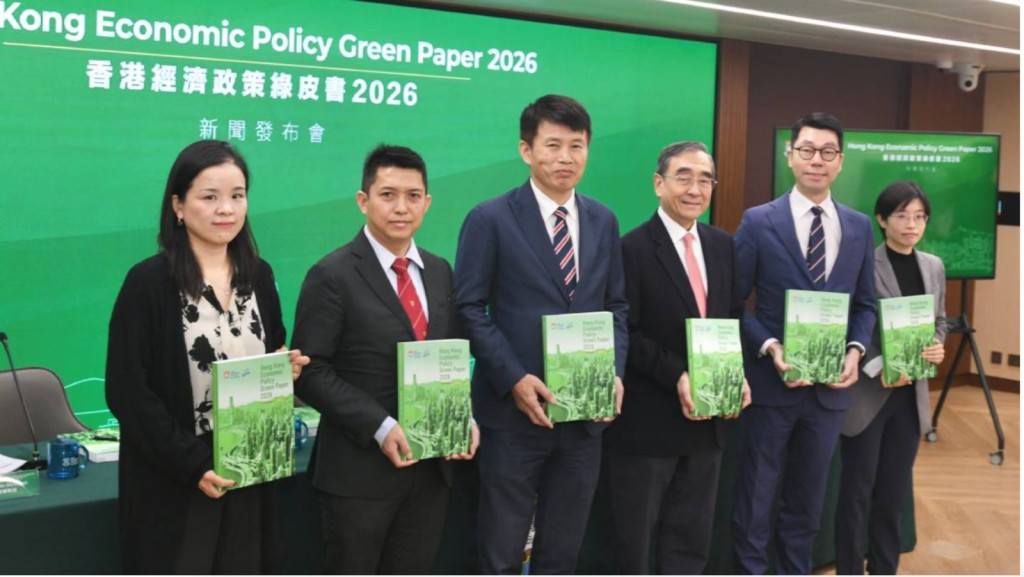
Hong Kong should proactively integrate with Chinese mainland industries and actively build networks in key international markets, as the city’s traditional role as a "super connector" no longer fits the current global landscape, according to the University of Hong Kong Business School.
At the launch of the 2026 Hong Kong Economic Policy Green Paper, Dean Cai Hongbin called on the city to better understand national economic development and strategic needs, serve as a reliable partner for mainland enterprises going global, and establish deep international connections.
He also urged society to fully support higher education, citing quality internationalized education as a key driver for attracting top talent, fostering innovation, and ensuring long-term growth.
Associate Vice-President Tang Hei-wai highlighted challenges eroding Hong Kong’s traditional strengths, including declining trade financing from HK$500 billion in 2013 to HK$380 billion today, lagging digital infrastructure, paper-based customs processes, and limited cross-border data connectivity, which weaken the trade finance ecosystem.
He noted, however, that global geopolitical shifts have created opportunities for the city, as companies explore new markets in the Middle East and the Association of Southeast Asian Nations, where Hong Kong can leverage its role as a re-export hub.
Tang recommended upgrading Hong Kong from a "super connector" to a "super value-adder", addressing gaps in legal services, talent training, and other non-financial support for enterprises going abroad.
Despite pressure, he projected that the city’s economy would remain on a stable upward trajectory this year, with the financial sector continuing as a core growth driver, while stable stock and property markets could help narrow the fiscal deficit.
On green finance, Professor Dragon Tang Yongjun noted that global growth has stalled due to "greenwashing", where opaque capital flows undermine investor confidence, and said blockchain technology, with real-time tracking and immutable records, can address the problem.
Hong Kong has emerged as a world leader in this field, issuing the world’s first government tokenized green bond in 2023, which expanded from HK$800 million to HK$10 billion by 2025, aligned with international standards, he said.
He called for further standardization and technical interoperability to consolidate Hong Kong’s position as a global green finance hub.