Will Dunham
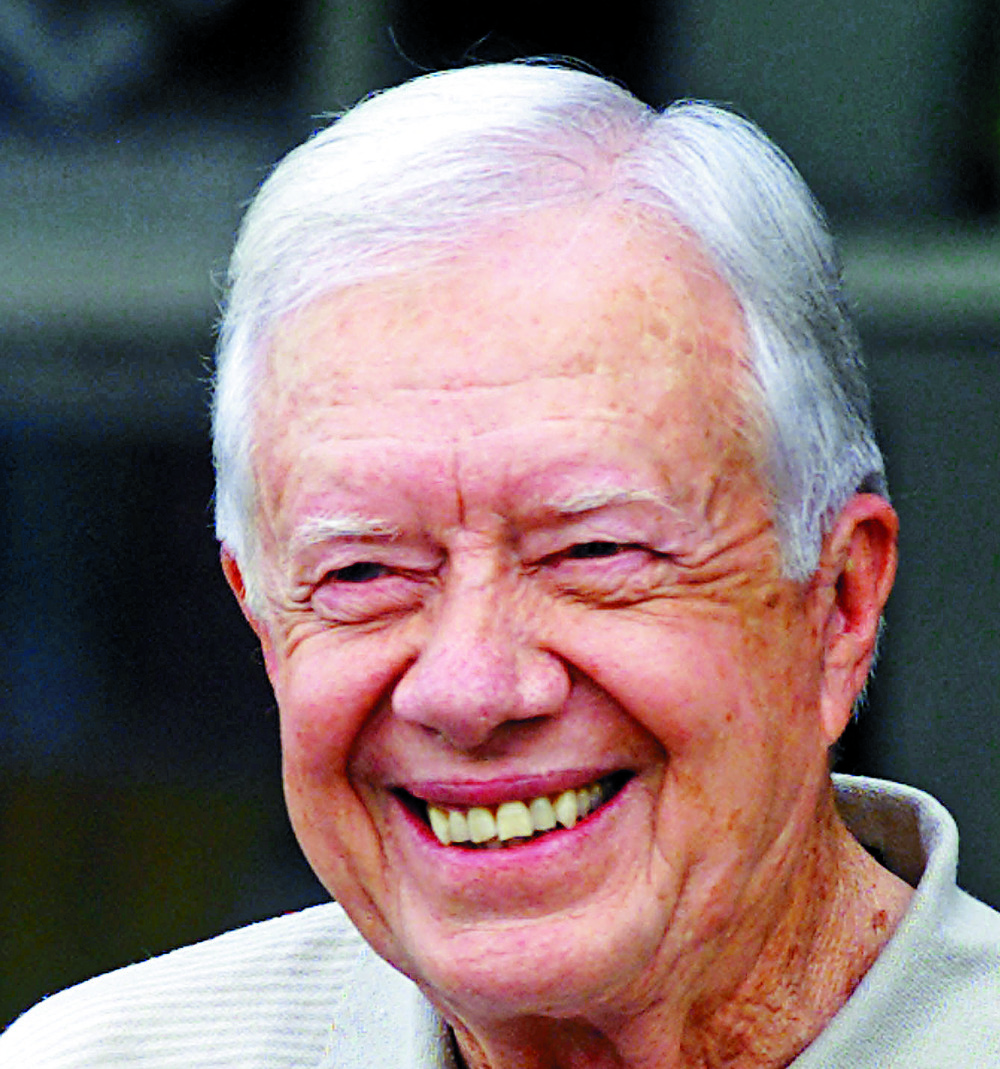
Jimmy Carter was the earnest Georgia peanut farmer who as US president struggled with a bad economy and the Iran hostage crisis but brokered peace between Israel and Egypt and later received the Nobel Peace Prize for his humanitarian work.
Carter became president in 1977 after defeating Republican president Gerald Ford in 1976. His one-term presidency was marked by the highs of the 1978 Camp David accords between Israel and Egypt, bringing some stability to the Middle East.
But it was also dogged by a recession, persistent unpopularity and the Iran hostage crisis. He ran for re-election in 1980 but was swept from office in a landslide as voters embraced Ronald Reagan, the former actor and California governor.
Carter lived longer than any US president and, after leaving the White House, earned a reputation as a committed humanitarian. He was widely seen as a better former president than he was a president - a status he readily acknowledged.
In recent years, Carter had experienced several health issues including melanoma that spread to his liver and brain.
He decided to receive hospice care last February instead of undergoing additional medical intervention. His wife, Rosalynn, died last November at age 96. He looked frail at her memorial service and funeral.
Carter left office profoundly unpopular but worked energetically for decades on humanitarian causes. He was awarded the Nobel Peace Prize in 2002 in recognition of his "untiring effort to find peaceful solutions to international conflicts, to advance democracy and human rights, and to promote economic and social development."
Carter had been a centrist as governor with populist tendencies when he moved into the White House.
"I'm Jimmy Carter and I'm running for president. I will never lie to you," he promised with an ear-to-ear smile.
Despite his difficulties in office, he gained global acclaim as a tireless human rights advocate, a voice for the disenfranchised and a leader in the fight against hunger and poverty, winning the respect that eluded him in the White House.
He won the Nobel Peace Prize in 2002 for his efforts to promote human rights and resolve conflicts around the world. His Carter Center sent election-monitoring delegations to polls around the world.
A Sunday school teacher since his teens, he brought a strong sense of morality.
The Middle East was the focus of Carter's foreign policy.
The 1979 Egypt-Israel peace treaty, based on the 1978 Camp David accords, ended a state of war between the neighbors.
Carter brought Egyptian president Anwar Sadat and Israeli prime minister Menachem Begin to Camp David for talks. Later, as the accords seemed to be unraveling, he saved the day by flying to Cairo and Jerusalem for personal shuttle diplomacy.
Begin and Sadat each won a Nobel Peace Prize in 1978.
By the 1980 election, the overriding issues were double-digit inflation, interest rates of over 20 percent and soaring gas prices, as well as the Iran hostage crisis. They marred his presidency and undermined his chances of winning a second term.
He protested the then Soviet Union's 1979 invasion of Afghanistan by boycotting the 1980 Olympics in Moscow. He also asked the senate to defer consideration of a major nuclear arms accord with Moscow.
Carter won narrow senate approval in 1978 of a treaty to transfer the Panama Canal to the control of Panama despite critics arguing it was vital to American security.
He also completed negotiations on full US ties with China.
Carter created two Cabinet departments - education and energy. Amid high gas prices, he said America's "energy crisis" was "the moral equivalent of war" and urged the country to embrace conservation. "Ours is the most wasteful nation on Earth," he said to Americans in 1977.
In 1979, Carter delivered what became known as his "malaise" speech to the nation, although he never used that word.
"After listening to the American people I have been reminded again that all the legislation in the world can't fix what's wrong with America," he said.
"The threat is nearly invisible in ordinary ways. It is a crisis of confidence. It is a crisis that strikes at the very heart and soul and spirit of our national will. The erosion of our confidence in the future is threatening to destroy the social and the political fabric of America."
REUTERS
A life well lived saw Jimmy Carter, clockwise from above left, sworn into office in 1977; keeping in touch with the man on the street; building on his hopes for a better world in 2007 in a Habitat for Humanity home in Los Angeles with wife Rosalyn; a