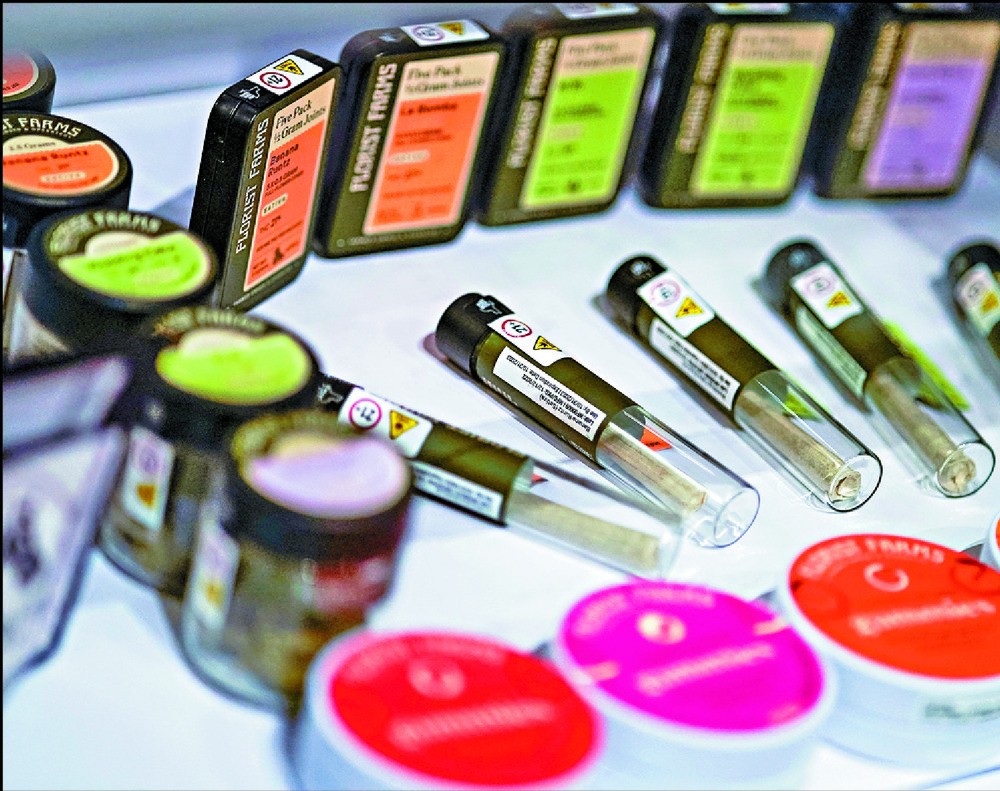
When New York's first licensed recreational marijuana outlet opened in Manhattan last month the chief of the state's Office of Cannabis Management, Chris Alexander, proudly hoisted a tin of watermelon-flavored gummies. Then he displayed a jar containing dried flowers of a cannabis strain called Banana Runtz, which some aficionados say has overtones of "fresh, fruity banana and sour candy."
Inside the store run by the nonprofit Housing Works, shelves brimmed with vape cartridges suggesting flavors of pineapple, grapefruit and "cereal milk," written in rainbow bubble letter print.
For decades, health advocates have chided the tobacco industry for marketing harmful nicotine products to children, resulting in more cities and states - including New York - outlawing flavored tobacco products, including e-cigarettes.
Now as cannabis shops proliferate across the country, the same concerns are growing over the packaging and marketing of flavored cannabis that critics say could entice children to partake of products labeled "mad mango," "loud lemon" and "peach dream."
"We should learn from the nicotine space, and I certainly would advocate that we should place similar concern on cannabis products in terms of appealability to youth," says Katherine Keyes, a professor of epidemiology at Columbia University who has written extensively about the rise in marijuana use among young people.
"If you go through a cannabis dispensary right now it's almost absurd how youth-oriented a lot of the packaging and the products are."
Keyes adds that public health policymakers - and researchers like her - are trying to catch up with an industry and marketplace that's expanding and evolving rapidly.
New York, which legalized recreational marijuana in March 2021, forbids marketing and advertising that "is designed in any way to appeal to children or other minors."
But New York's state Office of Cannabis Management has yet to adopt rules on labeling, packaging and advertising that could ban cartoons and neon colors as well as prohibit depictions of food, candy, soda, drinks, cookies or cereal on packaging.
Lyla Hunt, OCM's deputy director of public health and campaigns, recently saw a cannabis product calling itself "Stony Patch Kids" that she says looked like popular candy Sour Patch Kids.
Similar products are being sold by the dozens of illegal pot dispensaries that operate in the open and that could be unsafe. But once packaging and marketing standards are established the illicit marketplace will likely not comply, experts say.
Under state law, a minor in possession of marijuana faces a civil penalty of not more than US$50 (HK$389). Licensed cannabis retailers who sell to minors face fines and the loss of their licenses but not prison.
Science has long established the addictive nature of nicotine and health maladies associated with smoking tobacco, including cancer and emphysema. Less settled are the health repercussions from vaping, particularly among children whose bodies and internal organs have yet to fully develop.
While smoking tobacco cigarettes has fallen among teens and young adults, the use of e-cigarettes and vapes has risen.
A handful of states - California, Massachusetts, New Jersey, New York, Rhode Island - have bans on most flavored tobacco products, including e-cigarettes and vapes. An increasing number of cities, including New York, also have similar bans.
But those rules need to be broadened to include marijuana, says Linda Richter of the Partnership to End Addiction. "There's more scrutiny on the tobacco industry."
Because of the relative infancy of the legalized industry, she adds, US states have yet to coalesce rules on a single national standard. States often look to the federal government to set those standards, but marijuana remains illegal on the federal level.
Anti-smoking groups, including the Campaign for Tobacco-Free Kids, have long railed against the tobacco industry for its marketing, such as using cartoon characters to help market products. In recent years they've campaigned against flavored nicotine products, including those in vaping form.
But such groups have not yet put the marijuana industry in their sights.
A study released early in January documented the steep rise in poisonings among young children, especially toddlers, who accidentally ate marijuana-laced treats.
The uptick in cases coincides with the rise in the number of states allowing the use of marijuana for medicine or recreation. Medical use of cannabis is currently allowed in 37 US states, while 21 states allow recreational use.
"When you're talking about strawberry-cheesecake, or mango, or cookies-and-cream flavors, it's very difficult to argue those are for older adults," says Pamela Ling, director for the Center for Tobacco Control Research and Education at the University of California in San Francisco.
"Folks who consider themselves to be more like cannabis aficionados," she adds, "would say that smoking a flavored cannabis product is like putting ketchup on your steak."
ASSOCIATED PRESS
Cannabis vaping products fill one shelf as the obligatory warning over children gets a fairly prominent display.