As the Federal Reserve tightens aggressively, worries about recession are getting firmer, especially with US first-quarter gross domestic product shrinking over the previous three months (minus 1.4 percent).
It may be true that a recession is not imminent given that the major economic components are still expanding - private consumption expenditure, for example, rose by 2.7 percent quarter on quarter.
Because of this, there are now two camps: one, led by academics like Lawrence Summers, says there will be a severe crash or prolonged stagflation; the other, mainly government officials, asserts there will only be a mild recession.
To gauge which will turn out to be the case, it is useful to go back to the 1970s as the current loss of control over the inflation environment is comparable to things then.
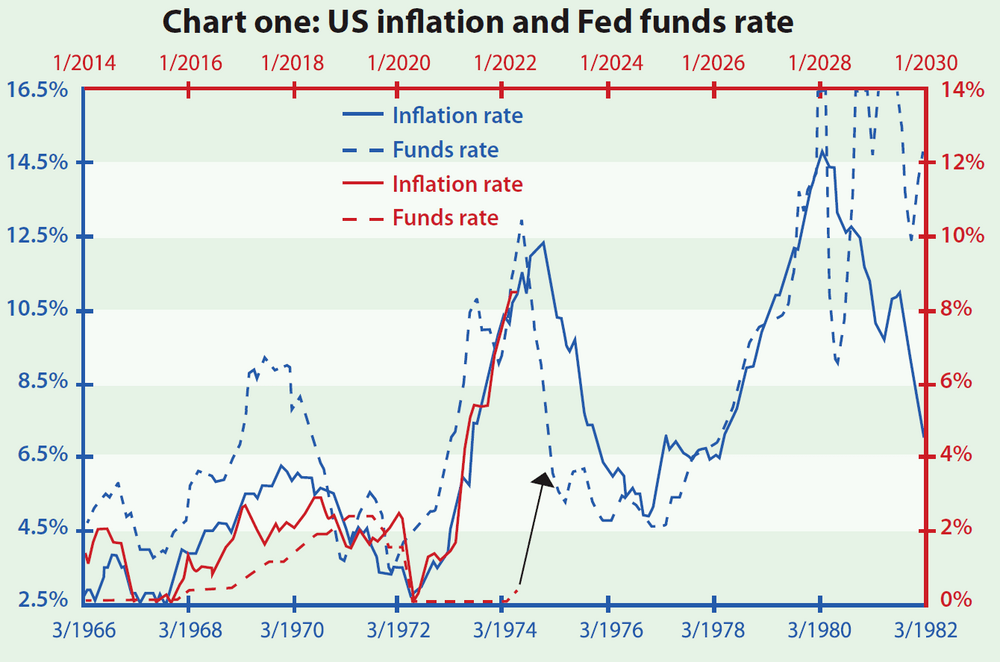
The solid lines in chart one are inflation; the overlapping blue and red lines mean inflation is uncontrolled like in 1974.
However, the willingness to curb inflation is pretty much different by comparing the dotted lines - the Federal funds rate or the policy rate.
In the 70s the Fed was "relatively pre-emptive" in raising rates ahead of inflation, though it was often criticized for not doing enough.
How about now? The much lower dotted red line suggests the Fed is almost unresponsive.
Thus, it is not surprising at all that the 70s stagflation is not repeating itself now thanks to the ridiculously accommodative stimulus measures.
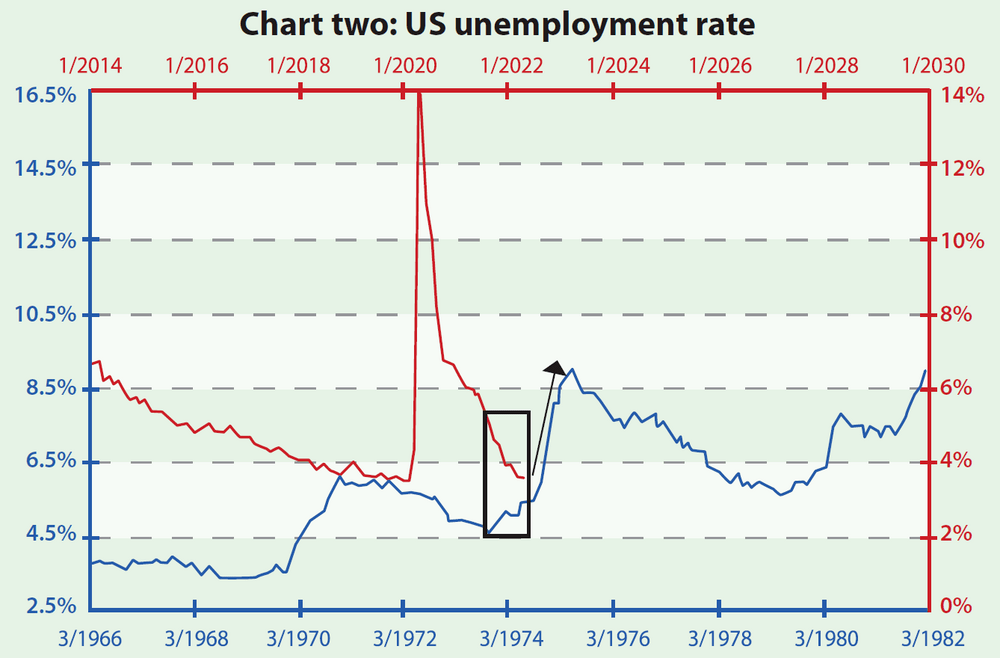
Chart two compares the jobless rate in the manner of chart one, the presumably rising rate is manipulated to come down for longer than it should be (boxed part).
Analogous to the traditional saying, what comes down must go up.
For an aggressive hike as the arrow in chart one shows, the unemployment rate might also rise as the chart two arrow goes.
By then inflation might come down, there will not be stagfl ation but a recession.
The more aggressive the hike, the more severe the recession will be.
Law Ka-chung has worked in the financial industry and the government for two decades. Reach him at mewe.com/join/lawkachung, facebook.com/kc.economist, lawkachung@gmail.com