
Read More
When I last wrote about the transformation of the construction industry, I focused on new facilities and tools. A year on, what has become more striking is not the technology itself, but how quickly it has been translated into policy, standards, and actual application on site.
ADVERTISEMENT
SCROLL TO CONTINUE WITH CONTENT
The Development Bureau has moved beyond encouragement to a clear direction – through a series of technical circulars that place artificial intelligence and robotics firmly into mainstream public works delivery. Construction robots are no longer viewed as demonstration models, but as practical tools adopted in relevant projects. By formally defining what qualifies as “highly effective construction robots” and setting out requirements for their use, the bureau has sent a strong signal that innovation is now part of its business.
Equally important is the way AI has been framed. It is no longer discussed only in abstract terms, but as specific applications that improve safety, productivity, quality, and supervision. For an industry that values clarity and certainty, this matters.
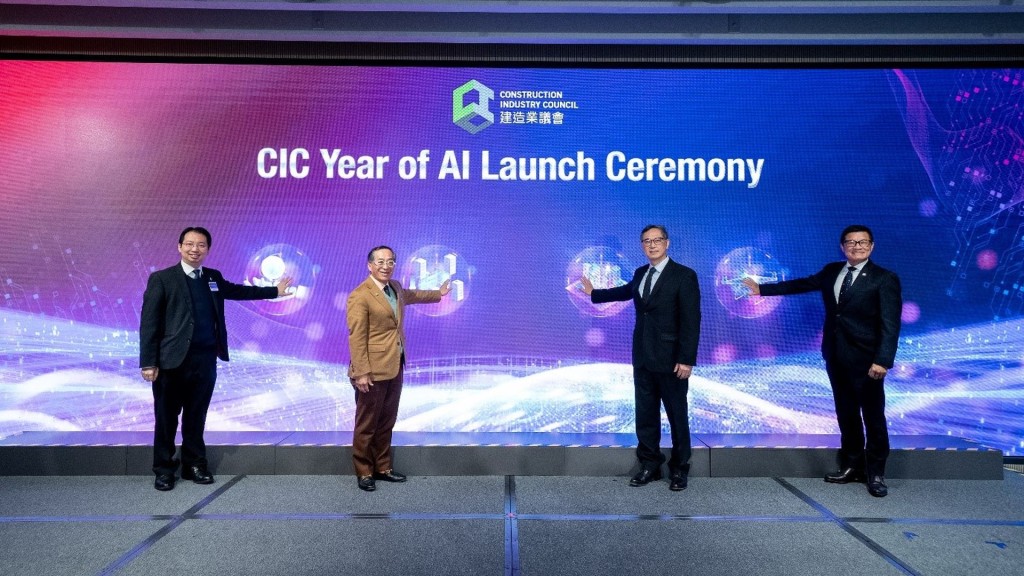
Against this backdrop, the Construction Industry Council’s decision to designate 2026 as the “Year of AI” has proved timely. Rather than a slogan, it has become an action list incorporating training, standards, trial projects, and industry engagement.
The council has identified eight focus areas, covering the entirety of a project’s lifecycle, from planning and design through construction and operation: AI + Safety, AI + Design Optimisation, AI + Programme Planning, AI + Procurement, AI + Quality Inspection, AI + Sustainability, AI + Robotics and AI + Total Lifecycle Management.
What is notable is not just the breadth of these focus areas, but also the discipline in linking them to actual cases. Of a targeted 50 practical AI use cases, 26 have already been rolled out. These are not just pilot studies but applications in real projects, such as incorporating computer vision for site safety and AI-assisted inspection, planning, and project controls.
Over the past year, the number of robots deployed on construction sites has grown rapidly. Tasks that were once labor-intensive, repetitive, or hazardous – drilling, welding, inspection, and progress monitoring, to name a few – are increasingly supported by machines guided by sensors, automation, and AI. According to industry figures, more than a hundred robots have already been deployed on construction sites, with the number growing fast with time. For an industry long characterized by manual processes, this marks a significant shift in mindset.
What I find encouraging is that this expansion has not been driven by novelty, but by demand. Public works departments have reported tangible benefits such as faster processes, more consistent quality, and safer working environments. These experiences are now feeding back into policy, reinforcing the case for wider adoption and closing the loop between trial, evidence, and requirement.
The pleasing result is the cultural shift. Engineers, site supervisors, and teams are becoming more comfortable working alongside digital tools and machines. Training programs, demonstrations, and site visits have helped to demystify AI and robotics, shifting the mindset from “will this replace people?” to “how can this support people?” That change in tone is vital, especially in an industry facing manpower challenges and an aging workforce.
It is now clear that digital transformation is no longer confined to laboratories or showcases. It is unfolding in live projects, subject to genuine time, cost, and safety constraints. Government policy has provided the push, the CIC has provided the platform and direction, and the industry is responding with action.
There is still a long way to go. Targets must be met, standards refined, and skills continuously upgraded. But compared with a year ago, the trajectory is clear and the pace noticeably quicker.
Smart construction has finally moved from promise to practice.
Veteran engineer Edmund Leung Kwong-ho casts an expert eye over features of modern life