In my last column, I explored how Hong Kong’s sporting achievements, from Olympic and Asian Games success to the co-hosting of the 15th National Games in November 2025, reflect a city growing in confidence on the regional and international sports stage. I also touched on how the Law Society’s Sports Law Mega Event, including an international sports law conference, highlighted the expanding role of law behind the scenes of sports. That discussion naturally leads to the next question: how sports disputes are actually resolved.
Elite sporting careers are often short and unforgiving. Years of training can hinge on a handful of competitions, where a single decision, injury or disagreement may alter an athlete’s future. In such moments, the law is not an abstract concept. It is a safeguard that protects rights and preserves fairness.
Modern sports law extends well beyond rulebooks and referees. Contracts, sponsorships, broadcasting rights, image rights, anti-doping regulations and disciplinary decisions all carry legal consequences. When disputes are handled poorly, they can damage careers, undermine trust and overshadow sporting achievements that should unite the community.
This is why dispute resolution has become a central pillar of sports law. A fair, efficient and confidential system allows disagreements to be resolved without unnecessary confrontation, while maintaining confidence in competitions that the public care deeply about.
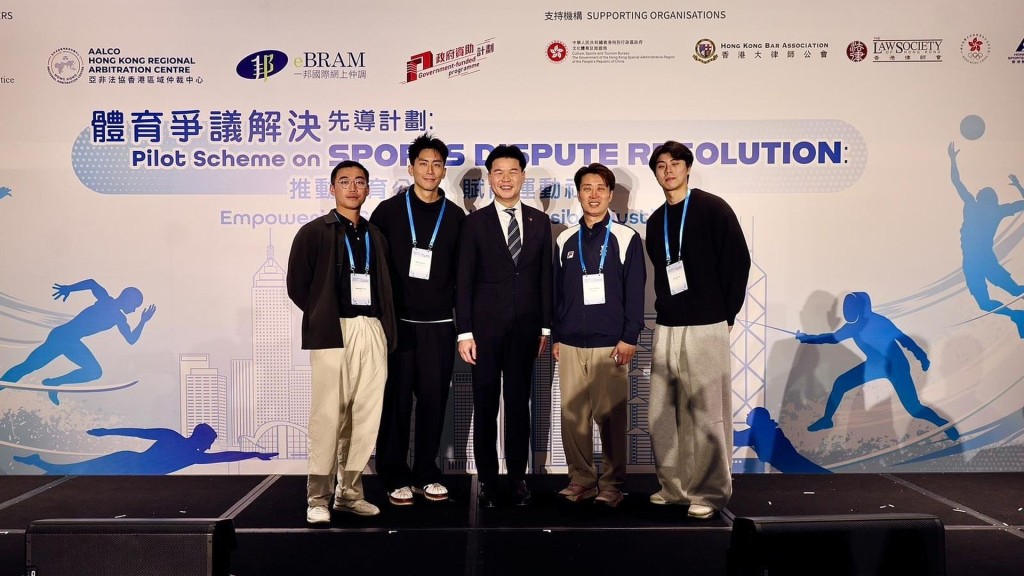
Hong Kong has taken a meaningful step forward with the launch of the Pilot Scheme on Sports Dispute Resolution. Introduced under the Chief Executive’s Policy Address and led by the Department of Justice, the scheme is administered by the AALCO Hong Kong Regional Arbitration Centre, an established international dispute resolution institution based in Hong Kong. Technological support is provided by eBRAM International Online Dispute Resolution Centre Limited, enabling disputes to be handled through a dedicated online platform that enhances accessibility and efficiency.
The scheme adopts a mediation-first approach, followed by arbitration where necessary, reflecting Hong Kong’s strengths in both consensual and adjudicative dispute resolution. The Law Society of Hong Kong is one of the advisory and supporting organizations, working alongside stakeholders from the legal and sports sectors to help ensure that the framework meets practical needs and upholds professional standards.
As Hong Kong prepares to host more major sporting events and further develop its sports industry, success will not be measured only by medals or attendance figures. It will also be measured by how fairly disputes are resolved and how firmly the rule of law supports sports beyond the spotlight.
Roden Tong is President of The Law Society of Hong Kong